Direct Answer
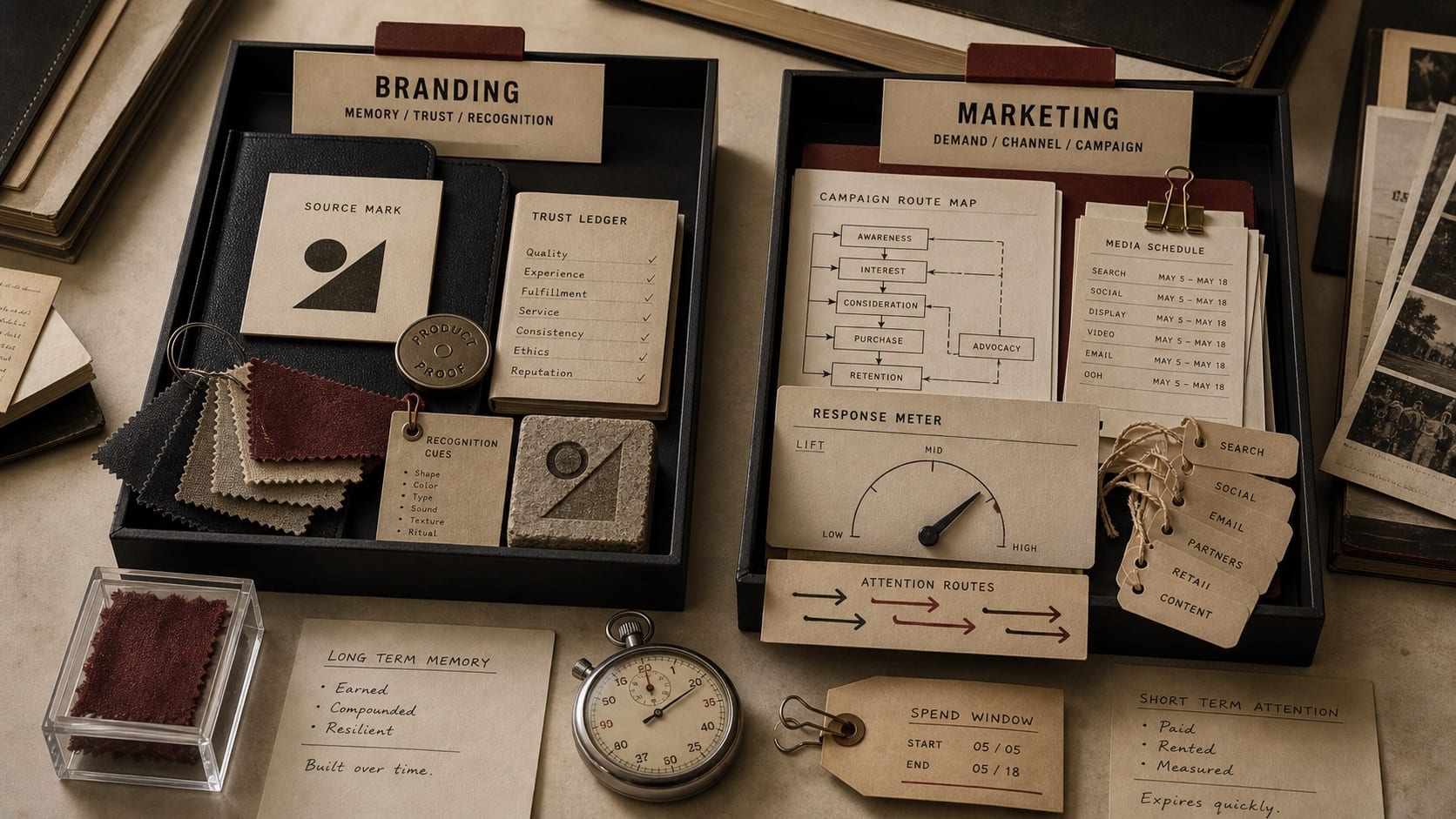
Branding is the memory and trust layer. Marketing is the demand and distribution layer. Advertising is one paid or placed way marketing gets attention. They work together, but they answer different questions. Branding asks what people remember and believe. Marketing asks how attention becomes action. Advertising asks where the message should appear, how often, to whom, and at what cost.
Reader payoff
By the end of this page, you should be able to
- Tell whether a problem needs brand repair, marketing repair, advertising repair, or all three.
- Explain branding vs marketing vs advertising without turning the answer into slogans.
- Use case examples to see where attention helped, where it damaged meaning, and where proof made memory durable.
- Write a better brief before approving a campaign, rebrand, website rebuild, or media spend.
Answer Map
Start with the decision, then check the proof.
Quote-ready definition
Grow Your Brand definition
"Grow Your Brand defines branding vs marketing as the distinction between the memory system people use to recognize and trust a brand, the demand system used to reach and convert audiences, and the paid or placed messages used to put that demand in front of people."
Commercial meaning
Why This Matters Commercially
The distinction matters because a campaign can create attention without durable memory, and a strong brand can still fail if demand never reaches the right buyer.
When the terms blur, teams approve the wrong fix. A brand problem gets more ads. A demand problem gets a logo refresh. A channel problem gets a strategy deck. The useful page tells the team which system is failing before money moves.
Mistake to catch
What Brands Usually Get Wrong
People often call every public activity marketing. That hides the difference between a temporary campaign result and a brand asset that keeps working after the campaign ends.
The other mistake is treating branding as slow and marketing as fast. Both can be fast or slow. The real split is job: memory, demand, or paid attention.
Competitive gap
What most pages miss
Most comparison pages stop at a polite definition: branding is who you are, marketing is how you promote. That sounds clean and still leaves the decision vague.
The Brand Archive test is harder: what survives after spend stops, what makes the buyer act now, what proof keeps the promise believable, and which public mistake proves the difference.
Comparison
Memory, demand, and paid attention
The cleanest way to separate branding, marketing, and advertising is to ask what job each system performs after the channel, campaign, or spend changes.
| Question | Branding | Marketing | Advertising |
|---|---|---|---|
| Main job | Build recognition, trust, meaning, and expectation. | Reach people, create demand, persuade, convert, and measure. | Place a message in front of a chosen audience. |
| Time horizon | Works across repeated contact and memory. | Works across campaigns, channels, launches, funnels, and lifecycle moments. | Usually works inside a media buy, placement, sponsorship, or campaign flight. |
| Core asset | Cues, proof, reputation, behavior, association, and expectation. | Offers, messages, content, distribution, targeting, funnel, and measurement. | Creative, media plan, placement, audience, frequency, and cost. |
| Failure mode | Known but not trusted, remembered for the wrong thing, or hard to describe. | Attention without a clear reason to choose, or demand routed to a weak proof path. | Reach with weak message, wrong audience, bad frequency, or public backlash. |
| Best test | Can people recognize and explain the brand later? | Did the right people act now or move closer to action? | Did the placement produce the intended response at a sane cost without damaging meaning? |
Proof matrix
Where the difference becomes visible
The difference between branding, marketing, and advertising becomes useful when a case shows what happened after attention arrived.
| Case | What happened | What it proves | Operator lesson |
|---|---|---|---|
| Nike Launch / 1971-present |
The Swoosh kept receiving meaning from product, athlete proof, retail, events, and repeated performance language. | Branding is the residue that remains after many campaigns teach the same cue. | Advertising can carry the cue, but product and culture have to keep proving it. |
| Pepsi Disaster / 2017 |
A high-attention ad produced the wrong public reading. | Advertising reach can damage brand meaning when the message borrows emotion it has not earned. | Judge the borrowed emotion before judging the media plan. |
| FedEx Trust / 1973-present |
The overnight promise worked because operations made the time claim believable. | Marketing can create demand when the brand promise has measurable proof behind it. | Put the proof close to the promise before scaling the message. |
| Liquid Death Launch / 2019 |
Entertainment, packaging, retail, and social distribution made water compete in a different mental category. | Branding and marketing can overlap when the channel repeats a durable category code. | The joke has to become an ownable buying shortcut, not a one-week stunt. |
| Dove Trust / 2004-present |
Campaign emotion kept attaching back to care, product category, and a longer platform. | A campaign becomes branding when it repeats the same trust idea through enough surfaces. | Make the message earn a home in the product category. |
| Old Spice Comeback / 2010 |
A sharp campaign voice helped refresh the brand because product, channel, and audience behavior could carry the joke. | Marketing can refresh brand memory when the tone is attached to a recognizable product and repeatable format. | Do not copy tone unless the audience has a reason to keep using it. |
The decision is not which word sounds more important. The decision is which system needs repair: remembered meaning, demand route, or paid placement.
Pattern map
Group the examples by mechanism
Use the pattern map before approving work. The fix changes depending on whether the problem is memory, demand route, placement, or overlap.
| Pattern | What it means | Cases to inspect |
|---|---|---|
| Brand problem | People see the offer but do not remember, trust, describe, or prefer it. | Gap, Tropicana, New Coke, BP |
| Marketing problem | The brand has proof, but the right buyers do not meet the right offer at the right moment. | FedEx, Shopify, Costco, Stripe |
| Advertising problem | The paid or placed message reaches people with the wrong claim, audience, timing, or emotional borrow. | Pepsi, Bud Light, SunChips, Google Bard |
| Overlap | A campaign, channel, or media habit repeats a durable brand code. | Nike, Old Spice, Red Bull, Liquid Death |
Decision framework
How to use it
The practical test is whether the concept changes a real decision.
- Classify the work Ask whether the work is building memory, routing demand, or doing both.
- Find the residue Name what people will remember after the campaign spend ends.
- check the proof Make sure the message points to product, service, or operating evidence.
- Measure separately Track immediate response and long-term recognition instead of merging them.
- Protect the code If the campaign creates a useful cue, decide whether it should become part of the brand system.
- Separate advertising If the issue is placement, frequency, audience, creative, or cost, name it as advertising before rewriting the brand.
Questions to consider
Questions to apply before the decision
Use these questions before changing a cue, promise, channel, page, package, or proof point.
- If spend stops tomorrow, what still helps people recognize or trust the brand?
- If the logo stays the same, what marketing route is still failing?
- If the campaign reaches the right people, what proof do they meet next?
- If the ad performs, what brand cue should be protected and repeated?
- If the ad backfires, did it fail because of audience, emotion, timing, claim, or brand contradiction?
- Which metric belongs to the decision: recognition, trust, traffic, lead quality, conversion, retention, or cost per action?
Common mistakes
Mistakes to avoid
These mistakes are common because they sound reasonable inside the company and fail when customers meet the brand.
Calling every campaign branding
A campaign becomes branding only when it leaves useful memory.
Treating brand as an excuse not to sell
Strong brands still need demand routes; FedEx and Shopify show brand meaning tied to operating use.
Treating marketing as only short-term spend
Marketing can build brand when it repeats useful cues and proof.
Judging campaign reach as brand strength
Pepsi shows that attention can move against meaning.
Buying ads to fix a trust problem
More reach can expose weak proof faster. Repair the evidence before adding spend.
Refreshing identity to fix a channel problem
If buyers cannot find the offer, the fix may be distribution, search, email, retail, sales enablement, or media, not a new mark.
Use this page when
When this concept is the right lens
This page is most useful when the decision depends on proof, memory, risk, behavior, or market consequence.
- A team is debating whether to spend on ads, refresh identity, rewrite positioning, rebuild a website, or repair proof.
- A campaign created attention but did not leave memory, trust, leads, or repeat behavior.
- A brand has strong recognition but weak demand routes.
- A media plan is being treated as a brand strategy.
Operator test
What to check before spending money
Use the checklist as a pressure test. If the answer is vague, the brand decision is not ready.
- If the asset stops when spend stops, treat it as marketing.
- If the cue helps people recognize the brand later, treat it as branding.
- check whether the campaign teaches a repeatable brand code.
- check whether the brand has enough demand routes to be found.
- Do not use campaign attention as proof of long-term brand memory.
- Write the advertising job separately: audience, placement, frequency, message, cost, and risk.
- Write one metric for memory and one metric for action before calling the work successful.
Commercial use
What Another Brand Can Use
Use the page to decide what must be protected before money moves: the name, cue, promise, proof, channel, page, package, or customer habit.
The useful output is not a prettier opinion. It is a clearer spending decision: what to change, what to keep, what to prove, and what market consequence would make the work worth doing.
For private branding work, use the protected contact page.
Related Files
Keep the answer inside Grow Your Brand.
Branding vs Marketing FAQ
What is the difference between branding and marketing?
Branding builds the memory and trust system. Marketing creates demand, routes attention, and measures response.
What is the difference between branding, marketing, and advertising?
Branding is what people remember and trust. Marketing is how demand is created and routed. Advertising is a paid or placed message used inside marketing to reach a chosen audience.
Is advertising the same as marketing?
No. Advertising is one marketing channel or tactic. Marketing also includes positioning, offers, content, distribution, lifecycle, conversion, research, and measurement.
Is brand strategy the same as marketing strategy?
No. Brand strategy defines the memory, proof, cues, and expectations the brand should own. Marketing strategy defines how the offer reaches, persuades, converts, and retains the right audience.
Can marketing build a brand?
Yes, when it repeats useful cues and proof. A campaign that only creates attention may not become brand memory.
Which comes first, branding or marketing?
The useful order is proof, position, recognition, then demand. In practice they often move together.