Disaster / Beverage / 2017
Pepsi and the Protest Shortcut
The Kendall Jenner protest ad collapsed because it borrowed the visual language of social struggle without earning the moral or cultural context behind it.
Short Answer
Pepsi and the Protest Shortcut is a disaster case about Pepsi in 2017. The campaign treated protest imagery as a universal unity signal, but the public read the visual language as a commercial flattening of real social conflict. Brands cannot borrow the emotional charge of a movement without accepting the context, stakes, and lived cost behind that movement. If the campaign needs pain as atmosphere, the brand is probably taking meaning it has not earned.
Brand Entity
Pepsi has a parent brand file.
Pepsi: brand decisions on file collects the filed cases, source trail, concept paths, and primary visual proof for this brand.
Reader Task
What this entry should help you finish
Use this entry to finish four jobs: answer what happened to Pepsi, see why it belongs in the disaster lane, inspect the decision consequence, and leave with the operator lesson. The point is not to remember the brand. The point is to know what decision, proof surface, or failure mode a team should check next. Then compare it with Boeing, WeWork, Pan Am before turning the case into a rule.
What Pepsi teaches
- The disaster was not simply that the internet disliked an ad. The campaign used protest as a visual shortcut for unity.
- The product was positioned as a symbolic solution inside a scene that resembled real civic conflict.
- Pepsi's quick withdrawal showed that cultural-risk review had failed before the ad reached the public.
- The case is a warning against treating social movements as aesthetic material for brand warmth.
Why This Brand Belongs In Grow Your Brand
Pepsi belongs in Grow Your Brand because the page studies a specific brand decision, not a company profile. The decision sits in disaster and gives operators a way to see how operating layer changes commercial value.
The useful archive question is what changed in recognition, trust, demand, pricing power, category position, or public memory after the market saw the move.
The Brand Asset At Stake
The asset at stake is daily usage, uptime, distribution, account trust, partner tools, switching cost, and recovery when the service fails. That asset matters because it affects how people find, understand, choose, trust, or repeat the brand when the company is not in the room to explain itself.
For Pepsi, the asset is not abstract equity. It has to show up in the buying surface, product surface, service route, source record, or repeated customer behavior.
What Changed
The campaign treated protest imagery as a universal unity signal, but the public read the visual language as a commercial flattening of real social conflict.
The change forced the market to decide whether the old shortcut still worked, whether the new proof was strong enough, and whether the brand had made the category easier or harder to understand.
What The Market Learned
The market learned to judge Pepsi through the gap between the visible move and the proof behind it. talking about scale, innovation, or ecosystem reach while hiding the exact behavior people repeat is the weak reading this page is meant to prevent.
A useful brand decision makes buying, remembering, trusting, or repeating easier. A weak decision makes the audience do more work before it believes the claim.
Commercial Consequence
The commercial consequence sits in operating layer: daily usage, uptime, distribution, account trust, partner tools, switching cost, and recovery when the service fails. When that proof becomes easier to see, customers have more reason to choose, trust, repeat, or pay attention. When it becomes harder to see, the brand has to spend more money explaining what the market used to understand faster.
Pepsi matters because the decision changed more than presentation. It changed buyer confidence, memory, category position, or repeat behavior in beverage. That is why the case belongs in a brand decision library instead of a general company profile.
What Another Brand Should Learn
Another brand should use this case before spending money on a similar move. Name the customer behavior, the proof surface, the protected cue, and the consequence that would make the decision worth the cost.
If the same proof does not exist in the business, copying Pepsi would copy the surface while missing the reason the decision mattered.
The Decision
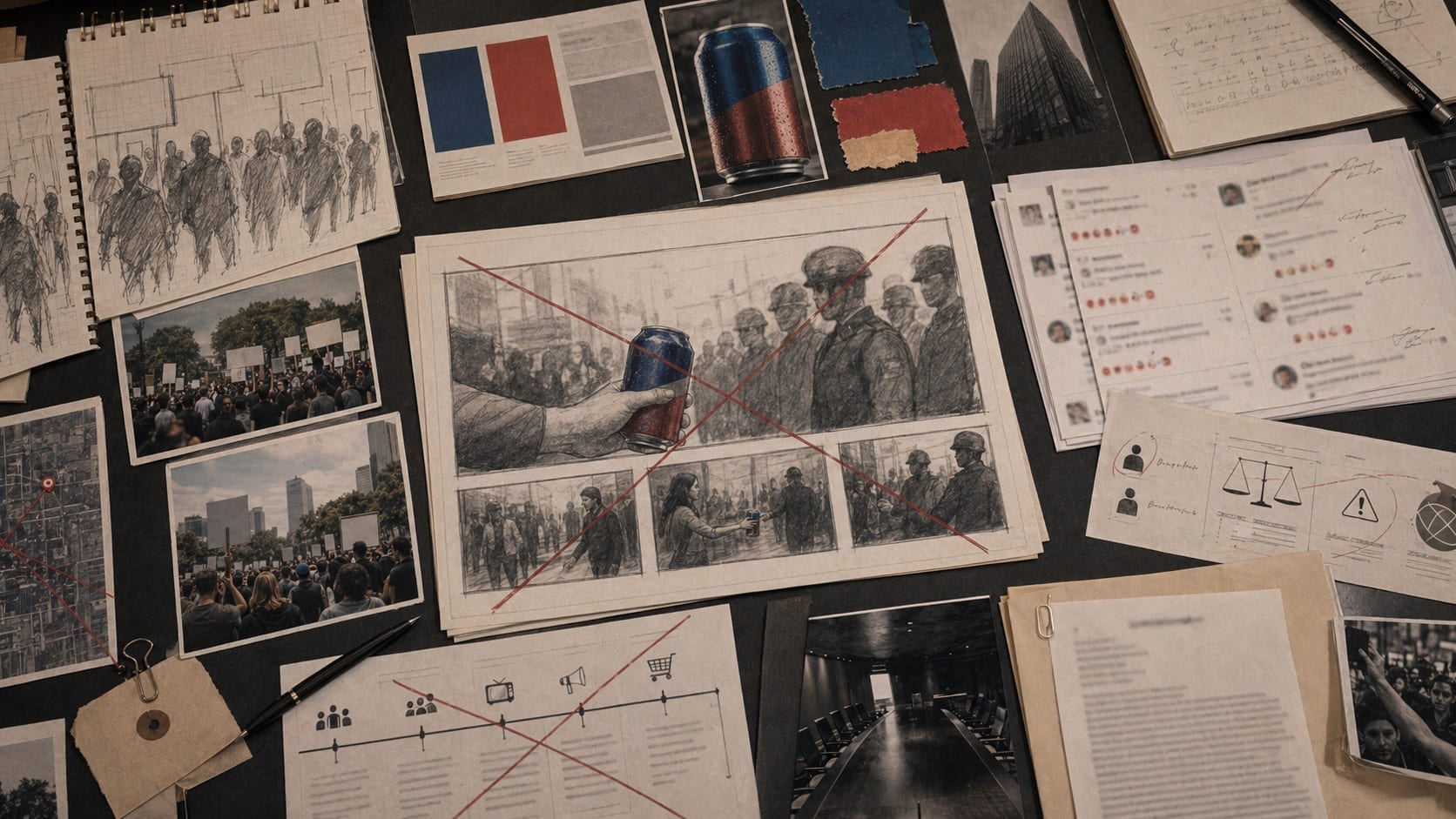
In April 2017, Pepsi released a global campaign featuring Kendall Jenner leaving a photo shoot, joining a staged street protest, and offering a can of Pepsi to a police officer. The scene ends with release, smiles, and a crowd reaction, turning the product into a symbolic bridge between protesters and authority.
The campaign appeared to be reaching for unity, youth energy, and cultural relevance. But the visual structure of the ad pulled from protest imagery at a moment when protest in the United States carried concrete stakes around police violence, racial justice, immigration, and political power. That context changed the meaning of the commercial.
What The Ad Tried To Do
Pepsi wanted a broad emotional message: people from different backgrounds coming together. In brand terms, that is an old beverage move. Soft drinks often sell optimism, refreshment, shared moments, and public togetherness. The problem was the chosen stage.
A protest is not a generic crowd. It is a claim, a risk, a conflict, and often a response to harm. By using protest as a backdrop while keeping the issue vague, the campaign kept the emotional intensity but removed the political substance. That made the scene feel less like solidarity and more like extraction.
What Broke
The backlash was immediate. CBS News reported that critics accused the ad of co-opting protest imagery and trivializing social movements. The Guardian noted comparisons to the widely circulated photograph of Ieshia Evans standing before police in Baton Rouge after the killing of Alton Sterling.
Those comparisons mattered because the ad's central image was not neutral. A privileged celebrity handing a soda to an officer did not resolve tension. It trivialized the actual stakes that made protest imagery powerful in the first place. The more the campaign tried to look meaningful, the more it exposed the distance between brand intent and lived reality.
The Withdrawal
Pepsi pulled the ad on April 5, 2017, after the backlash. CBS News, the Associated Press, and The Guardian reported the company's apology: Pepsi said it was trying to project a global message of unity, peace, and understanding, but had missed the mark and was halting the rollout.
The speed of the withdrawal showed that the issue was not a small misread. The campaign had lost control of its own meaning. Once audiences framed the ad as trivializing protest and social justice, the brand could not re-explain it back into safety.
The Cultural Risk
The campaign failed because it confused recognizability with permission. Protest imagery was recognizable. That did not mean a soda brand had permission to use it as emotional shorthand. The brand borrowed the aura of civic courage while avoiding the specificity that gives civic courage its weight.
This is the cultural-risk pattern: a brand wants relevance, chooses a charged symbol, removes the discomfort, and expects the remaining aesthetic to transfer warmth. Instead, audiences notice the missing context. The absence becomes the message.
The Decision Lesson
The Pepsi case is a cultural-shortcut disaster. It shows what happens when a campaign tries to convert social struggle into a brandable mood. Unity is not wrong as a brand theme. But unity without a real conflict, real point of view, or real cost can read as avoidance.
Brands can speak about civic themes only when they know exactly what claim they are making, who is affected by it, and what proof the company has earned. Otherwise the brand is not joining a conversation. It is using the conversation as scenery.
The Operating Pattern
Before using charged cultural imagery, leadership should ask what specific history the image carries, who paid the cost of that history, and whether the brand has a legitimate role in that conversation.
The campaign review should include not merely legal approval and creative testing, but cultural-context review: what could this image be compared to, who might feel exploited by the comparison, and what happens if the public names the reference before the brand does?
Where The Strategy Can Break
Pepsi should not be read as a clean success label. The useful question is where the disaster promise can fail in the real category: users depend on the system to work in ordinary moments, not in brand campaigns.
The weak reading is talking about scale, innovation, or ecosystem reach while hiding the exact behavior people repeat. That kind of page sounds polished but gives the reader no way to judge the decision.
The concrete failure mode is this: the name becomes large but less useful because the user cannot tell which part of the system solves the problem. If the case cannot explain that risk, the brand story is not finished.
The Bad Example
A bad Pepsi copycat would start with the visible surface: the mark, the color, the store, the app, the route, the campaign, or the public phrase. Then it would assume the surface created the result.
That is usually backwards. The surface worked only if the category proof underneath it was already strong enough: daily usage, uptime, distribution, account trust, partner tools, switching cost, and recovery when the service fails.
The page has to protect readers from that shortcut. The mistake is not ambition. The mistake is copying the artifact while leaving the constraint untouched.
What To Copy
Copy the discipline, not the costume. For Pepsi, the discipline sits in the link between beverage pressure, customer behavior, and the proof a buyer or user can inspect.
A useful reader should be able to point to one behavior that changed, one risk that dropped, and one cue that helped the change stick.
If those three pieces are missing, the page should not pretend the case is a repeatable playbook. It is only a brand example with missing machinery.
The Proof Trail
Start with the year or period: 2017. Then ask what was visible to the market at that time, what changed after the decision, and what evidence still exists now.
The source list gives the inspection trail. Use it to separate what Pepsi says about itself from what the case page argues about the brand decision.
The proof should answer five checks: daily behavior, uptime or access, user control, switching cost, failure recovery. If the page cannot answer them, the case needs more source work before anyone treats it as a decision record.
The Decision Limit
The case should not be used as a slogan for doing the same thing. It should be used as a boundary test. The question is whether the same market pressure, customer behavior, proof surface, and timing exist before the decision gets copied.
Pepsi gives Grow Your Brand a concrete inspection point: daily usage, uptime, distribution, account trust, partner tools, switching cost, and recovery when the service fails. If a team cannot point to that proof in its own business, the comparison is weak, even when the visible asset looks similar.
The better lesson is operational. Decide what must be true before the cue, campaign, name, product, route, or experience can carry the promise. Then decide which signal would stop the move if customers reject it, ignore it, or use it in the wrong way.
A serious reader should leave with a constraint, not a mood. For Pepsi, the constraint sits in beverage: who is choosing, what risk they are managing, which proof they can inspect, and what would make the promise collapse under normal use.
The final check is the comparison set. Put Pepsi beside two adjacent cases and ask what changed in each file: the cue, the behavior, the channel, the proof, the public language, or the operating burden. The answer keeps the case from becoming trivia.
This is where Grow Your Brand page earns its keep. It turns a brand story into a decision memo: what changed, who had to believe it, what proof reduced the risk, what failure would expose the gap, and which nearby cases warn against copying the surface too quickly.
Compare Next
Related Cases
Do not read Pepsi alone. Compare it against nearby cases: Boeing, WeWork, Pan Am; concept paths: Humor in Emotional Branding, Negative Brand Associations, Failed Brand Strategy Examples.
Sources
- The Guardian, Pepsi pulls Kendall Jenner ad ridiculed for co-opting protest movements, April 5, 2017
- Associated Press via Boston.com, Pepsi pulls widely mocked ad featuring Kendall Jenner, April 5, 2017
- CBS News, Pepsi pulls Kendall Jenner protest ad after uproar, April 5, 2017
- Wired, Pepsi's Kendall Jenner Ad Was So Awful It Did the Impossible: It United the Internet, April 5, 2017
- Wikimedia Commons, Pepsi logo file

People Also Ask
What happened to Pepsi?
Pepsi and the Protest Shortcut is a disaster case about Pepsi in 2017. The campaign treated protest imagery as a universal unity signal, but the public read the visual language as a commercial flattening of real social conflict. Brands cannot borrow the emotional charge of a movement without accepting the context, stakes, and lived cost behind that movement. If the campaign needs pain as atmosphere, the brand is probably taking meaning it has not earned.
Why is Pepsi a disaster case?
Pepsi is filed as a disaster case because the visible consequence sits in that decision pattern. The campaign treated protest imagery as a universal unity signal, but the public read the visual language as a commercial flattening of real social conflict.
What can brands learn from Pepsi?
Brands cannot borrow the emotional charge of a movement without accepting the context, stakes, and lived cost behind that movement. If the campaign needs pain as atmosphere, the brand is probably taking meaning it has not earned.
Is Pepsi still operating?
Grow Your Brand marks Pepsi as Active / continuing. That means the brand, company, platform, product system, or parent organization is still operating, continuing, or being actively resolved.
What should Pepsi be compared with?
Compare Pepsi with Boeing, WeWork, Pan Am to see the same decision pattern from nearby cases.