Asset 1
Blue-box mark, store sign, shopping bag, website header, mall memory, public response, and reversal
Blue-box mark, store sign, shopping bag, website header, mall memory, public response, and reversal.
A Brand Signal Card from Grow Your Brand
Gap showed how quickly a familiar mark can become a governance issue when a redesign underprices memory.
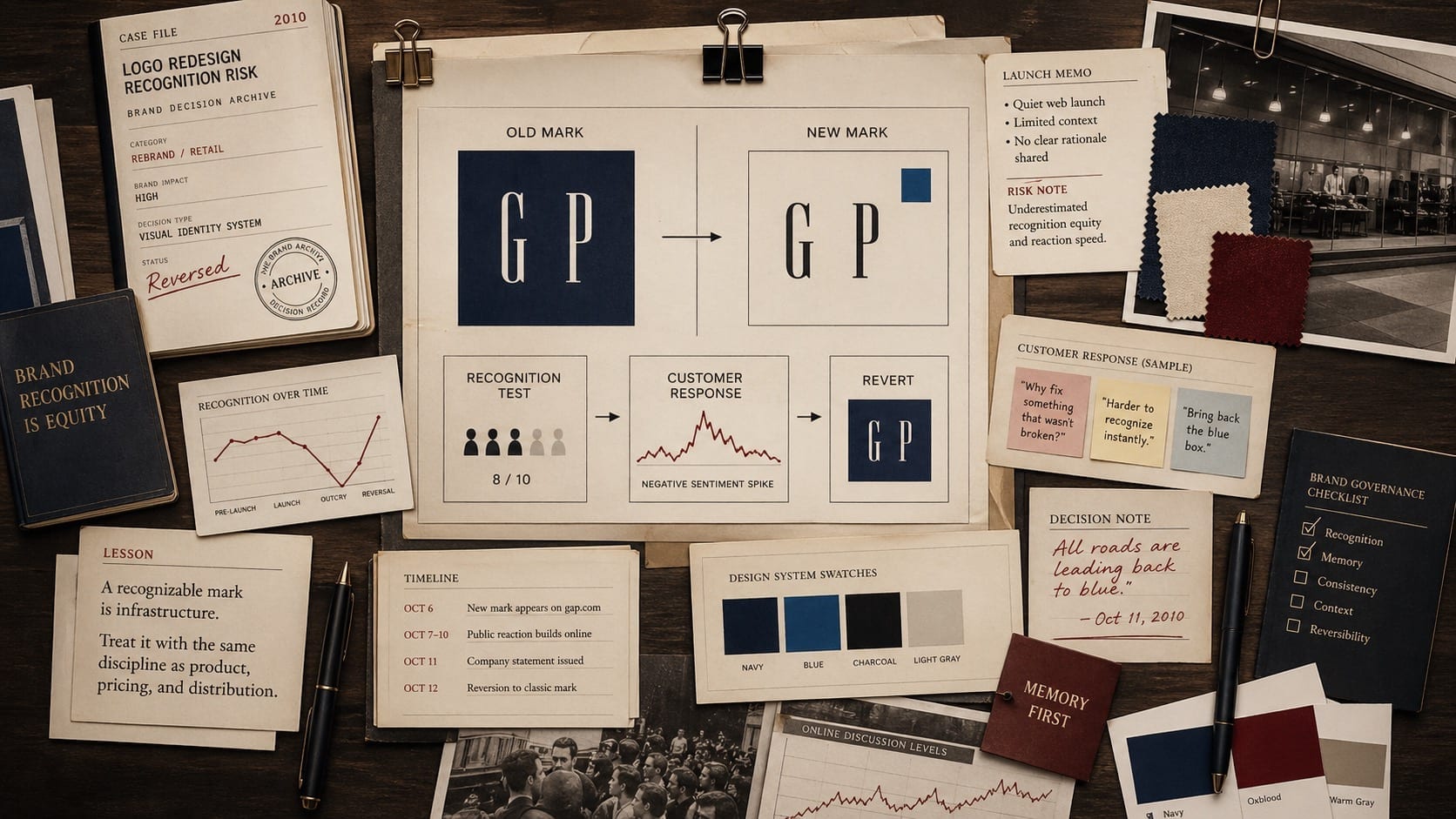
Identity snapshot
The snapshot keeps the route useful without turning the page into a company profile.
Recognition assets
These points come from the existing source material and keep the page tied to observable brand behavior.
Asset 1
Blue-box mark, store sign, shopping bag, website header, mall memory, public response, and reversal.
Color system
Color is shown as a controlled signal layer attached to the brand surfaces.
The old memory container customers used to recognize the brand.
A small continuity cue that could not carry the same recognition burden.
A clean field that exposed how much the old blue box had been doing.
Product or service signal
A Brand Signal Card has to connect identity to a real surface, product, service, or repeated customer behavior.
Blue-box mark, store sign, shopping bag, website header, mall memory, public response, and reversal.
Gap showed how quickly a familiar mark can become a governance issue when a redesign underprices memory.
Visual proof
These are existing local visual assets wired only where a page-specific asset is already available.


Brand pressure
The events stay compact so the reader can see what pressure the brand had to absorb.
October 2010 change
Gap replaced the familiar blue box mark online.
Public response
Reaction turned a design change into a recognition question.
October 11 reversal
Gap said it would keep the classic blue box logo.
Timeline
Only timeline facts already present in the source are shown.
Signal checks
Scores stay qualitative here because the batch is preserving source-backed facts, not inventing a numeric model.
Recognition
The redesign removed the container people remembered.
Proof
The market did not see what problem the new mark solved.
Pressure
The public forced the identity decision back into view.
Steal / avoid
The point is not to copy the visible artifact. It is to copy the discipline behind it.
Map which assets carry public memory before changing the style system.
Do not spend recognition before the replacement has earned a clearer reason to exist.
Browse taxonomy
These links keep the transferred route inside the current Brand Signal Index foundation.
Related cards
Related links use existing Grow Your Brand routes already present in the public tree.
Source board
Source links are carried over from the existing source material.
Private brand work