Direct Answer
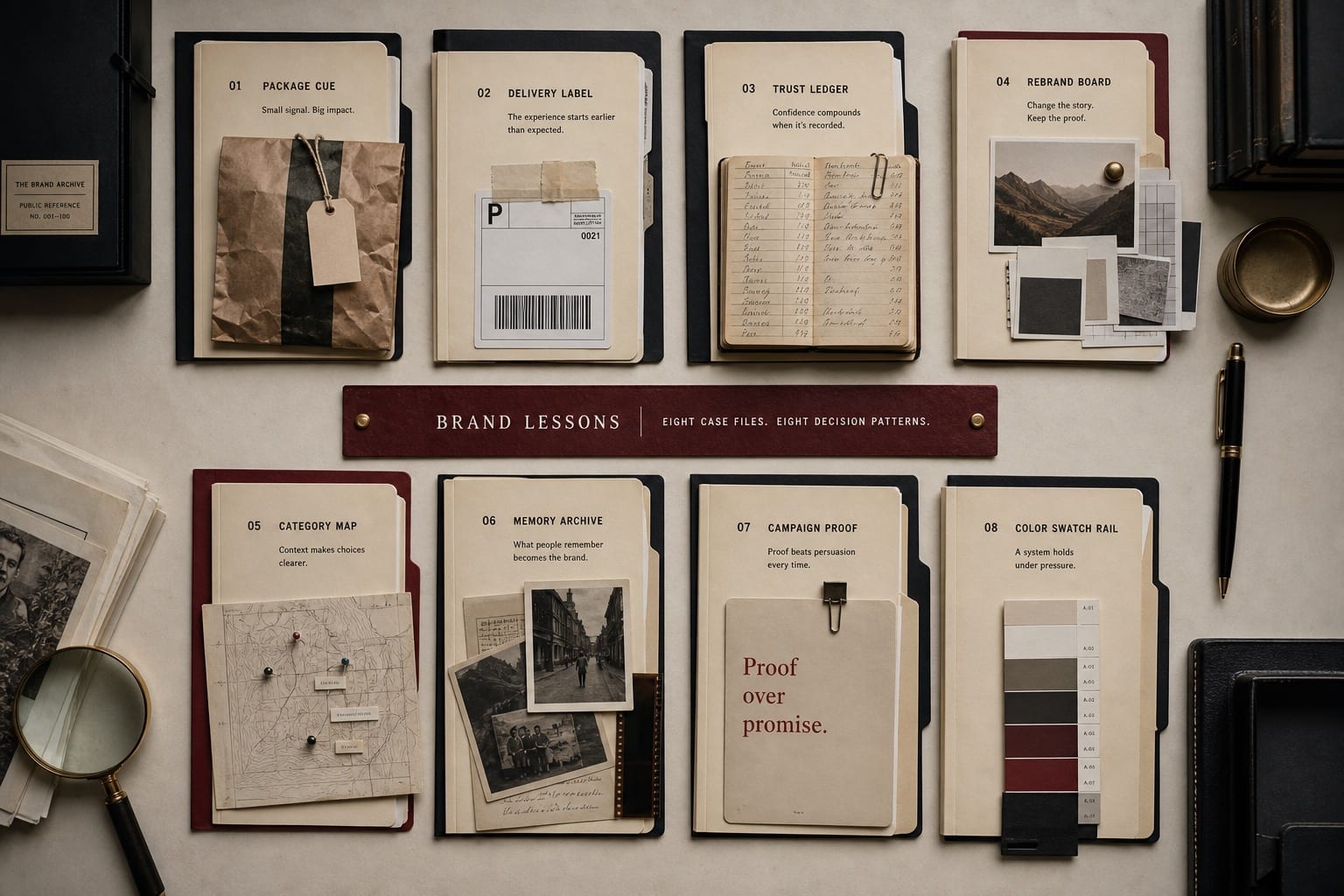
Brand Lessons is the pattern layer above the Brand Signal Cards. It groups examples by the rule they prove: protect recognition assets, make operations visible, build trust as a system, keep rebrands tied to proof, create categories through repeated behavior, separate ownership from proof, and separate remembered brands from working businesses.
Quote-ready definition
Grow Your Brand definition
"Grow Your Brand defines brand lesson as a repeatable rule drawn from several source-cited cases, showing what brands should protect, test, change, or stop."
Lesson map
Read the pattern before copying the case.
Lesson Index
13 pattern files for brand decisions.
Why it matters
Why it matters
Single cases are memorable. Grouped cases teach the operator pattern and make Grow Your Brand useful before a reader knows which Brand Signal Card to open.
Mistake to catch
The expensive mistake
The mistake is turning lessons into loose advice. A Grow Your Brand lesson has to point back to named cards, state the mechanism, and show what each case proves under pressure.
How to use it
Use the lesson only after the case pattern repeats.
A single brand story can be memorable and still be a bad rule. The lesson layer exists to compare cases until the mechanism repeats: the same recognition problem, trust burden, operating proof, habit shift, category cue, or retrieval failure appears in more than one file.
- Open at least three cases in the lesson family before writing a rule.
- Name the mechanism that repeats across the cases.
- Name the bad example: the surface a team might copy too quickly.
- Write the operator check that would have caught the mistake before approval.
- Link the lesson back to a decision page, checklist, or Brand Signal Card so the reader can inspect the proof.
How to read
A lesson is a repeated mechanism, not a quote from one famous case.
Use the lesson hub when a brand problem appears in several cards: the same cue gets damaged, the same trust burden appears, the same habit moves, or the same operating proof keeps deciding the outcome.
A useful lesson starts with a pattern that repeats across cases. Gap and Tropicana are not the same business, but both warn against deleting a cue customers still use. FedEx and Zappos are not the same category, but both show that trust gets stronger when the recovery path is visible before the customer has to ask.
The hub should stop readers from copying the famous surface. A team can copy a color, a slogan, a platform language, a parent-brand diagram, or a cleaner logo and still miss the mechanism. The question is what the customer could inspect: shelf cue, route, policy, habit, source trail, product change, service behavior, or category ritual.
Read each lesson as a pre-approval test. Before a rebrand, open the recognition and proof lessons. Before a marketplace, open the trust and operations lessons. Before a platform expansion, open the gravity and habit lessons. The point is to slow down the copycat move before budget, pride, and launch pressure make it hard to stop.
A weak lesson says a brand should be authentic, consistent, or memorable. The Grow Your Brand version names the operating condition. What has to repeat? What can break? Which customer moment proves the claim? Which bad example looks attractive but fails under pressure?
The lesson layer also protects the Brand Signal Cards. A case can be vivid enough to mislead. The hub forces comparison, so one story does not become a universal rule. A pattern earns the word lesson only after several cards point to the same decision pressure.
A good use of the hub starts with the live decision. If the team is changing a logo, begin with recognition assets. If the team is changing a portfolio, begin with architecture and parent ownership. If the team is stretching a platform, begin with ecosystem gravity. The route should match the risk.
The hub is also a guardrail against cheap inspiration. A famous brand can make a move look simple after the fact. The lesson page should recover the hidden work: the operating rule, proof burden, customer habit, source trail, and failure condition that made the move work or fail.
Each lesson has to produce a meeting sentence. Protect the cue. Show the handoff. Prove the trust claim. Do not let the parent name replace product proof. Do not call a category new until people repeat the behavior. That sentence is the value of the layer.
The weak reading is to treat the hub as a list of tips. Tips get skipped. Tests get used. A Grow Your Brand lesson should read like a test a founder, marketer, product lead, or agency can run before the public sees the decision.
The maintenance rule is simple: when a new card enters the index, it should either support an existing lesson or expose a new one. That keeps the lesson layer alive instead of turning it into a static advice page.
The practical output is a decision memo, not a quote. Name the lesson, name the cases, name the proof, name the mistake, name the customer moment, and name the stop rule. That is the format that keeps the archive useful in a real approval meeting.
The hub should also make gaps visible. If a brand problem has no lesson yet, the index needs more case evidence before publishing advice. If a lesson has only one example, it belongs as a card note until the mechanism repeats.
This is the quality line for future pages: every new lesson needs named cases, a bad read, a customer-side test, a decision consequence, and a route back to sources. Anything less turns into generic strategy writing.
The hub should make the next decision easier to argue, easier to source, and easier to stop when the proof is missing before approval.
Brand Lessons FAQ
What is a brand lesson?
A brand lesson is a repeatable rule drawn from several source-cited brand cases.
How is this different from advice?
Advice can float without evidence. A lesson has to point to named cases and say what each case proves.
How should the lesson pages be used?
Use them as pattern maps before opening the individual Brand Signal Cards.