Direct Answer
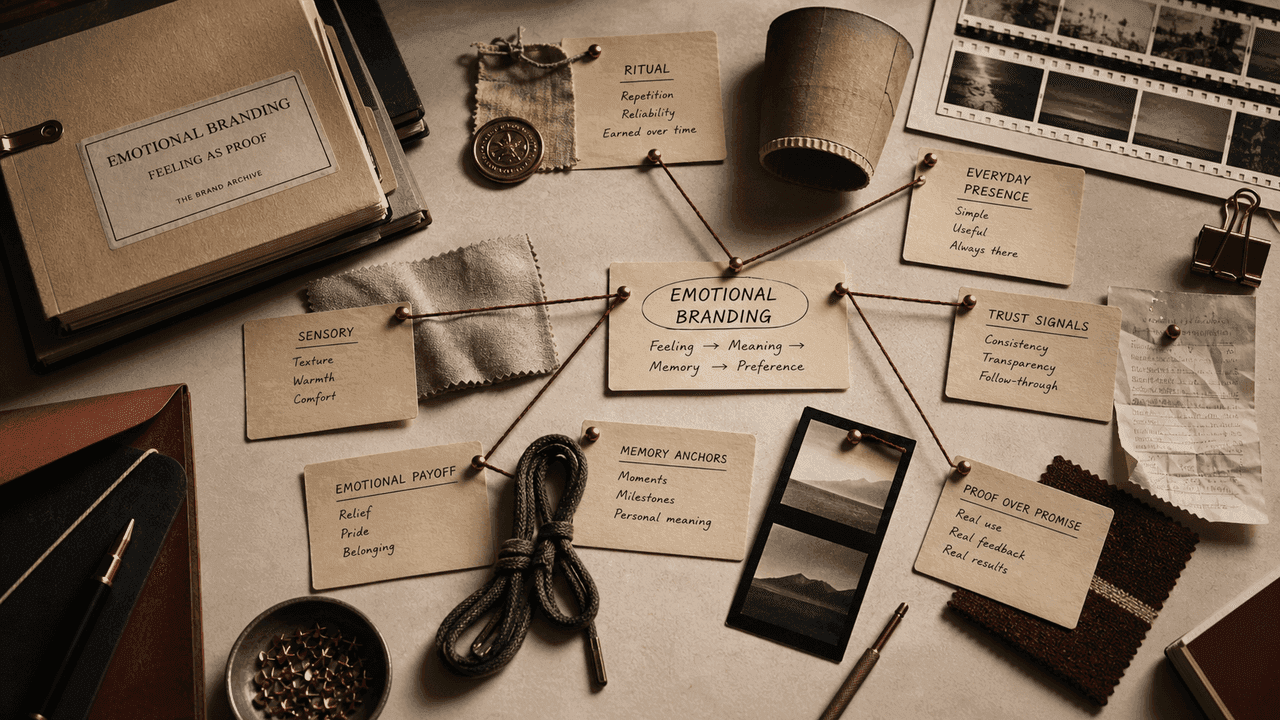
Emotional branding is the system that makes a useful reading easy to find at the moment of decision. The reading has to live in a cue, product, service, ritual, or public record. If there is no proof, the emotion turns into theater.
Reader payoff
By the end of this page, you should be able to
- Name the reading without turning it into mood.
- identify the cue, behavior, or proof that carries it.
- See which case to inspect next.
- Avoid emotion that becomes manipulation.
Answer Map
Start with the decision, then check the proof.
Quote-ready definition
Grow Your Brand definition
"Grow Your Brand defines emotional branding as the use of reading, proof, memory, and repeated behavior to make a brand easier to recognize, trust, prefer, and describe."
Commercial meaning
Why This Matters Commercially
People do not buy with spreadsheets alone.
They buy with risk, pride, habit, fear, trust, and memory in the room.
Mistake to catch
What Brands Usually Get Wrong
The mistake is treating emotion as mood.
The customer should not have to decode the reading. The product, service, ritual, or cue should carry it.
Competitive gap
What most pages miss
Most pages list emotional branding examples.
That is not enough. The useful question is: what reading did the brand earn, and what proof keeps that reading alive?
Comparison
Emotion needs a job
Emotional branding is strongest when the reading helps the customer make a decision, not when it merely decorates a message.
| Emotion | Decision job | Archive examples |
|---|---|---|
| Belonging | Make a new behavior read socially legible. | Airbnb and Starbucks |
| Confidence | Lower risk before the customer chooses. | Volvo, FedEx, Toyota |
| Identity | Let the buyer signal who they are or what they reject. | Nike, Patagonia, Liquid Death |
| Care | Make service or product use read human and protective. | Dove, Zappos, Marriott |
| Habit | Make repeat use read rewarding or familiar. | Duolingo, McDonald's, Costco |
Proof matrix
Brand Examples
These examples are not here because they are famous.
Each one proves a different emotional mechanism.
| Case | What happened | What it proves | Operator lesson |
|---|---|---|---|
| Nike Launch / 1971-present |
Nike kept emotion tied to sport proof: shoes, athletes, training, winning, and ordinary effort all fed the Swoosh. | The emotion is action-based. Customers can wear the cue and perform the ambition instead of only watching an ad. | Anchor emotion to a behavior customers can repeat in public. |
| Dove Trust / 2004-present |
Dove kept care and self-image close to a personal-care category where the product already touches confidence. | The reading works because it sits beside product use, body image, and care rather than floating as a campaign mood. | Keep emotional claims inside the use moment the product can credibly support. |
| Airbnb Rebrand / 2014 |
Airbnb asked belonging to carry a lodging marketplace where strangers, homes, money, and safety all create risk. | Belonging needs trust infrastructure. The symbol cannot make a marketplace read human if hosts, guests, and recovery paths fail. | Belonging is useless if the service still reads unsafe. |
| Liquid Death Launch / 2019 |
Liquid Death turned water into a loud public object through cans, music cues, comedy, and anti-boring retail behavior. | The rebellion works because the can, tone, music context, and retail presence turn water into a social object. | Make the reading easy to perform in the category before you write it into campaign language. |
| Duolingo Launch / 2012-present |
Duolingo turned lessons, streaks, mascot pressure, and reminders into an emotional return loop. | The reading is habit tension. The brand stays present because users risk losing progress, not because the owl is cute alone. | Tie emotional pressure to a real behavior the product wants repeated. |
| Patagonia Pivot / 2011-2022 |
Patagonia tied purpose to repair, restraint, environmental commitments, and ownership structure. | The emotion survives because buyers can see operating choices behind the claim. | If the reading is purpose, the business model has to carry evidence before critics ask for it. |
| Starbucks Rebrand / 2011 |
Starbucks built reading through repeated store visits, cups, names, routines, and the green siren. | The emotion is place memory. The mark retrieves a familiar stop in the day, not coffee quality in isolation. | Make the emotional cue show up in the routine and the service behavior. |
| McDonald's Launch / 1948-present |
McDonald's turned comfort into a quick retrieval cue through arches, menu familiarity, speed, price cues, and repeat service. | Comfort comes from predictability. The reading is trained by knowing what will happen before ordering. | Build emotional memory from repeatable operations customers can count on. |
The pattern is simple: emotion works when the customer can find the proof.
Pattern map
Group the examples by mechanism
Group the cases by the job the reading performs. Belonging, trust, status, nostalgia, humor, rebellion, care, and identity each need a different proof carrier.
| Pattern | What it means | Cases to inspect |
|---|---|---|
| Belonging | The brand gives people a group, ritual, place, or symbol they can join. | Airbnb, Nike, Disney, LEGO, Starbucks |
| Trust | The reading lowers perceived risk because proof keeps showing up. | FedEx, Toyota, Volvo, Zappos, eBay |
| Nostalgia | Old memory speeds up recall, but only if the current behavior still works. | McDonald's, Coca-Cola, LEGO, Disney, Sears |
| Identity | Use says something about the customer and the product at the same time. | Nike, Patagonia, Apple, Dove |
| Humor and rebellion | The brand makes a category easier to share, talk about, or choose publicly. | Liquid Death, Duolingo, Oatly |
Decision framework
How to use it
Use the page when the brand reading has to change a real decision.
- Name the reading Use a real decision emotion: trust, relief, pride, belonging, status, nostalgia, fear, humor, or care.
- Attach it to a cue Find the mark, package, service moment, ritual, or phrase that can carry it.
- Attach it to proof Show the behavior that keeps the reading from becoming manipulation.
- Repeat it in use Emotion becomes brand memory when it returns in the product or service moment.
- check the contradiction If public behavior contradicts the reading, the emotion becomes fragile.
Questions to consider
Questions to apply before the decision
Use these questions before changing a cue, promise, channel, page, package, or proof point.
- What reading should the customer retrieve before reading the full message?
- What cue, ritual, service moment, or product behavior earns that reading?
- What proof stops the emotion from becoming campaign tone?
- What decision does the reading help with: trust, belonging, status, habit, care, or recall?
- What contradiction would turn the reading into a negative memory?
- Where does the customer meet the reading after the ad is gone?
Common mistakes
Mistakes to avoid
The weak move is to name the emotion and stop. The stronger move is to ask what carries it when the campaign is gone.
Confusing emotional advertising with emotional branding
Advertising can create a reading; branding keeps that reading attached to repeat behavior.
Borrowing emotion the company has not earned
A purpose, care, or belonging claim needs proof outside the campaign.
Ignoring negative emotion
Fear, frustration, resentment, and betrayal can become brand memory too.
Using emotion without a decision job
Name how the reading helps the customer choose, return, recommend, or forgive.
Use this page when
When this concept is the right lens
This page is most useful when the decision depends on proof, memory, risk, behavior, or market consequence.
- A brand promise depends on trust, identity, belonging, memory, care, humor, or status.
- A campaign creates reading but the product or service does not repeat it.
- A rebrand risks removing a cue that carries personal or social meaning.
- A team needs to explain why emotion has to be proof-backed, not mood-led.
Operator test
What to check before spending money
Use the checklist as a pressure test. If the answer is vague, the brand decision is not ready.
- Name the specific reading the brand needs to earn.
- Name the cue or behavior that carries the reading.
- Put proof beside the emotion.
- check whether the reading appears during actual use.
- Do not ask emotion to cover a proof gap.
Commercial use
What Another Brand Can Use
Use the page to decide what must be protected before money moves: the name, cue, promise, proof, channel, page, package, or customer habit.
The useful output is not a prettier opinion. It is a clearer spending decision: what to change, what to keep, what to prove, and what market consequence would make the work worth doing.
For private branding work, use the protected contact page.
Source trail
Sources used to check the page claims.
- Nike company story
Use this as the source trail for ambition tied to sport, athletes, products, and participation.
- Dove Real Beauty
Use this as the source trail for care and self-image tied to a personal-care category.
- Airbnb Newsroom: About Us
Use this as the source trail for belonging under marketplace trust pressure.
- Patagonia company purpose
Use this as the source trail for purpose backed by ownership and operating choices.
- Liquid Death about page
Use this as the source trail for humor, category contrast, and public buying cues.
- Duolingo about page
Use this as the source trail for habit, practice, streaks, and language-learning behavior.
Related Files
Keep the answer inside Grow Your Brand.
Emotional Branding FAQ
What is emotional branding?
Emotional branding is the work of attaching a useful reading to a brand's cue, proof, behavior, and memory.
What are examples of emotional branding?
Nike, Dove, Airbnb, Liquid Death, Duolingo, Patagonia, Starbucks, and McDonald's are useful examples because emotion is tied to behavior.
Is emotional branding manipulation?
It can be manipulative when the reading has no proof. It is stronger when the emotion helps customers understand real behavior or reduce real risk.
How do brands create emotional connection?
They repeat a reading through product, service, ritual, community, proof, and language until the reading becomes easy to retrieve.