Direct Answer
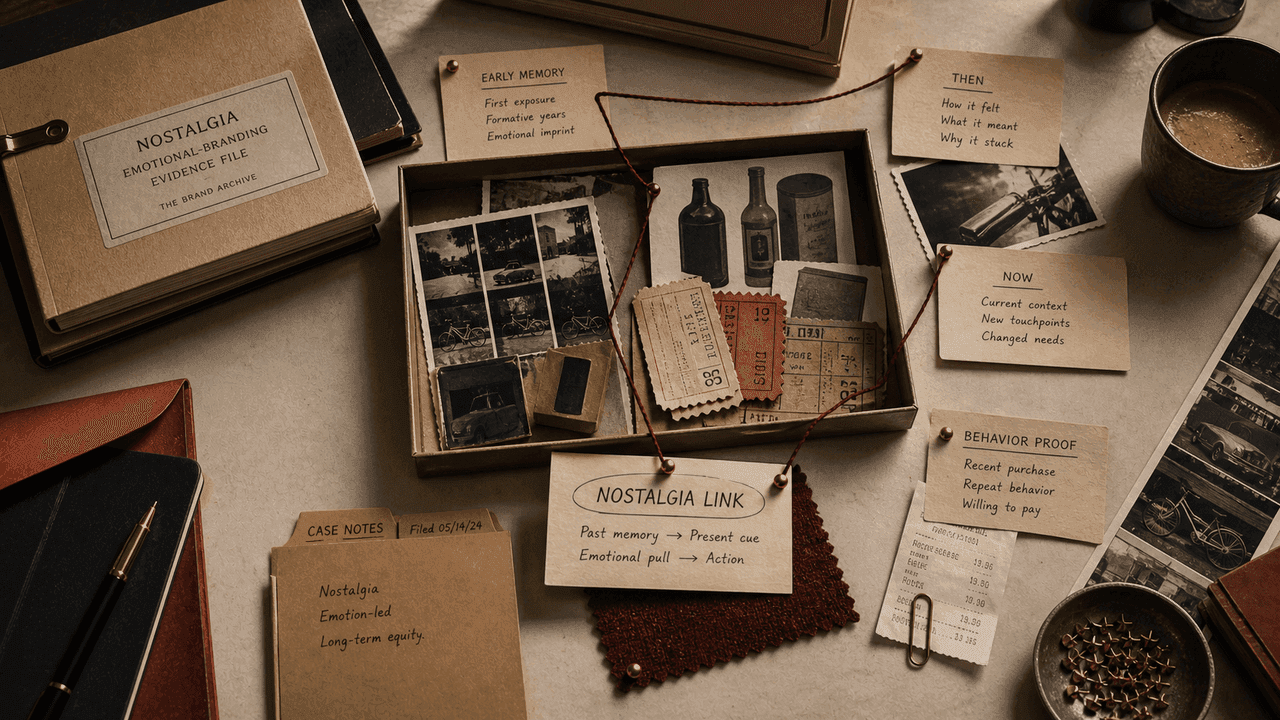
Nostalgia branding uses old memory to reduce today's decision pressure. It helps only when the current product, service, or ritual still earns the memory.
Reader payoff
By the end of this page, you should be able to
- Tell living memory from dead familiarity.
- Find the current ritual that keeps the past useful.
- Avoid heritage moves that weaken choice.
Answer Map
Start with the decision, then check the proof.
Quote-ready definition
Grow Your Brand definition
"Grow Your Brand defines nostalgia in branding as the use of remembered products, rituals, symbols, places, or eras to make a brand easier to retrieve and trust in the present."
Commercial meaning
Why This Matters Commercially
Old memory can make a choice read safe, warm, inherited, or familiar.
It turns stale when people remember the brand but no longer need it.
Mistake to catch
What Brands Usually Get Wrong
The mistake is treating familiarity as demand.
Nostalgia helps only when the current product still earns the old memory.
Competitive gap
What most pages miss
Most nostalgia pages treat old memory as a shortcut.
This page separates useful memory from dead familiarity.
Comparison
Nostalgia that works vs nostalgia that stalls
Nostalgia needs a present-tense job.
| Type | What makes it useful | Archive cases |
|---|---|---|
| Ritual nostalgia | An old routine still repeats. | McDonald's, Hallmark |
| Story nostalgia | Characters and worlds keep finding new surfaces. | Disney, Nintendo |
| Product nostalgia | The object or system still invites use. | LEGO, Coca-Cola |
| Dead-route nostalgia | Memory remains after behavior moves. | Blockbuster, Sears |
| Confused nostalgia | The brand leans on memory while changing the cue. | Tropicana, Gap |
Proof matrix
Brand Examples
The cases separate living rituals from memory with no buying route.
| Case | What happened | What it proves | Operator lesson |
|---|---|---|---|
| McDonald's Launch / 1948-present |
McDonald's keeps childhood and road-trip memory alive through food cues, arches, routines, and predictable service. | Nostalgia stays useful because the current visit still matches the old memory. | Protect the ritual that lets old affection convert into today's choice. |
| Disney Brand System / 1923-present |
Disney carries characters and stories from childhood into parks, streaming, merchandise, and family trips. | The memory keeps working because the brand gives each generation a new point of entry. | Renew old memory with current behavior, more than anniversary language. |
| LEGO Comeback / 2000s |
LEGO recovered by refocusing on the brick system that parents remembered and children could still use. | Nostalgia works because the old play pattern remained functional. | Use nostalgia to restart a behavior, not to freeze the brand in the past. |
| Nintendo Comeback / 2017 |
Nintendo brought play memory back through a product that made solo, family, and portable play easy again. | The nostalgia is active. People can repeat the reading through a current device. | Give old fans a new behavior that still reads familiar. |
| Hallmark Brand System / 1910-present |
Hallmark keeps memory tied to recurring occasions: birthdays, grief, holidays, thanks, and love. | The brand retrieves reading because the calendar keeps creating the need. | Tie memory to moments that predictably return. |
| Coca-Cola Failure / 2011 |
Coca-Cola's white holiday can disrupted the red-can cue customers used to identify the original. | Nostalgia depends on stable signals. Seasonal emotion can confuse the product if it weakens recognition. | Treat holiday memory as an overlay, not a replacement for core cues. |
| Blockbuster Failure / 1985-2014 |
Blockbuster retained warm memory after the Friday-night rental route had moved to streaming. | Awareness and affection can outlive usefulness. Nostalgia alone did not preserve the buying behavior. | Warm memory does not help if the current behavior has moved somewhere else. |
| Sears Failure / 1886-2018 / remnant brand |
Sears kept catalog and department-store trust in memory while modern retail behavior shifted elsewhere. | Old trust loses force when the buying route no longer fits the customer. | Inherited trust has to find a modern buying route before it becomes museum memory. |
Nostalgia works when memory still has somewhere to go.
Pattern map
Group the examples by mechanism
The useful pattern is the decision mechanism. Brand names are evidence, not the organizing principle.
| Pattern | What it means | Cases to inspect |
|---|---|---|
| Living ritual | The memory still returns inside current use. | McDonald's, Disney, LEGO |
| Seasonal memory | A calendar cue retrieves the brand quickly. | Coca-Cola, Hallmark |
| Generational transfer | Adults bring childhood memory into new family use. | LEGO, Nintendo, Disney |
| Dead familiarity | People remember the brand but no longer choose it. | Blockbuster, Sears |
| Cue disruption | A familiar asset changes and memory pushes back. | Coca-Cola, Tropicana |
Decision framework
How to use it
The practical test is whether the concept changes a real decision.
- Name the old memory What exactly do people remember?
- Name the current route How can people act on that memory now?
- Protect the cue Which visual, product, phrase, or ritual carries the memory?
- Add present proof Show why the brand still works now.
- Watch nostalgia without behavior If people remember but do not choose, the route is broken.
Questions to consider
Questions to apply before the decision
Use these questions before changing a cue, promise, channel, page, package, or proof point.
- What reading should the customer retrieve before reading the full message?
- What cue, ritual, service moment, or product behavior earns that reading?
- What proof stops the emotion from becoming campaign tone?
- What decision does the reading help with: trust, belonging, status, habit, care, or recall?
- What contradiction would turn the reading into a negative memory?
- Where does the customer meet the reading after the ad is gone?
Common mistakes
Mistakes to avoid
These mistakes are common because they sound reasonable inside the company and fail when customers meet the brand.
Confusing affection with purchase
Blockbuster shows warm memory can survive after use disappears.
Changing the remembered cue
Tropicana and Gap show that cleaner design can damage memory.
Using nostalgia with no current proof
Old affection needs a present reason to choose.
Ignoring younger users
Nostalgia has to translate for people who did not live through the original cue.
Use this page when
When this concept is the right lens
This page is most useful when the decision depends on proof, memory, risk, behavior, or market consequence.
- A brand wants to reuse old memory without becoming stale.
- Awareness is high but current choice is weak.
- A visual or product change could break a memory cue.
Operator test
What to check before spending money
Use the checklist as a pressure test. If the answer is vague, the brand decision is not ready.
- Name the remembered cue.
- Name the current behavior it should support.
- check whether the route still exists.
- Add current proof beside the old memory.
- Do not mistake fondness for demand.
Commercial use
What Another Brand Can Use
Use the page to decide what must be protected before money moves: the name, cue, promise, proof, channel, page, package, or customer habit.
The useful output is not a prettier opinion. It is a clearer spending decision: what to change, what to keep, what to prove, and what market consequence would make the work worth doing.
For private branding work, use the protected contact page.
Related Files
Keep the answer inside Grow Your Brand.
Nostalgia in Emotional Branding FAQ
What is nostalgia in branding?
It is the use of remembered products, rituals, symbols, places, or eras to make a brand easier to retrieve and trust now.
What are nostalgia branding examples?
McDonald's, Disney, LEGO, Nintendo, Hallmark, Coca-Cola, Blockbuster, and Sears show different nostalgia outcomes.
When does nostalgia fail?
It fails when warm memory is no longer connected to a current buying or use route.