Treating fame as salience
Fame can persist after the habit has moved, as Sears and Blockbuster show.
Branding guide · evidence and decision
Brand awareness means known. Brand salience means retrieved in the buying moment. See the difference through real brand cases.
decision · proof · use
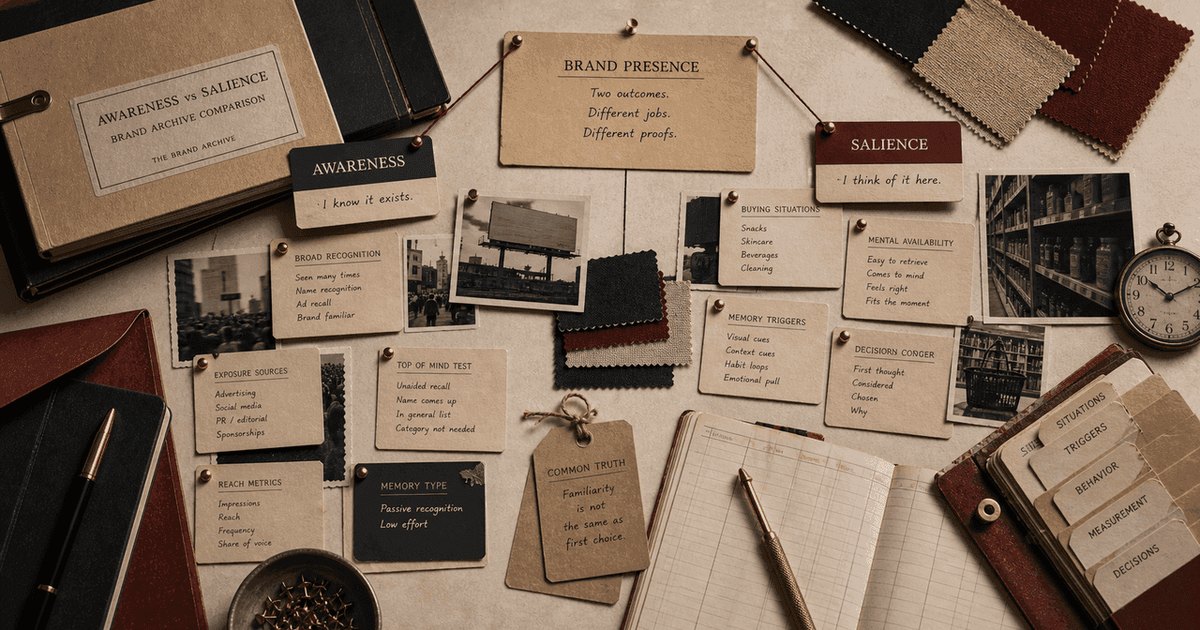
Brand awareness means people can recognize or recall a brand. Brand salience means the brand comes to mind when the customer is about to act. Awareness is stored memory. Salience is memory connected to a situation: urgent delivery, quick food, a coffee stop, a gift, a repair, a refill, a commute, a workout, or a risk that needs lowering.
A buyer may know Sears, Blockbuster, Kodak, or BlackBerry and still never retrieve them for the current job.
That is the danger. Awareness can become museum memory. Salience has to live in the live buying route.
"Grow Your Brand defines brand awareness vs brand salience as the difference between knowing a brand exists and being able to retrieve it when a need, occasion, category, or comparison appears."
The distinction matters because a famous brand can still lose the next choice. Sears and Blockbuster stayed familiar while the route to buy moved away from them.
Salience is more demanding than familiarity. The brand has to be linked to category entry points, distinctive cues, availability, and repeated behavior.
For an operator, the question is not whether people have heard of the brand. The question is whether the brand appears before a competitor or substitute at the moment the customer needs the category.
The common mistake is celebrating reach, impressions, followers, recall, or name familiarity while ignoring the moment where choice happens.
A second mistake is measuring recall without a situation. A brand can be easy to name in a survey and absent when the buyer is hungry, late, uncertain, traveling, replacing something, or comparing options.
A third mistake is treating salience as a media problem. Media can build memory, but the memory still needs a cue, occasion, proof, route to buy, and reason to return.
Most pages define awareness and salience as a funnel distinction. This page shows the harder issue: known brands still fail when they are not retrieved at the moment of need.
Many pages define awareness and salience. The better test is whether the brand appears when the need appears, in the place where the customer can act.
| Question | Brand awareness | Brand salience |
|---|---|---|
| What does it measure? | Whether people know or recognize the brand. | Whether people retrieve the brand in a buying or use moment. |
| Main evidence | Recognition, prompted recall, unaided recall, search interest, social familiarity. | Category entry points, choice moments, habit loops, shelf or app retrieval, route to buy. |
| What can go wrong? | The brand is famous but no longer chosen. | The brand is retrieved for too few occasions or cannot be bought when retrieved. |
| Strong question | Do people know us? | When do people need the category, and do we appear there first? |
| Archive warning | Sears and Blockbuster stayed known after behavior moved. | FedEx and McDonald's attach cues to clear occasions. |
| Best action | Increase recognition and memory structure. | Attach distinctive cues to real need moments, then make the route to buy obvious. |
The proof matrix shows the case, what happened, what it proves about the concept, and what an operator should learn.
| Case | What happened | GYB interpretation | Practical check |
|---|---|---|---|
| Sears Failure / 1886-2018 / remnant brand | Sears remained known while the shopping route moved away from catalogs and department stores. | Awareness did not create choice once the use occasion changed. | Track the buying route and name recognition together. |
| Blockbuster Failure / 1985-2014 | Blockbuster kept warm memory while entertainment habits moved to streaming. | People could remember the brand without needing it. | Ask whether memory still appears at the current category entry point. |
| FedEx Trust / 1973-presentFedEx | FedEx retrieves under urgent delivery pressure because the promise is tied to time. | Salience is specific: the brand appears when the need is deadline certainty. | Map the need state that should call the brand up. |
| Target Launch / 1962-presentTarget | Target's bullseye makes retail recognition usable from the road, app, bag, or ad. | A cue turns awareness into fast retrieval. | Give awareness a working visual shortcut. |
| DHL Trust / 1969-presentDHL | DHL's moving color system keeps the brand visible in logistics contexts. | Salience increases when the service cue appears during the category behavior. | Place cues inside the operation customers see. |
| McDonald's Launch / 1948-presentMcDonald's | McDonald's connects arches and routine to fast food occasions people repeat often. | Salience comes from a known situation, not broad fame alone. | Own a recurring occasion before chasing more awareness. |
| Amazon Prime Brand System / 1994-present | Amazon Prime turns fast delivery expectation into a shortcut for online buying. | Awareness becomes salience when the brand answers a concrete need faster than alternatives. | Build retrieval around the promise that changes choice. |
| Starbucks Rebrand / 2011 | Starbucks ties the siren to coffee stops, cups, stores, and routine breaks. | The brand is salient because the cue sits inside a repeated occasion. | Make the cue appear where the need starts. |
| Duolingo Launch / 2012-presentDuolingo | Duolingo uses streaks and reminders to make return behavior hard to forget. | The brand manufactures salience through habit pressure. | Use product mechanics to create retrieval before adding media exposure. |
The useful pattern is the decision mechanism. Brand names are evidence, not the organizing principle.
| Pattern | What it means | Cases to inspect |
|---|---|---|
| Category entry point | The brand appears in memory at the moment a need begins. | McDonald's, FedEx, Amazon Prime |
| Retrieval cue | A sign, color, mascot, or service behavior makes recall fast. | Target, DHL, Duolingo, Starbucks |
| Behavioral availability | The brand is easy to choose because the route to use is clear. | FedEx, Amazon Prime, McDonald's |
| Awareness without usefulness | People know the name but stop using it at the buying moment. | Blockbuster, Sears |
| Repeated context | The cue keeps appearing in the same decision context. | DHL, Target, Starbucks |
The practical test is whether the concept changes a real decision.
Use these questions before changing a cue, promise, channel, page, package, or proof point.
These mistakes are common because they sound reasonable inside the company and fail when customers meet the brand.
Fame can persist after the habit has moved, as Sears and Blockbuster show.
Ask whether the brand appears inside real buying and use moments.
A cue becomes more useful when it is tied to a category entry point.
A remembered brand still loses when the route to buy is missing or inconvenient.
Reach is exposure. Salience needs retrieval at a need moment.
A brand can be salient for one use and absent for others. Map the occasions before expanding spend.
If people smile at the brand but choose another route, awareness has become a lagging indicator.
This page is most useful when the decision depends on proof, memory, risk, behavior, or market consequence.
Use the checklist as a pressure test. If the answer is vague, the brand decision is not ready.
Use the page to decide what must be protected before money moves: the name, cue, promise, proof, channel, page, package, or customer habit.
The useful output is not a prettier opinion. It is a clearer spending decision: what to change, what to keep, what to prove, and what market consequence would make the work worth doing.
Brand awareness means people know or recognize the brand.
Brand salience means the brand is retrieved when the customer has a need or buying situation.
Both matter, but awareness that does not affect the buying moment can become inert memory.
Yes. Sears and Blockbuster remained familiar after the main buying route moved away from them.
Map the need moments, attach distinctive cues to those moments, make the route to buy easy, and repeat the proof until retrieval becomes natural.
A category entry point is a situation that starts category demand, such as urgent delivery, quick food, a coffee break, a gift, a repair, or a refill.