Direct Answer
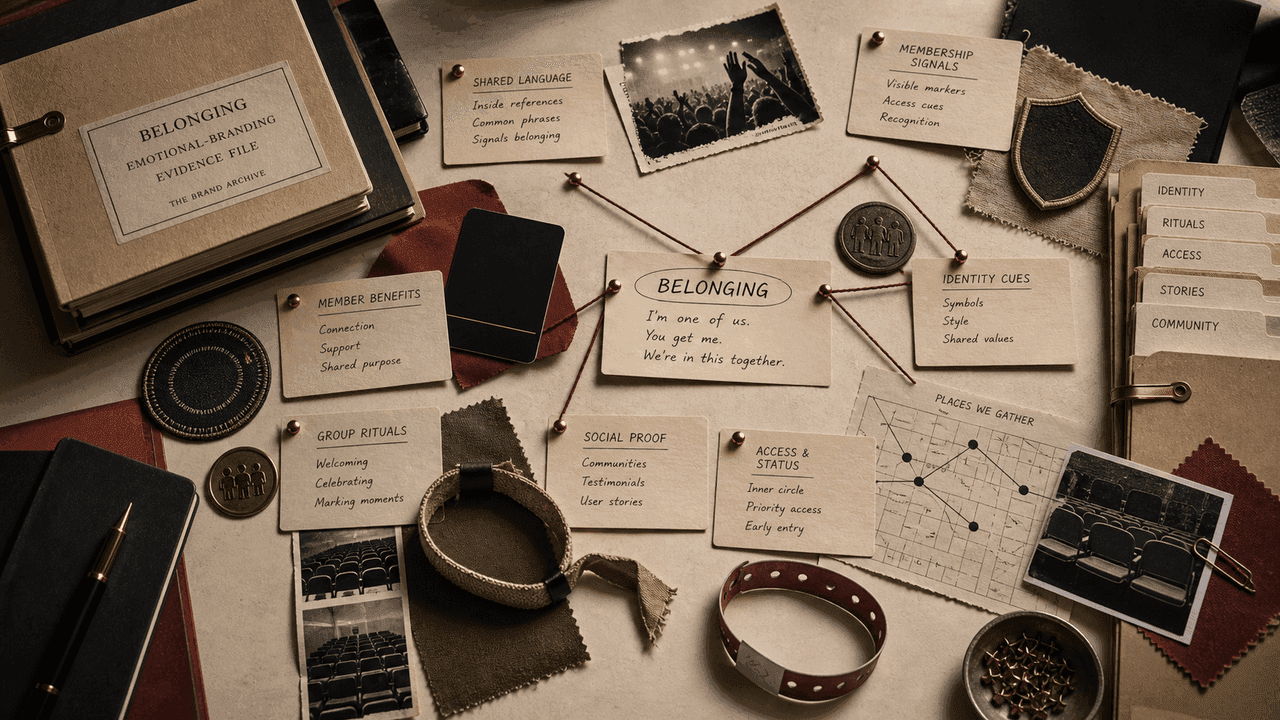
Belonging branding works when people know what they are joining and read safe enough to join it. The proof can be a place, ritual, symbol, shared language, or repeated behavior.
Reader payoff
By the end of this page, you should be able to
- Spot the difference between audience and belonging.
- Find the action or ritual people are joining.
- check whether trust is strong enough for participation.
Answer Map
Start with the decision, then check the proof.
Quote-ready definition
Grow Your Brand definition
"Grow Your Brand defines belonging in emotional branding as the reading that a brand gives people a recognizable group, ritual, place, language, or behavior they can join without extra explanation."
Commercial meaning
Why This Matters Commercially
Belonging is powerful because people use brands to locate themselves.
It becomes fragile when the service, platform, or product makes the group read risky.
Mistake to catch
What Brands Usually Get Wrong
The mistake is calling any audience a community.
A real belonging system has a shared action people can repeat without needing the brand to explain it every time.
Competitive gap
What most pages miss
Most belonging pages say community.
This page asks what people actually join: a place, ritual, symbol, shared language, or repeated behavior.
Comparison
Belonging carriers
Belonging becomes durable when the carrier appears in use.
| Carrier | What it makes visible | Archive cases |
|---|---|---|
| Place | A setting people can imagine joining. | Airbnb, Starbucks, Disney |
| Symbol | A mark that signals membership fast. | Nike, Patagonia, LEGO |
| Ritual | A repeat behavior that creates return. | Peloton, Discord, McDonald's |
| Shared language | Words the group uses without explanation. | Discord, Airbnb, LEGO |
| Operating proof | Trust that makes belonging safe enough to use. | Airbnb, Patagonia, Peloton |
Proof matrix
Brand Examples
Each case shows a different way people join a brand world.
| Case | What happened | What it proves | Operator lesson |
|---|---|---|---|
| Airbnb Rebrand / 2014 |
Airbnb turned travel into a belonging claim while the service still depended on host quality, guest safety, and dispute handling. | Belonging has to survive a real stay. The marketplace promise is emotional only if the trust layer works. | Do not use belonging language until the participation risk is visible and managed. |
| Nike Launch / 1971-present |
Nike gives runners, athletes, and casual customers the same performance cue to wear and recognize. | The Swoosh lets people join an effort-based identity without needing a formal club. | Make belonging visible through a cue people can use in the activity. |
| Patagonia Pivot / 2011-2022 |
Patagonia makes belonging read tied to restraint, repair, and environmental choices rather than logo display alone. | The group signal is credible because the company asks buyers to share a standard, more than a style. | Belonging is stronger when membership has a visible ethic or behavior. |
| Disney Brand System / 1923-present |
Disney gives families shared characters, parks, music, merchandise, and repeat stories. | Belonging comes from a shared world that people can re-enter at different ages. | Give the group more than content. Give it rituals and places to return to. |
| LEGO Comeback / 2000s |
LEGO rebuilt around the brick system, fan communities, family building, and adult nostalgia. | Belonging is practical here: people join by building, modifying, collecting, and showing work. | Make the shared behavior obvious before calling it community. |
| Discord Brand System / 2015-present |
Discord made servers the unit of participation, with roles, channels, voice, and group norms inside the product. | Belonging is built into the interface. The product shows who belongs where and why. | Design the membership behavior into the product surface. |
| Peloton Brand System / 2012-present |
Peloton made home exercise social through instructors, live classes, leaderboards, and recurring class habits. | Belonging lowers isolation because the brand turns a private workout into a shared event. | Use belonging to reinforce the repeat behavior the product needs. |
| Starbucks Rebrand / 2011 |
Starbucks made belonging local and routine through stores, orders, names, cups, and the third-place idea. | The brand reads joinable because customers know how to participate without explanation. | Belonging gets easier when the ritual is simple and repeatable. |
Belonging is strongest when the customer can enter the system without translating it.
Pattern map
Group the examples by mechanism
The useful pattern is the decision mechanism. Brand names are evidence, not the organizing principle.
| Pattern | What it means | Cases to inspect |
|---|---|---|
| Shared place | People know where the brand world happens. | Airbnb, Starbucks, Disney |
| Shared symbol | A cue lets people signal membership quickly. | Nike, Patagonia, LEGO |
| Shared ritual | Repeat use turns participation into memory. | Peloton, Discord, McDonald's |
| Shared language | People can describe participation without a brand script. | Discord, Airbnb, LEGO |
| Trust to join | Belonging is safe enough to use because proof is visible. | Airbnb, Patagonia |
Decision framework
How to use it
The practical test is whether the concept changes a real decision.
- Name the group Who is meant to read recognized?
- Name the ritual What action makes belonging visible?
- Name the symbol Which cue lets people recognize the group quickly?
- Name the trust requirement What proof makes the behavior safe enough to join?
- Name the exclusion risk What would make the belonging signal read fake or closed?
Questions to consider
Questions to apply before the decision
Use these questions before changing a cue, promise, channel, page, package, or proof point.
- What reading should the customer retrieve before reading the full message?
- What cue, ritual, service moment, or product behavior earns that reading?
- What proof stops the emotion from becoming campaign tone?
- What decision does the reading help with: trust, belonging, status, habit, care, or recall?
- What contradiction would turn the reading into a negative memory?
- Where does the customer meet the reading after the ad is gone?
Common mistakes
Mistakes to avoid
These mistakes are common because they sound reasonable inside the company and fail when customers meet the brand.
Using community as decoration
A community claim needs a repeat behavior people can see.
Skipping trust
Airbnb shows belonging fails if use risk is not handled.
Mistaking audience for membership
A large audience is not the same as a joined behavior.
Over-polishing the symbol
The symbol must stay usable in the places the group appears.
Use this page when
When this concept is the right lens
This page is most useful when the decision depends on proof, memory, risk, behavior, or market consequence.
- A brand wants community but has not named the shared behavior.
- A marketplace or platform needs people to read safe enough to participate.
- A symbol is supposed to signal identity or membership.
Operator test
What to check before spending money
Use the checklist as a pressure test. If the answer is vague, the brand decision is not ready.
- Name the shared behavior.
- Name the visible cue.
- Name the place or surface where belonging appears.
- Name the trust proof.
- check whether the claim still works after a service failure.
Commercial use
What Another Brand Can Use
Use the page to decide what must be protected before money moves: the name, cue, promise, proof, channel, page, package, or customer habit.
The useful output is not a prettier opinion. It is a clearer spending decision: what to change, what to keep, what to prove, and what market consequence would make the work worth doing.
For private branding work, use the protected contact page.
Related Files
Keep the answer inside Grow Your Brand.
Emotional Branding and Belonging FAQ
How do brands create belonging?
They repeat a group behavior, symbol, place, or ritual until people can recognize participation without extra explanation.
What are belonging brand examples?
Airbnb, Nike, Patagonia, Disney, LEGO, Discord, Peloton, and Starbucks show different belonging mechanics.
Can belonging backfire?
Yes. It backfires when the behavior is unsafe, performative, exclusionary, or unsupported by product proof.