Grow Your Brand Brand lesson · Branding for Ecommerce 2026-07-18
Grow Your Brand Plain brand guides for clearer words, stronger proof, and cleaner decisions.

Branding guide · evidence and decision

Branding for Ecommerce

Ecommerce branding reduces online buying risk through trust, packaging, checkout, returns, reviews, service, and repeat memory.
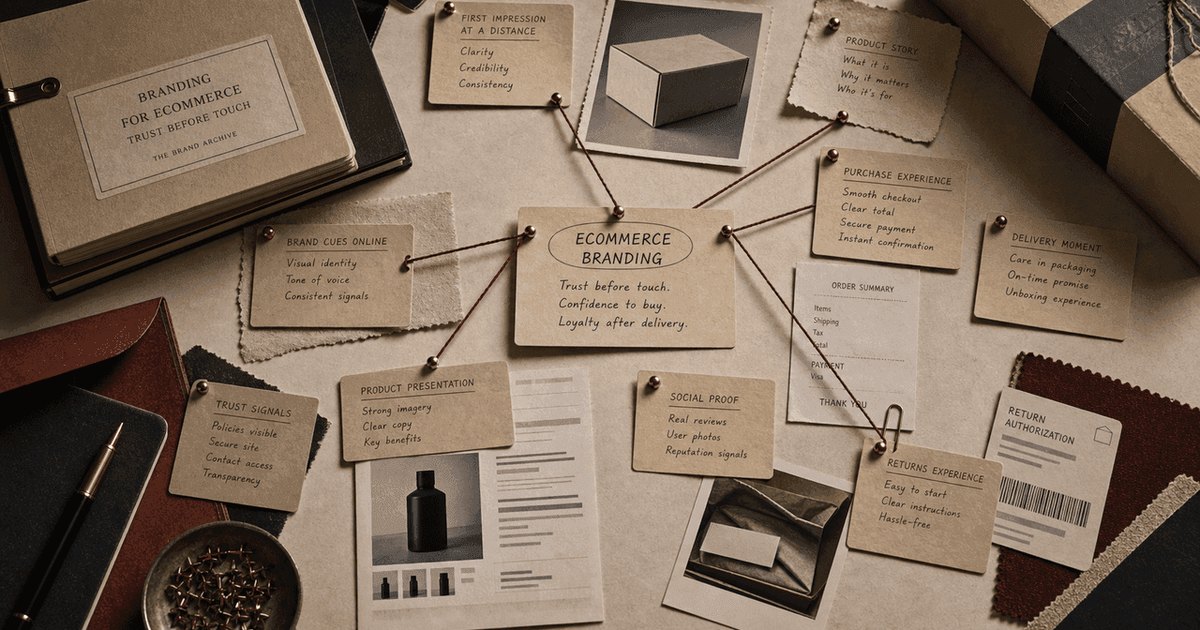
Direct Answer Ecommerce branding is the proof system that helps a buyer trust a product before touching it. It lives in product pages, checkout, marketplace context, delivery, packaging, returns, support, and the memory that survives after the tab closes.
By the end of this page, you should be able to Find the risk point blocking purchase.
Trust before touch. The product page, checkout, package, and return path have to do the work the hand cannot do online.
Branding for Ecommerce: Trust, Examples, and Decision Framework | Grow Your Brand visual

Branding For Ecommerce

decision · proof · use

A practical brand lesson built around the evidence, the decision, and what to check next.
01

Direct Answer

Direct Answer Ecommerce branding is the proof system that helps a buyer trust a product before touching it. It lives in product pages, checkout, marketplace context, delivery, packaging, returns, support, and the memory that survives after the tab closes.
02

By the end of this page, you should be able to

Point 1

Find the risk point blocking purchase.

Point 2

Use product pages, checkout, marketplaces, packaging, and returns as proof surfaces.

Point 3

Choose the ecommerce case that matches the buyer anxiety.

03

Trust before touch.

Trust before touch. The product page, checkout, package, and return path have to do the work the hand cannot do online.
04

Start with the decision, then check the proof.

Start with the decision, then check the proof. Ecommerce branding is the proof system that helps a buyer trust a product before touching it. It lives in product pages, checkout, marketplace context, delivery, packaging, returns, support, and the memory that.
Evidence 2 Find the risk point blocking purchase.
Evidence 3 the system of cues, proof, checkout trust, product presentation, packaging, service, reviews, delivery, returns, and repeat behavior that helps customers choose online
Evidence 4 The online buyer cannot hold the product first. That makes proof, recovery, delivery, fit, and payment confidence part of the brand.
Evidence 5 The mistake is treating ecommerce branding as store polish. The real work starts where the buyer sees risk: product page, cart, payment, delivery, returns, and support.
Evidence 6 Most ecommerce branding advice starts with surface polish. The real problem starts earlier: can the buyer trust the product before touching it?
Evidence 7 Competitor ecommerce guides focus on store creation. the guide view is wider: every risk and handoff teaches the brand.
Evidence 8 Named ecommerce cases showing where trust is proved before the product is in hand.
Evidence 9 Find the risk: What makes the buyer hesitate: fit, fraud, quality, shipping, privacy, return cost, or support?
Evidence 10 Treating branding as homepage design: The buyer often meets the brand on product pages, marketplace listings, checkout, email, packaging, and returns.
Evidence 11 Name the buyer's biggest online risk.
Point 1

Where ecommerce brands are read

05

Grow Your Brand definition

Grow Your Brand definition "Grow Your Brand defines ecommerce branding as the system of cues, proof, checkout trust, product presentation, packaging, service, reviews, delivery, returns, and repeat behavior that helps customers choose online."
Point 1

"Grow Your Brand defines ecommerce branding as the system of cues, proof, checkout trust, product presentation, packaging, service, reviews, delivery, returns, and repeat behavior that helps customers choose online."

06

Why This Matters Commercially

Why This Matters Commercially The online buyer cannot hold the product first.
Evidence 2 That makes proof, recovery, delivery, fit, and payment confidence part of the brand.
07

What Brands Usually Get Wrong

What Brands Usually Get Wrong The mistake is treating ecommerce branding as store polish.
Evidence 2 The real work starts where the buyer sees risk: product page, cart, payment, delivery, returns, and support.
08

What most pages miss

What most pages miss Most ecommerce branding advice starts with surface polish.
Evidence 2 The real problem starts earlier: can the buyer trust the product before touching it?
09

Where ecommerce brands are read

Where ecommerce brands are read Competitor ecommerce guides focus on store creation. the guide view is wider: every risk and handoff teaches the brand.
Point 1

Make the offer inspectable before purchase.

Point 2

Shopify merchants, Oatly, Liquid Death

Point 3

Lower money and trust risk.

Point 4

Amazon, Shopify, Klarna, Afterpay

Point 5

Reviews and marketplace signals

Point 6

Make stranger trust legible.

Point 7

Turn distance into confidence.

Point 8

Amazon Prime, Zappos, Coupang

Point 9

Carry memory after the click.

Point 10

Liquid Death, Oatly, Tiffany

10

Brand Examples

Brand Examples These cases show the places ecommerce brands prove trust before the product is in hand.
Evidence 2 The stronger ecommerce brand names the risk, puts proof beside it, and keeps the recovery path visible.
Point 1

Shopify Launch / 2006-present

Point 2

Shopify gives merchants storefront, checkout, apps, payments, and sales channels as one commerce system.

Point 3

Ecommerce branding can be infrastructure: the brand helps sellers look credible and operate consistently.

Point 4

Brand the tools that shape the customer's buying experience.

Point 5

Amazon Prime Brand System / 1994-present

Point 6

Amazon Prime turns delivery, returns, membership, and availability into predictable buying signals before checkout.

Point 7

Trust before touch comes from expected fulfillment behavior.

Point 8

Make delivery and recovery part of the brand promise.

Point 9

Zappos Trust / 1999-present

Point 10

Zappos reduced online shoe anxiety through returns, service, shipping, and human support.

Point 11

The ecommerce brand is strongest at the regret point.

Point 12

Show the rescue path before the buyer commits.

Point 13

eBay Trust / 1997-present

Point 14

eBay made unknown sellers more legible through feedback, reputation, and buyer protection.

Point 15

Marketplace branding depends on trust signals between strangers.

Point 16

Make seller credibility visible where comparison happens.

Point 17

Etsy Trust / 2005-present

Point 18

Etsy has to balance handmade individuality with marketplace rules, seller identity, and buyer confidence.

Point 19

The brand carries trust by making small sellers easier to find and easier to hold accountable.

Point 20

Do not let marketplace charm replace protection and clarity.

Point 21

Coupang Brand System / 2010-present

Point 22

Coupang turned fast local delivery into a repeated commerce memory.

Point 23

Speed can become ecommerce branding when it changes what buyers expect.

Point 24

Let fulfillment behavior teach the brand.

Point 25

Flipkart Brand System / 2007-present

Point 26

Flipkart's marketplace trust depends on local payment, delivery, seller, and service proof.

Point 27

Ecommerce branding is local when trust barriers are local.

Point 28

Put proof next to the risks buyers already know.

Point 29

Liquid Death Launch / 2019

Point 30

Liquid Death's can, voice, and entertainment cues make water recognizable in feeds, shelves, and unboxing moments.

Point 31

Ecommerce memory improves when the product is visually and socially shareable.

Point 32

Design the package and voice for browsing, delivery, and social proof.

11

Group the examples by mechanism

Group the examples by mechanism The useful pattern is the decision mechanism. Brand names are evidence, not the organizing principle.
Point 1

The page has to make value, fit, use, and risk legible before touch.

Point 2

Shopify, Amazon, Sephora, Nespresso, Nike

Point 3

Payment, fulfillment, and recovery signals lower purchase anxiety.

Point 4

Stripe, Amazon Prime, eBay, Zappos, American Express

Point 5

The box, wrapper, carton, or capsule carries recognition after the click.

Point 6

Tropicana, Liquid Death, Oatly, Tiffany, Nespresso

Point 7

The buyer believes the brand before buying because recovery looks real.

Point 8

Zappos, Amazon Prime, Costco, eBay

Point 9

Marketplace versus owned route

Point 10

The brand either borrows platform trust or earns direct memory through its own store.

Point 11

Shopify, Amazon, eBay, Etsy, Walmart

Point 12

Membership, replenishment, loyalty, service, or owned retail turns the first order into memory.

Point 13

Costco, Nespresso, Sephora, Apple, Zappos

12

How to use it

How to use it The practical test is whether the concept changes a real decision.
Point 1

Find the risk What makes the buyer hesitate: fit, fraud, quality, shipping, privacy, return cost, or support?

Point 2

Put proof on the surface Show reviews, specs, photos, source trails, guarantees, delivery clarity, and return paths where risk appears.

Point 3

Make cues portable Use packaging, color, product naming, email, and support language so memory survives outside the site.

Point 4

Make the handoff branded Delivery, tracking, unboxing, returns, and service should reinforce the same expectation.

Point 5

Measure repeat behavior A strong ecommerce brand earns return visits, direct search, repeat purchase, reviews, and word of mouth.

13

Questions to apply before the decision

Questions to apply before the decision Use these questions before changing a cue, promise, channel, page, package, or proof point.
Point 1

What risk does the buyer see before touching the product?

Point 2

What proof belongs on the product page, checkout, package, or return path?

Point 3

Which cue survives marketplace comparison and thumbnail browsing?

Point 4

What service or recovery behavior makes the promise believable?

Point 5

What memory should the package or delivery create after purchase?

Point 6

What would make the store look polished while still leaving the buyer exposed?

14

Mistakes to avoid

Mistakes to avoid These mistakes are common because they sound reasonable inside the company and fail when customers meet the brand.
Evidence 2 The buyer often meets the brand on product pages, marketplace listings, checkout, email, packaging, and returns.
Evidence 3 Proof belongs beside the risk, not buried in footer policy pages.
Evidence 4 A store can function and still be forgettable if no cue or proof repeats.
Evidence 5 Delivery, support, returns, and packaging decide whether the brand becomes trusted.
Point 1

Treating branding as homepage design

Point 2

Copying platform templates without a memory cue

Point 3

Ignoring the post-purchase brand

15

When this concept is the right lens

When this concept is the right lens This page is most useful when the decision depends on proof, memory, risk, behavior, or market consequence.
Point 1

A store looks polished but buyers hesitate before checkout.

Point 2

A brand sells through marketplaces and owned channels at the same time.

Point 3

Product pages need to carry proof, fit, service, and memory.

Point 4

Packaging, returns, or support are doing more brand work than the homepage.

16

What to check before spending money

What to check before spending money Use the checklist as a pressure test. If the answer is vague, the brand decision is not ready.
Point 1

Name the buyer's biggest online risk.

Point 2

Put proof beside the risk point.

Point 3

Make the product easy to understand without touching it.

Point 4

Use packaging and service as memory surfaces.

Point 5

check whether the brand can be recognized in search, marketplace, inbox, box, and support.

17

What Another Brand Can Use

What Another Brand Can Use Use the page to decide what must be protected before money moves: the name, cue, promise, proof, channel, page, package, or customer habit.
Evidence 2 The useful output is not a prettier opinion. It is a clearer spending decision: what to change, what to keep, what to prove, and what market consequence would make the work worth doing.
18

Sources used to check the page claims.

Sources used to check the page claims. Source trail for checkout risk, abandonment, and the need to make money, delivery, and recovery signals clear.
Evidence 2 Source trail for visible ecommerce trust signals near the buying decision.
Evidence 3 Case source for delivery expectation, membership memory, and repeat purchase confidence.
Evidence 4 Case source for return-path trust in a category where fit risk can stop the order.
Evidence 5 Case source for marketplace trust when buyers transact with unknown sellers.
Evidence 6 Case source for marketplace rules, seller accountability, and handmade-commerce trust.
Point 1

Baymard Institute ecommerce checkout research Source trail for checkout risk, abandonment, and the need to make money, delivery, and recovery signals clear.

Point 2

Shopify trust badges and checkout trust Source trail for visible ecommerce trust signals near the buying decision.

Point 3

Amazon Prime delivery benefits Case source for delivery expectation, membership memory, and repeat purchase confidence.

Point 4

Zappos returns and customer service Case source for return-path trust in a category where fit risk can stop the order.

Point 5

eBay seller ratings Case source for marketplace trust when buyers transact with unknown sellers.

Point 6

Etsy seller policy Case source for marketplace rules, seller accountability, and handmade-commerce trust.

19

Keep the answer inside the guide.

Point 1

Recognition Assets Guide

Point 2

Ecommerce Checkout Trust

Point 3

Returns and Trust in Ecommerce Branding

Point 4

Marketplace vs Owned Store Branding

Point 5

Operations Can Become the Brand

Point 6

Trust Is Built as a System

20

Branding for Ecommerce FAQ

Branding for Ecommerce FAQ Ecommerce branding is the trust and memory system around product pages, checkout, reviews, packaging, delivery, returns, service, and repeat buying.
Evidence 2 Online buyers cannot touch the product first, so branding has to lower risk and make the choice easier.
Evidence 3 Shopify, Amazon Prime, Zappos, eBay, Etsy, Coupang, Flipkart, Liquid Death, and Oatly show different ecommerce branding mechanics.
Evidence 4 They show proof at the risk point: product evidence, reviews, delivery clarity, return paths, support behavior, and consistent post-purchase cues.
Point 1

What is ecommerce branding?

Point 2

Why is branding important for ecommerce?

Point 3

What are ecommerce branding examples?

Point 4

How do ecommerce brands build trust?

21