Brand Entity / why did Nokia fail
Nokia: why its smartphone platform failed
Nokia is filed as a platform-transition brand: the phone memory stayed powerful while the smartphone ecosystem, developer market, and platform decision chain moved away from Nokia's control.
Short Answer
Nokia is filed here for one job: why did Nokia fail. The Nokia file proves that a company can survive while its most famous public category role fails.
Reader Task
What this brand entry should help you finish
Use this file to answer the Nokia brand question without falling into a company-history summary. The task is to understand the main why did Nokia fail pattern, check the sourced facts, open the primary case (Nokia and the Smartphone Platform Collapse That Did Not Kill the Company), and leave with a lesson or risk that can be compared against another brand. The file has 2 filed cases, so the next step should be clear before the reader leaves.
Fact Panel
Nokia facts
Only sourced facts render here. Unsourced company-history rows stay out of the page.
- Founded
- 1865 Source
- Founders
- Fredrik Idestam Source
- Parent / ownership
- Nokia Corporation (public company) Source
- Category
- Telecommunications networks, technology, patents, and formerly mobile devices Source
- Home market
- Espoo, Finland Source
- Distinctive assets
- Durable mobile-phone memory, Symbian-to-Windows Phone platform decision chain, Networks and infrastructure survival path
- Status
- Active company / failed smartphone platform position Source
- Decisions on file
- 2 filed cases
What Nokia teaches
The useful brand entry does not ask whether Nokia is famous. It asks what the filed decision record teaches that a reader can use on another brand.
- Main lesson: The Nokia file proves that a company can survive while its most famous public category role fails.
- Reader check: Inspect Symbian, MeeGo, the Windows Phone bet, the burning-platform memo, the 2013 devices sale, and the networks business that survived beyond phones.
- Failure mode: The risk is blaming one competitor while missing the platform, developer, software, and transition-timing problem underneath.
- Filed case: Nokia: A device brand loses strategic control when the category becomes a platform market and the company commits too late, too slowly, or to an ecosystem it cannot make default.
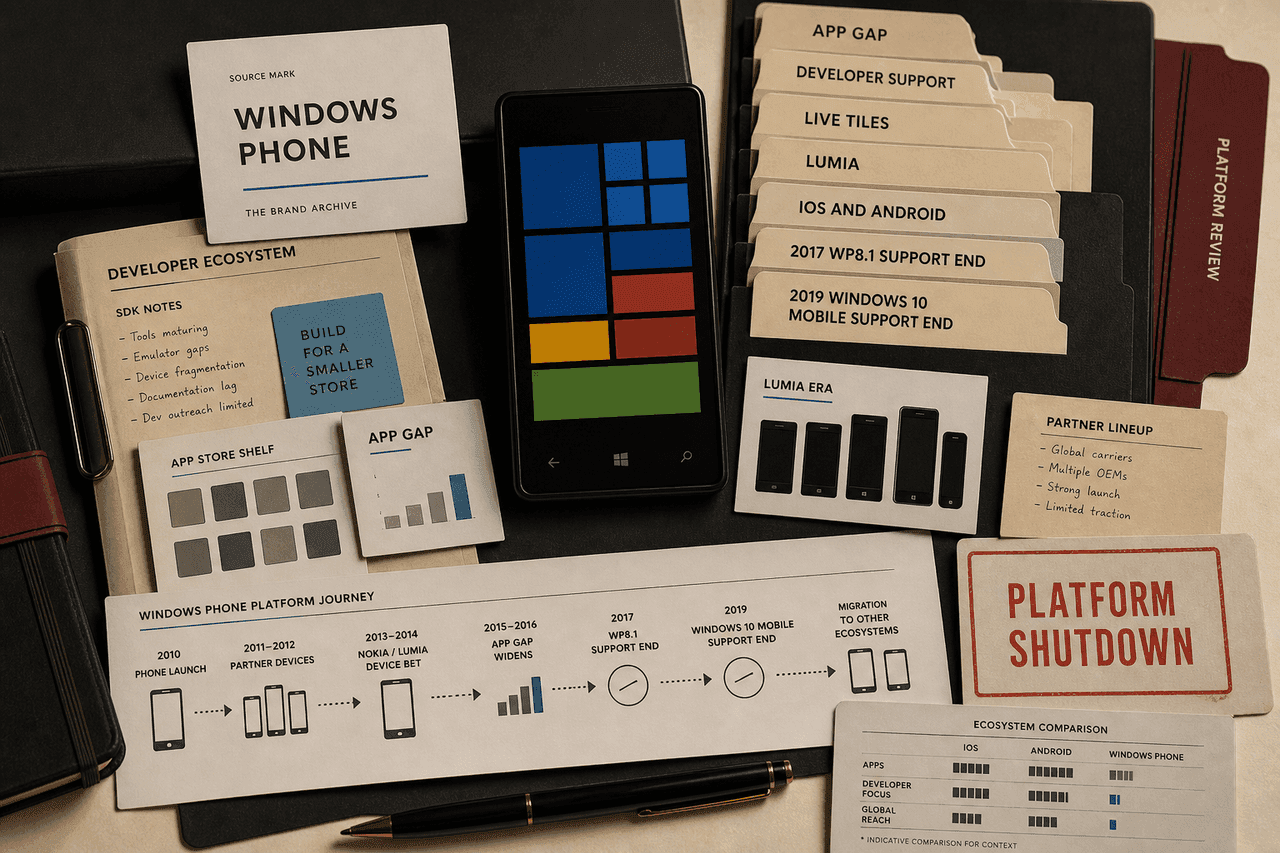
- Filed case: Windows Phone: Platform brands fail when design clarity does not become ecosystem gravity.
Mistake To Catch
Where the Nokia reading breaks
The risk is blaming one competitor while missing the platform, developer, software, and transition-timing problem underneath.
The weak read is to stop at the familiar name. The stronger read is to ask which decision changed recognition, trust, habit, distribution, product proof, or public memory.
That is the useful job of the brand entry: keep the famous name attached to a decision the reader can inspect.
Decision Depth
Read Nokia as a platform-transition failure, not a dead-company story.
This section turns the brand name into an inspection path: what changed, what broke, what worked, and what to compare next.
Nokia is useful because the company did not simply disappear. The famous phone role failed while other parts of the company continued. That distinction matters for any brand with a public category identity and a broader business underneath.
The smartphone problem was more than hardware. It was platform timing, software, developers, app availability, ecosystem choice, and the difficulty of moving public memory from durable phones into modern smartphones.
The inspection path is Symbian, MeeGo, the Windows Phone bet, app gaps, device sale, and the networks business that survived beyond the consumer phone story.
A weak reading blames one rival or one operating system. A stronger reading asks how platform control moved away from the brand.
Use this file before a company enters a platform shift. The approval test is whether product, software, developers, partners, and customer habit are moving together.
The copycat mistake is protecting hardware memory while the market has already moved to ecosystem memory.
Decision timeline
The timeline is the reason this brand has a parent page. Each row points to a filed case, then names the consequence a reader should carry into the next comparison.
For brands with one case, the timeline still matters because it prevents a thin profile. The brand page becomes the router, and the case page remains the proof.
| Filed decision | What happened | What it teaches |
|---|---|---|
| Nokia and the Smartphone Platform Collapse That Did Not Kill the Company Failure / 2007-2014 / networks survival |
Nokia did not simply get killed by the iPhone. The stronger lesson is that Nokia lost the smartphone platform transition while the company survived by shifting back toward networks, infrastructure, patents, and technology licensing. | A device brand loses strategic control when the category becomes a platform market and the company commits too late, too slowly, or to an ecosystem it cannot make default. |
| Windows Phone and the App Gap That Broke the Tile System Failure / 2010-2019 |
Windows Phone made a clean tile interface and a serious Lumia-era hardware bet, but the platform could not create enough app, developer, and user gravity against iOS and Android. | Platform brands fail when design clarity does not become ecosystem gravity. |
Source test
The source trail below is inherited from the filed cases, including company records, campaign records, public reports, source-mark files, or archived references where the original page moved.
Use the source list to verify the facts. Use the case links to inspect the decision. Use the comparison links to test whether the Nokia pattern repeats somewhere else.
Visual proof
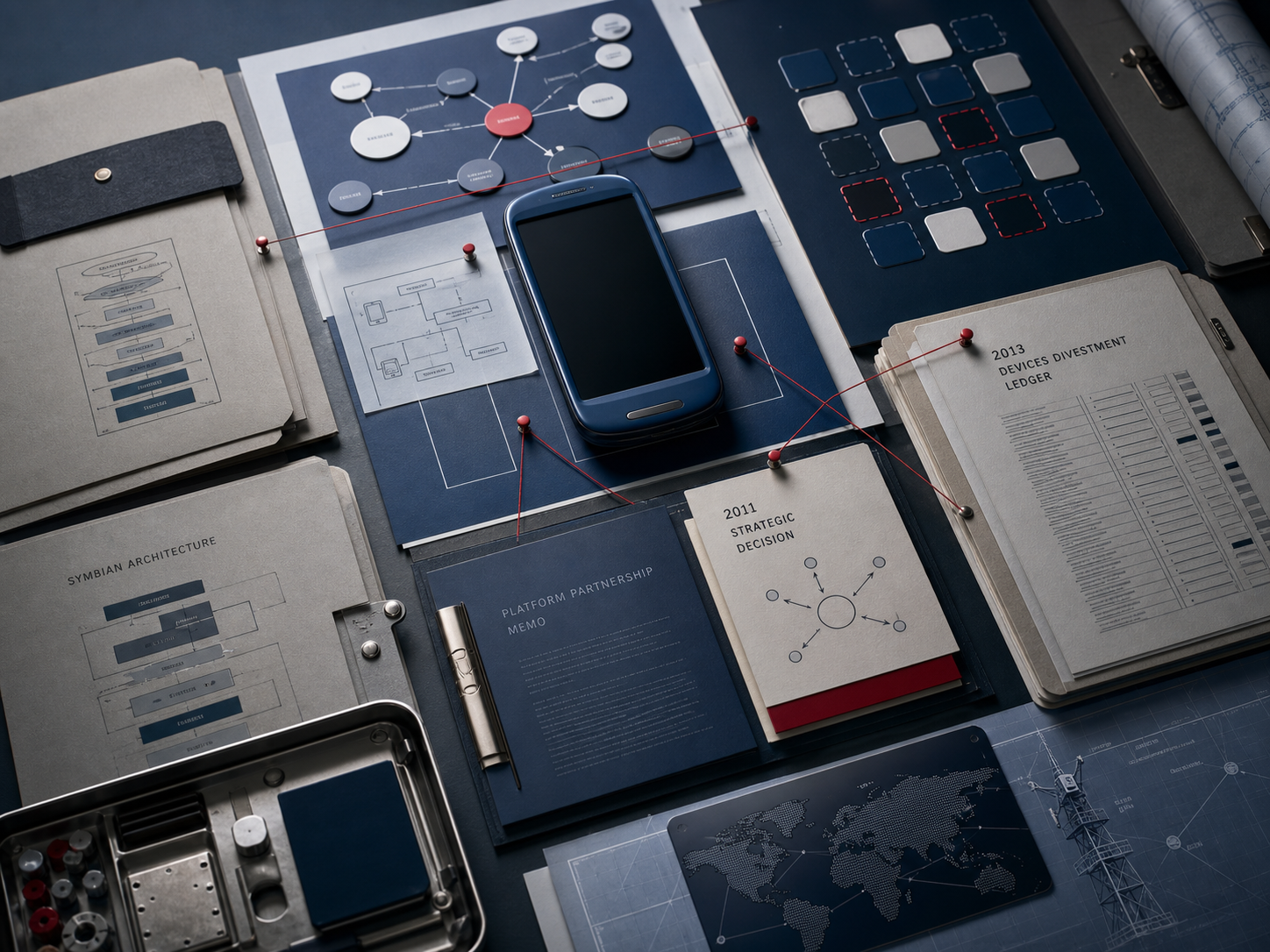
The hero image for this brand page uses the strongest generated editorial visual already attached to the primary case: Nokia and the Smartphone Platform Collapse That Did Not Kill the Company. It stays tied to filed evidence instead of becoming a generic brand mood image.
That visual rule matters for this build. Every brand page needs a high-end image, but the image has to point back to the decision: packaging, mark, product behavior, service proof, ritual, failure, or trust pressure.
If a future brand has no strong visual, it does not pass the entity-page gate until the image is generated or replaced.
Sources
- Nokia, company history
- Microsoft and Nokia, global mobile ecosystem partnership announcement, February 10, 2011
- Wired, Nokia standing on a burning platform, February 9, 2011
- Microsoft, Nokia Devices & Services acquisition announcement, September 3, 2013
- Microsoft, Nokia Devices & Services acquisition completion, April 25, 2014
- Microsoft Official Blog, Windows Phone 7 Series introduction, February 15, 2010
- Microsoft Official Blog, Windows Phone 7 launch availability recap, October 11, 2010
- Microsoft Lifecycle, Windows Phone 8.1 support ended July 11, 2017
- Microsoft Lifecycle, Windows 10 Mobile support ended December 10, 2019
- Editorial Windows Phone source-mark treatment

People Also Ask
What happened to Nokia, and what should readers inspect?
The Nokia file proves that a company can survive while its most famous public category role fails. Start by inspecting this point: Inspect Symbian, MeeGo, the Windows Phone bet, the burning-platform memo, the 2013 devices sale, and the networks business that survived beyond phones.
What does Nokia teach about branding?
The Nokia file proves that a company can survive while its most famous public category role fails.
What should readers inspect first in the Nokia file?
Inspect Symbian, MeeGo, the Windows Phone bet, the burning-platform memo, the 2013 devices sale, and the networks business that survived beyond phones.
What is the main risk in the Nokia file?
The risk is blaming one competitor while missing the platform, developer, software, and transition-timing problem underneath.
Which Nokia case should readers open first?
Start with Nokia and the Smartphone Platform Collapse That Did Not Kill the Company, because it is the primary filed case behind this brand file.