Failure / Smartphones / mobile commerce / 2014-2015
Amazon Fire Phone Failure Case: Smartphone Switching Cost
Amazon Fire Phone is the brand-extension failure case for testing whether parent-brand strength, shopping features, and hardware novelty can overcome smartphone ecosystem lock-in.

Short Answer
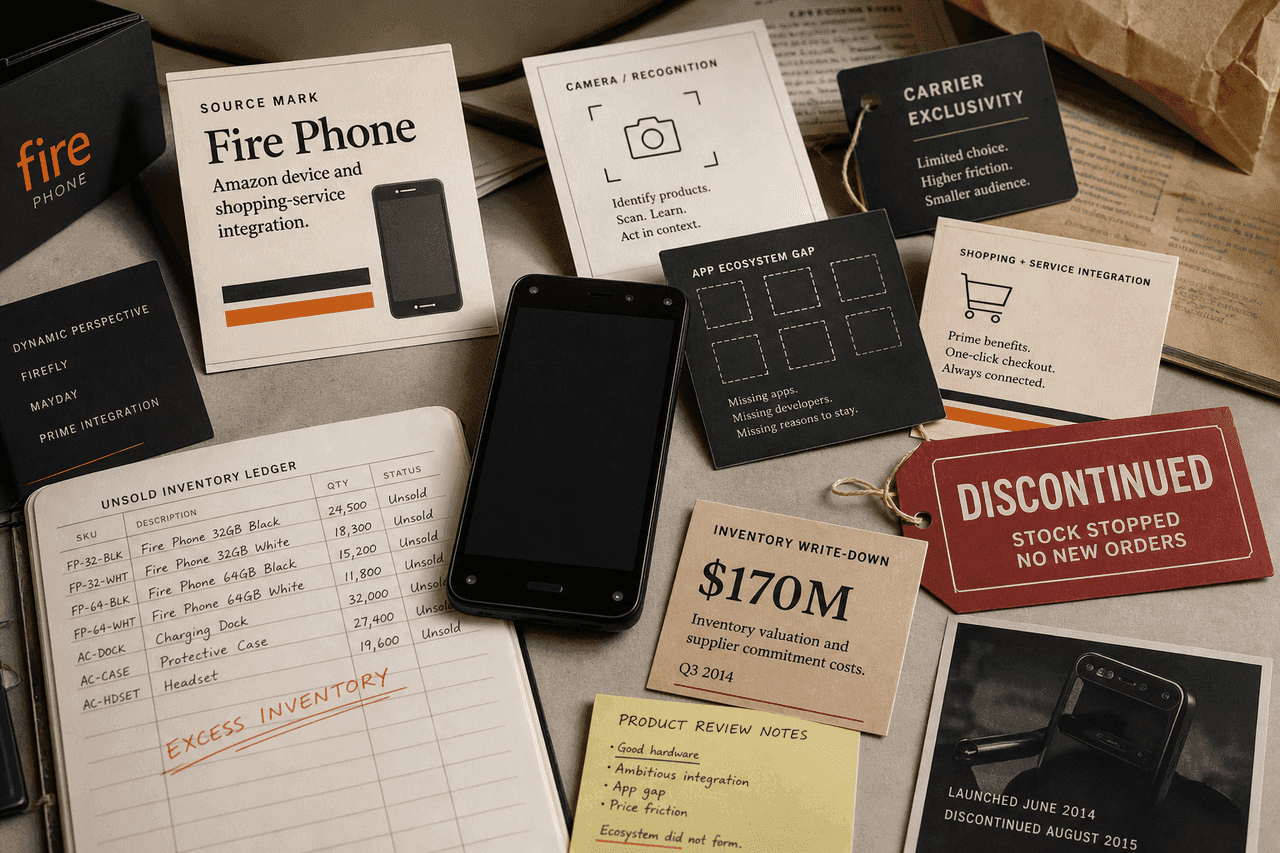
Amazon Fire Phone Failure Case: Smartphone Switching Cost is a failure case about Amazon Fire Phone in 2014-2015. Fire Phone failed because Amazon's commerce strength did not answer the smartphone buyer's switching test: apps, carrier path, daily interface, price, camera, and ecosystem trust. A powerful parent brand still has to win the category job. In smartphones, that means app gravity, developer support, carrier access, social proof, price logic, and daily-use superiority.
Brand Entity
Amazon Fire Phone has a parent brand file.
Amazon: brand decisions on file collects the filed cases, source trail, concept paths, and primary visual proof for this brand.
Reader Task
What this entry should help you finish
Use this entry to finish four jobs: answer what happened to Amazon Fire Phone, see why it belongs in the failure lane, inspect the decision consequence, and leave with the operator lesson. The point is not to remember the brand. The point is to know what decision, proof surface, or failure mode a team should check next. Then compare it with Amazon, Google Stadia, Quibi before turning the case into a rule.
What Amazon Fire Phone teaches
- Fire Phone was more than a device failure. It was an ecosystem-transfer failure.
- Amazon could make shopping, media, and services easier, but that did not make the phone easier to choose than iPhone or Android.
- Firefly and Dynamic Perspective gave the product novelty, but novelty did not beat app and carrier inertia.
- The weak copycat assumes parent-brand trust can pull customers into a daily-use category.
- The repair test is whether the extension wins the category's real switching cost before launch.
Why This Brand Belongs In Grow Your Brand
Amazon Fire Phone belongs in Grow Your Brand because the page studies a specific brand decision, not a company profile. The decision sits in failure and gives operators a way to see how service route changes commercial value.
The useful archive question is what changed in recognition, trust, demand, pricing power, category position, or public memory after the market saw the move.
The Brand Asset At Stake
The asset at stake is schedule reliability, route coverage, service recovery, loyalty behavior, and the handoff between promise and trip. That asset matters because it affects how people find, understand, choose, trust, or repeat the brand when the company is not in the room to explain itself.
For Amazon Fire Phone, the asset is not abstract equity. It has to show up in the buying surface, product surface, service route, source record, or repeated customer behavior.
What Changed
Fire Phone failed because Amazon's commerce strength did not answer the smartphone buyer's switching test: apps, carrier path, daily interface, price, camera, and ecosystem trust.
The change forced the market to decide whether the old shortcut still worked, whether the new proof was strong enough, and whether the brand had made the category easier or harder to understand.
What The Market Learned
The market learned to judge Amazon Fire Phone through the gap between the visible move and the proof behind it. describing national pride, premium service, or experience while skipping the operating proof behind the trip is the weak reading this page is meant to prevent.
A useful brand decision makes buying, remembering, trusting, or repeating easier. A weak decision makes the audience do more work before it believes the claim.
Commercial Consequence
The commercial consequence sits in service route: schedule reliability, route coverage, service recovery, loyalty behavior, and the handoff between promise and trip. When that proof becomes easier to see, customers have more reason to choose, trust, repeat, or pay attention. When it becomes harder to see, the brand has to spend more money explaining what the market used to understand faster.
Amazon Fire Phone matters because the decision changed more than presentation. It changed buyer confidence, memory, category position, or repeat behavior in smartphones / mobile commerce. That is why the case belongs in a brand decision library instead of a general company profile.
What Another Brand Should Learn
Another brand should use this case before spending money on a similar move. Name the customer behavior, the proof surface, the protected cue, and the consequence that would make the decision worth the cost.
If the same proof does not exist in the business, copying Amazon Fire Phone would copy the surface while missing the reason the decision mattered.
The Decision Context
Amazon launched Fire Phone from a position of enormous parent-brand strength. The company had commerce trust, Prime behavior, media assets, Kindle device memory, AWS infrastructure, and the ability to put a new product in front of millions of customers.
The smartphone category had a different test. Buyers were not choosing a shopping tool. They were choosing the device that carried their apps, photos, messages, accounts, work, payments, status, and daily interface.
Firefly Was Not Enough
Firefly gave the phone a clear Amazon idea: recognize products, media, and objects, then connect them to Amazon services. That made strategic sense inside Amazon's commerce universe.
The problem was priority. Smartphone buyers already had many ways to shop, search, scan, message, photograph, and browse. Firefly did not make the phone necessary enough to justify leaving a stronger ecosystem.
Dynamic Perspective Added Novelty, Not Gravity
Dynamic Perspective made the phone different, but difference is not the same as adoption. In a mature device category, novelty has to improve daily behavior or it becomes a demo feature.
The stronger question was whether the feature changed the everyday phone job. If it did not, it could not carry price, carrier, app, and social-proof friction.
The App Ecosystem Was The Brand Problem
Smartphone ecosystems are brand systems because users build their lives inside them. Apps, developer support, accessories, contacts, media, payments, and habits make the phone hard to replace.
Fire Phone asked Amazon's service strength to substitute for that ecosystem. The market answered with inventory and write-down pressure.
The Write-Down Made The Failure Concrete
Amazon's 2014 filing and public coverage made Fire Phone's failure visible through inventory valuation and supplier commitment costs. That matters because unsold hardware is direct market feedback.
The brand story did not move enough buyers at the offered price and category position. The failure became measurable, not merely aesthetic.
Where The Strategy Breaks
The strategy breaks when parent-brand power is mistaken for category permission. Customers may trust Amazon for shopping and logistics while still rejecting Amazon as their phone.
The second break is feature-first launch logic. A few memorable features cannot overcome daily ecosystem lock-in unless they change the entire choice equation.
The Bad Copycat
A bad copycat would say: we have customers, distribution, services, and trust, so our branded device will enter the category.
That skips the hard question. Does the extension beat the product system customers already use every hour? If not, the parent brand becomes a logo on the wrong job.
The Signal Reading
Fire Phone is filed here because it shows the limit of brand extension in a locked daily-use category.
The operator takeaway is to test switching cost before product romance. A strong parent cannot buy a category habit that the product does not earn.
The Decision Pressure
Fire Phone's pressure was the daily-use test. A customer does not switch phones because a parent company is powerful. They switch when the new device improves the set of jobs they repeat every day.
That set is larger than shopping. It includes messages, photos, maps, work apps, games, payments, accessories, family habits, carrier support, social proof, and the quiet confidence that the phone will still fit tomorrow's needs.
The page should teach that brand extension gets hardest when the target category already owns the customer's routine. Amazon had attention and service trust. Fire Phone still had to beat the phone systems people already lived inside.
Compare Next
Related Cases
Do not read Amazon Fire Phone alone. Compare it against nearby cases: Amazon, Google Stadia, Quibi; concept paths: Platform Brands Need Ecosystem Gravity, /branding-guide/platform-shutdowns/, Functional Brand Associations.
Sources
- Amazon, Fire Phone launch press release
- Amazon, Form 10-Q for quarter ended September 30 2014
- CNBC, Amazon takes 170 million dollar charge on Fire Phone
- The Guardian, Amazon Fire Phone discontinued
- The Verge, Amazon Fire Phone review archive
- Amazon Devices, Fire tablet family
- Editorial Fire Phone source-mark treatment
People Also Ask
What happened to Amazon Fire Phone?
Amazon Fire Phone Failure Case: Smartphone Switching Cost is a failure case about Amazon Fire Phone in 2014-2015. Fire Phone failed because Amazon's commerce strength did not answer the smartphone buyer's switching test: apps, carrier path, daily interface, price, camera, and ecosystem trust. A powerful parent brand still has to win the category job. In smartphones, that means app gravity, developer support, carrier access, social proof, price logic, and daily-use superiority.
Why is Amazon Fire Phone a failure case?
Amazon Fire Phone is filed as a failure case because the visible consequence sits in that decision pattern. Fire Phone failed because Amazon's commerce strength did not answer the smartphone buyer's switching test: apps, carrier path, daily interface, price, camera, and ecosystem trust.
What can brands learn from Amazon Fire Phone?
A powerful parent brand still has to win the category job. In smartphones, that means app gravity, developer support, carrier access, social proof, price logic, and daily-use superiority.
Is Amazon Fire Phone still operating?
Grow Your Brand marks Amazon Fire Phone as Product discontinued / parent active. That means the brand, company, platform, product system, or parent organization is still operating, continuing, or being actively resolved.
What should Amazon Fire Phone be compared with?
Compare Amazon Fire Phone with Amazon, Google Stadia, Quibi to see the same decision pattern from nearby cases.