Grow Your Brand Brand lesson · Platform and Product Shutdowns Guide 2026-07-27
Grow Your Brand Plain brand guides for clearer words, stronger proof, and cleaner decisions.

Branding guide · evidence and decision

Platform and Product Shutdowns Guide

A practical guide to failed products and platform shutdowns: launch heat, adoption, retention, ecosystem proof, switching reason.

Short Answer Read this section
Grow Your Brand definition Read this section
The first impression has more than one surface. Read this section
Platform and Product Shutdowns Guide archive visual

Platform Shutdowns

decision · proof · use

Editorial illustration for Platform and Product Shutdowns Guide.
Supporting proof surface for Platform and Product Shutdowns Guide.
Editorial illustration for Platform and Product Shutdowns Guide.
01

Short Answer

A shutdown is not always a failed brand. Sometimes the product never taught a habit. Sometimes the platform never formed an ecosystem. Sometimes the parent brand survives because the failed offer never became the core memory.

02

Grow Your Brand definition

"Grow Your Brand defines platform shutdown as the pattern where a product or platform fails because launch attention never becomes repeated use, retention, partner support, or ecosystem trust."

Case proof: Quibi , Google Stadia , Google Plus .

03

The first impression has more than one surface.

Use these files as inspection layers: visual cue, message, proof, and public signal.

04

Sources behind platform shutdown, retention, ecosystem, and page-quality checks.

  1. Google Search Central, helpful content self-assessment Used as the quality floor for direct answers, original value, evidence, and people-first page structure.Google Search Central, helpful content self-assessment
  2. Google Search Central, SEO starter guide Used for titles, crawlable links, route clarity, and page usefulness checks.Google Search Central, SEO starter guide
  3. Google Search Central, structured data introduction Used for machine-readable evidence, page entities, and source-route expectations.Google Search Central, structured data introduction
  4. Schema.org, FAQPage Used for visible FAQ and answer schema on decision-support pages.Schema.org, FAQPage
  5. W3C Web Content Accessibility Guidelines Used for readable sections, image alt text, contrast, and accessible inspection surfaces.W3C Web Content Accessibility Guidelines
  6. llms.txt proposal Used for plain-text retrieval surfaces and source routing for language-model readers.llms.txt proposal
05

A product launch becomes brand memory only after repeat use.

Many launches create attention. Fewer create a habit.

The brand question is not how loud the debut was. It is whether the product became a default behavior customers and partners kept repeating.

A failed product can damage a brand when it teaches the market to doubt the company's judgment, reliability, or category clarity. It can also disappear with limited damage when customers never attached it to the parent brand's core promise.

The problem reading should name the layer that broke. Was the offer unclear? Did retention fail? Did partners stay away? Did the economics require a scale the brand never earned? Those answers matter more than the shutdown headline.

These cases show products or systems breaking before a durable habit formed.

  • Google Stadia cloud gaming closed after weak traction
  • Quibi mobile video never formed the paid daily habit
  • Amazon Fire Phone smartphone extension failed the ecosystem test
  • Google Plus forced social adjacency did not become chosen use
  • Wii U the product frame was unclear at launch
  • Netflix the split created a customer-work problem
  • Snap AI utility met trust and use pressure
06

Read the path from launch to shutdown.

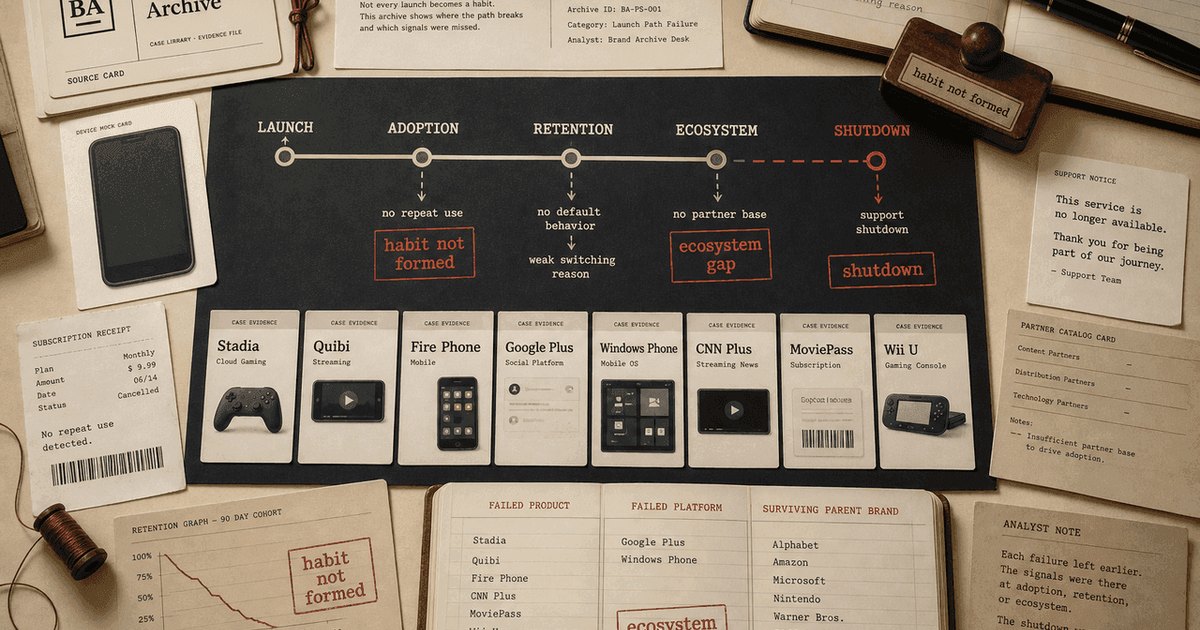
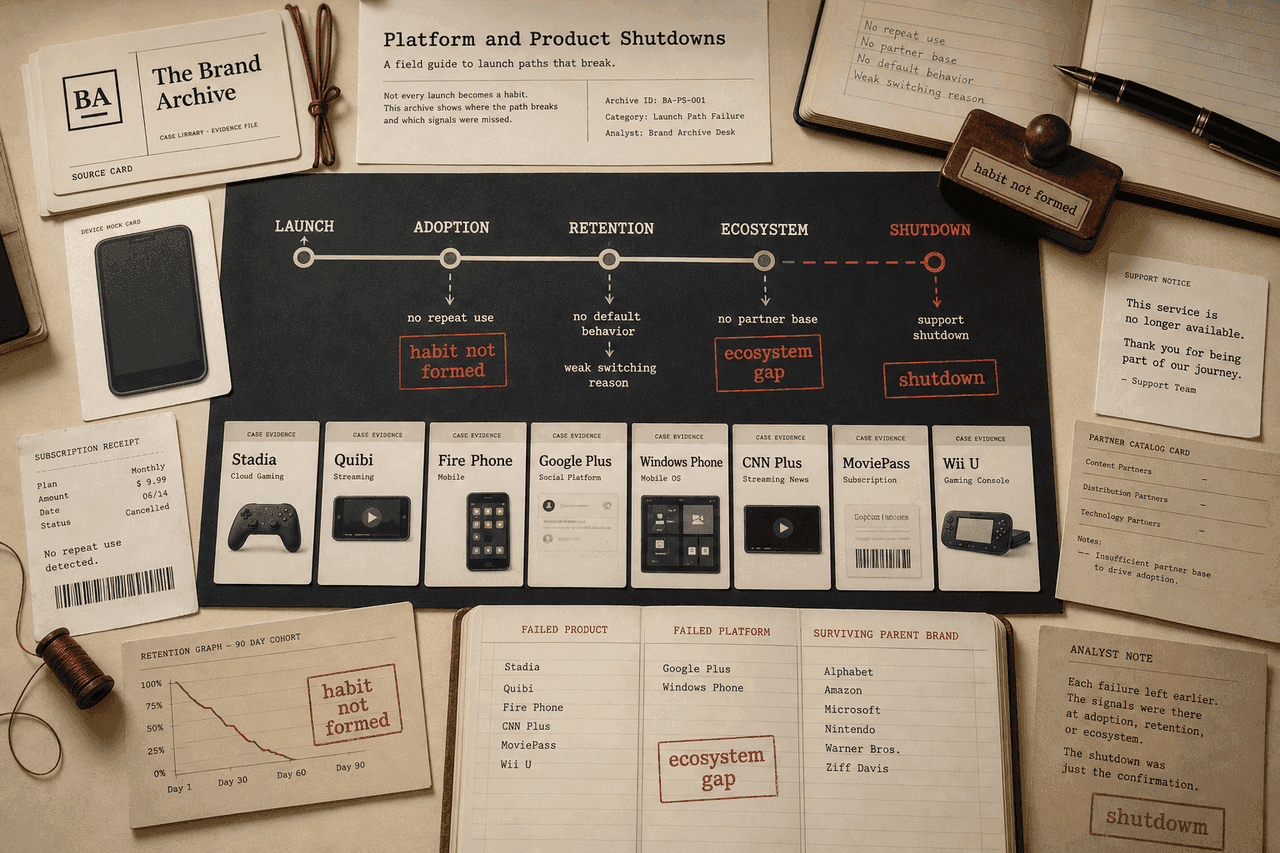
The path has stages: launch, adoption, retention, ecosystem, and either default behavior or shutdown.

A weak stage should be named before the case is used as a lesson.

Separate product, platform, and parent brand.

01

A product can fail while the parent brand stays strong. A platform failure is deeper because other people had to build on it, trust it, and keep returning.

  • Wii U console meaning blurred before adoption
  • Netflix product split risked parent memory
  • Adobe Creative Cloud a model shift worked because the system became clearer

check whether repeat behavior formed.

02

Interest, trials, press, and launch installs are weak proof. Repeat behavior is the first stronger signal.

  • ChatGPT the interface quickly taught repeat behavior
  • Red Bull use occasion moved beyond the can
  • Wii U unclear use weakened repeat logic

check the partner and content base.

03

Platforms need more than users. They need content, developers, sellers, suppliers, creators, operators, or distribution partners to make the habit worth returning to.

  • Shopify apps, checkout, and merchant tools formed a platform route
  • Microsoft product-family memory lived inside the platform
  • Disney content and channels fed one system
07

Shutdowns happen at different break points.

A shutdown can come from weak clarity, weak retention, weak ecosystem, weak trust, or a better default outside the company.

The point of the guide is to name the break before turning the case into a slogan.

Clarity breaks before adoption.

01

If customers cannot place the product, they cannot know whether to switch, upgrade, wait, or ignore it.

  • Wii U name and hardware frame blurred the product
  • Kia real-world reading changed interpretation
  • Gemini naming had to reduce model confusion

Retention breaks after trial.

02

A product can win curiosity and still fail if the user has no reason to return tomorrow.

  • Snap usefulness and trust pressure shaped repeat behavior
  • Notion daily work surfaces made return behavior valuable
  • ChatGPT repeat use made the behavior legible

Ecosystem breaks when others do not invest.

03

A platform needs people outside the company to make a bet. If creators, developers, sellers, studios, or partners hesitate, users get a thin product.

  • Shopify merchant tools and apps supported repeat value
  • Microsoft platform memory helped many products cohere
  • YouTube creator incentives shaped the platform promise
08

The mistake is reading launch noise as market proof.

Launch attention is easy to buy and easy to mistake for demand.

The shutdown file should track what happened after the first curiosity wave.

The company mistakes adoption for retention.

01

Trial means people looked. Retention means the product became useful enough to return to without persuasion.

  • Wii U interest did not overcome product confusion
  • Snap feature attention still had to become trusted use
  • ChatGPT repeat behavior became the stronger signal

The switching reason stays weak.

02

A product that is new but not easier, safer, cheaper, more useful, or more rewarding asks users to change for the company's benefit.

  • Netflix the split asked customers to manage company architecture
  • JCPenney customers lost a familiar value mechanic
  • X the new cue asked users to relearn public language

The shutdown is treated as the first signal.

03

By the time a product shuts down, the earlier signals were usually visible: weak clarity, weak repeat use, weak partner base, or weak trust.

  • Yahoo behavior moved before the sale
  • RadioShack category relevance narrowed before terminal status
  • Borders digital pressure was visible before collapse
09

Shutdown problem reading starts before the announcement.

A shutdown is the public endpoint, not the first signal. The useful check starts earlier: launch clarity, adoption, retention, partner base, switching reason, trust, and unit economics.

The first test is habit. Did the product become the default route for a real job, or did it remain a trial people could admire and abandon?

The second test is ecosystem. A platform needs creators, developers, sellers, suppliers, studios, operators, or partners to make the route worth returning to.

The third test is parent-brand exposure. Some shutdowns barely touch the parent because customers never attached the product to the core promise. Others damage judgment because the product sat close to the parent brand's authority.

A STOP verdict is appropriate when the company keeps marketing launch attention while repeat behavior, partner investment, or trust signals are already weak.

The repair is to name the failed layer. Product clarity, retention, ecosystem, economics, trust, and parent-brand damage require different decisions.
10

Move from shutdowns into route, memory, and value.

  1. Distribution and Channel : see how routes make or break adoption.Distribution and Channel
  2. Failed Brand Warning Signs : read the earlier habit signals.Failed Brand Warning Signs
  3. Category Creation : check whether the market learned the frame.Category Creation
  4. AI-era Brand Failures : inspect retrieval confusion around new categories.AI-era Brand Failures
  5. Operating Proof : find the proof that would make repeat use safer.Operating Proof
11

Platform and Product Shutdowns FAQ

Is every shutdown a brand failure?

No. A shutdown may be a failed product, failed platform, failed model, or failed category move while the parent brand still survives.

What should be checked before calling a platform failed?

check adoption, retention, partner base, content or supply, switching reason, trust, economics, and whether users formed a default habit.

Why do big companies shut down products?

Large companies shut down products when use, partner support, economics, trust, or strategic fit no longer justify continued investment.

What is the warning sign before shutdown?

A common warning sign appears when the product gets attention but does not become the normal route for the job it claimed.

Which cases help explain shutdown patterns?

Google Stadia, Quibi, Fire Phone, Google Plus, Wii U, Qwikster, Snapchat AI pressure, Yahoo, Borders, and RadioShack show different failure layers, even when not every case is a formal shutdown.

12