Grow Your Brand Brand lesson · Brand Trust Architecture Guide 2026-07-27
Grow Your Brand Plain brand guides for clearer words, stronger proof, and cleaner decisions.

Branding guide · evidence and decision

Brand Trust Architecture Guide

A practical guide to brand trust: the proof, recovery paths, service surfaces, standards, and operating behavior that make customers risk a decision again.

Short Answer Read this section
Grow Your Brand definition Read this section
Use this guide to inspect proof before changing the system. Read this section
Brand Trust Architecture Guide archive visual

Trust Architecture

decision · proof · use

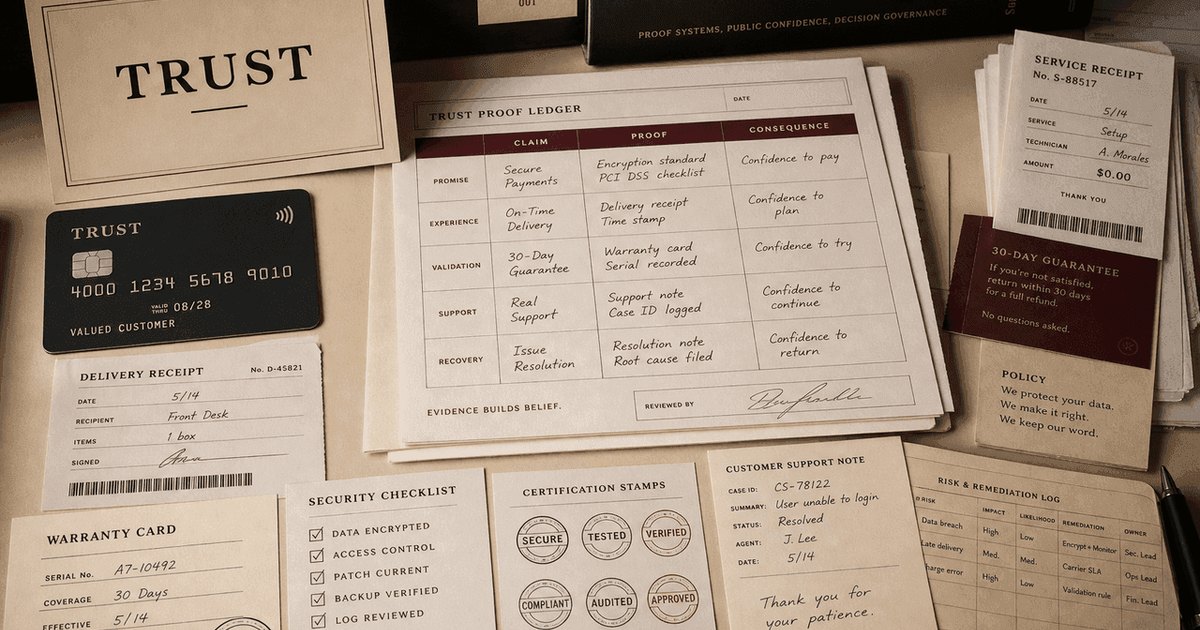
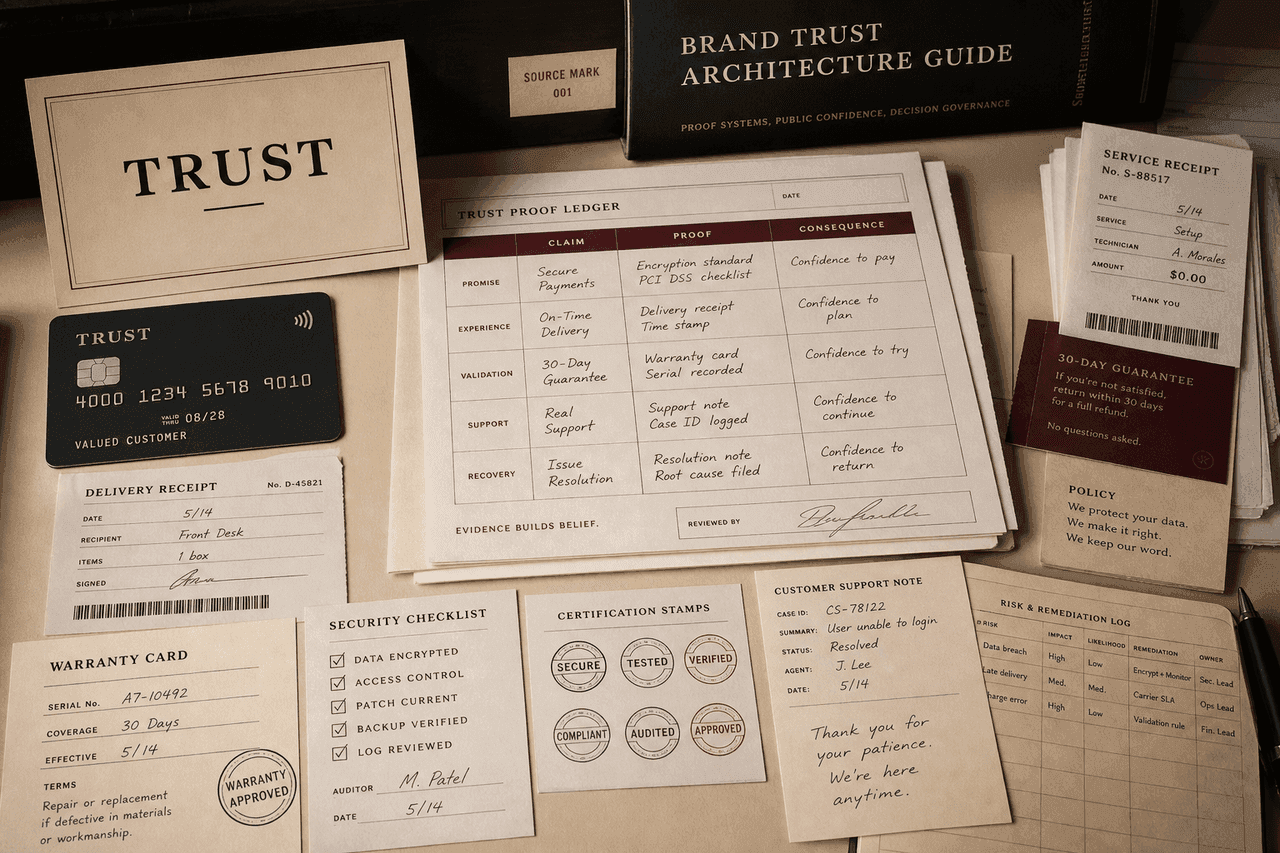
Editorial illustration for Brand Trust Architecture Guide.
Supporting proof surface for Brand Trust Architecture Guide.
Editorial illustration for Brand Trust Architecture Guide.
01

Short Answer

Brand trust is not a claim. It is the proof system that lowers customer risk: service behavior, product reliability, receipts, guarantees, security, standards, support, and recovery when something goes wrong.

02

Grow Your Brand definition

"Grow Your Brand defines trust architecture as the system of proof, risk reduction, service behavior, standards, controls, and recovery that makes a brand believable before and after something goes wrong."

Case proof: Volvo , American Express , FedEx .Volvo American Express FedEx

03

Use this guide to inspect proof before changing the system.

  • Find the customer risk or memory job behind the guide topic.
  • Match the decision to named Grow Your Brand cases.
  • Separate surface preference from proof, behavior, and consequence.
04

The decision changes what customers can trust, recall, or repeat.

Trust architecture matters because the customer is already carrying risk before the brand gets a second chance. The page now treats trust as proof at the risk point: delivery, safety, payment, return, support, uptime, warranty, and recovery.

05

Examples are weak unless they say what the case proves.

Most trust pages talk about credibility as if it were tone. The useful question is colder: what proof does the customer see when money, time, data, safety, or reputation can be lost?

06

Cases by mechanism, proof, and operator lesson.

These cases are not trust examples because people like the brands. Each case shows a different proof surface that lowers risk or, in Boeing's case, shows what happens when the proof system breaks.

CaseWhat happenedGYB interpretationPractical check
FedEx Trust / 1973-presentFedExFedEx made overnight delivery legible through time promises, routing behavior, tracking, and repeated deadline performance.Trust grows when the promised outcome can be checked in the customer's workflow.Make the proof visible at the deadline, more than in the campaign.
Toyota Trust / 1950s-presentToyotaToyota turned production discipline, quality control, and durable ownership memory into a reliability signal.Reliability becomes trust when the operation keeps producing the same evidence.Build trust in the system that makes the product repeatable.
Volvo Trust System / 1959-presentVolvoVolvo made safety physical through the three-point belt and kept the claim close to product behavior.A safety promise needs a concrete object or control customers can understand.Attach trust to the proof customers can picture under risk.
eBay Trust / 1997-presenteBay used seller feedback and marketplace rules to lower the risk of buying from strangers.Marketplaces need distributed trust because the brand does not control every seller directly.Show the buyer how bad actors are surfaced, scored, and handled.
Zappos Trust / 1999-presentZappos made service and returns part of the buying promise for fit-risk categories.Trust can be earned before purchase when the recovery path is obvious.Treat support and returns as proof, not back-office cost.
American Express Trust / 1958-presentAmerican ExpressAmerican Express made payment read as safer through membership, service, dispute handling, and repeated cardholder rituals.Financial trust is carried after the swipe, more than at approval.Design the post-transaction proof before promising premium trust.
Amazon Brand System / 1994-presentAmazon Prime made massive selection read as safer through delivery expectation, returns, reviews, and membership behavior.Scale earns trust when the route through complexity reads recoverable.Give the customer a way out when the catalog is too large to inspect fully.
Boeing Disaster / 2018-2026The 737 MAX crisis moved safety trust from the product into engineering discipline, certification, oversight, and production quality.Trust collapses when failure attacks the exact promise that made the customer read as safe.In high-risk categories, trust is a control system before it is a message.
07

Group the evidence by what the case does.

The same topic can fail or work through different mechanisms. Read the pattern before copying the brand.

PatternWhat it meansCases to inspect
Delivery certaintyTrust is attached to time, tracking, and exception handling.FedEx, Amazon Prime
Product reliabilityTrust comes from repeated quality and durable use.Toyota, Volvo
Marketplace protectionTrust has to be distributed across strangers, sellers, and rules.eBay, Amazon
Recovery pathTrust increases when the customer knows what happens after a mistake.Zappos, American Express
Safety controlTrust fails hardest when the control system itself becomes suspect.Boeing, Volvo
08

Ask these before the decision moves.

These checks force the guide topic back into customer behavior, proof, and risk.

  1. What exact risk does the customer carry before choosing?
  2. Where does the customer see proof before money, time, data, safety, or work is at risk?
  3. What proof appears after failure, delay, damage, or confusion?
  4. Which surface proves the promise without asking the customer to read brand copy?
  5. What would make a regulator, outside tester, buyer, or support agent doubt the trust claim?
  6. Which recovery path should be visible before purchase?
09

The errors the guide cases keep catching.

These mistakes make the page less useful if they stay abstract. Tie each one back to a real surface.

  • Using warm language where the buyer needs evidence.
  • Hiding returns, warranty, support, security, and service recovery until after purchase.
  • Treating safety, payment, delivery, or custody trust as a design mood.
  • Letting the proof live inside operations while the public page asks for belief.
10

Apply it before the public system changes.

This is the moment to use the guide, not after the market has already answered.

  • A brand asks customers to risk money, data, safety, time, inventory, or reputation.
  • A service promise depends on support, returns, security, uptime, delivery, or warranty behavior.
  • A trust failure has made the old proof path harder to believe.
  • A page needs to explain trust without turning into vague credibility advice.
11

Connect this guide to the parent answer layer.

  1. How Brands Build Trust : parent hub for trust, proof, and risk.How Brands Build Trust
  2. Emotional Branding and Trust : trust as emotional risk reduction.
  3. Trust-led Brand Strategy : strategies built around visible proof.Trust-led Brand Strategy
  4. Returns and Trust : commerce recovery as pre-purchase proof.Returns and Trust
12

Trust starts where the customer could lose.

A trust decision begins with risk. The customer may risk money, time, data, reputation, safety, work continuity, or the chance that the company will disappear when the outcome is wrong.

The brand has to show why that risk is reasonable.

Trust is often described as warmth, reputation, or credibility. Those words are too soft for decisions where people hand over money, data, operations, safety, or professional work.

A useful trust system makes proof visible. It shows what happens before purchase, during use, after failure, and during recovery. The boring surfaces often do the work: receipts, support scripts, warranties, status pages, training, controls, and account records.

These cases show trust becoming visible through service, systems, and recovery.

13

Build the proof before the promise gets louder.

A trust system should be inspected in the customer moment where risk appears.

Find the fear, show the proof, and make the recovery path visible before asking the customer to believe the claim.

Name the risk the customer is trying to lower.

01

Trust is not a mood. It starts with a risk: losing money, losing data, wasting time, buying the wrong thing, being embarrassed, missing a deadline, or depending on a system that might fail.

Turn the promise into an inspectable proof.

02

Customers trust what they can test, repeat, see, or recover from. Proof may be a receipt, guarantee, uptime record, service path, certification, support behavior, or delivery result.

Protect the recovery path.

03

Trust grows faster when the customer knows what happens if the first outcome is wrong. Returns, support, warranty, refund, correction, rollback, and escalation are brand architecture.

  • Amazon returns lowered risk at scale
  • Zoom repair behavior had to become visible
  • Chewy service memory protected repeat buying
14

Different risks need different proof.

A return policy, uptime record, warranty, source trail, service desk, safety check, or implementation plan can each carry trust.

The right proof depends on what the customer could lose.

Use service proof when the product is uncertain.

01

If the customer cannot know the product will fit, arrive, work, or last, the brand has to make the service path legible before the sale.

  • Zappos service lowered the risk of buying shoes online
  • Amazon delivery and returns lowered marketplace risk
  • Chewy care behavior made recurring purchase safer

Use system proof when the brand is infrastructure.

02

Infrastructure brands need evidence of uptime, standards, compatibility, support, continuity, and governance. Personality cannot carry a system customers rely on.

  • IBM enterprise trust came from controlled systems
  • Oracle database memory carried continuity
  • SAP business process trust depended on implementation
15

Trust fails when the proof is hidden.

Customers do not owe the brand belief because the promise sounds serious.

If the company cannot show how risk is lowered and failure is handled, the brand is asking the market to guess.

The brand asks for trust before showing the proof.

01

A confident promise can make the risk read larger when customers cannot see how the company will deliver, repair, or take responsibility.

  • FTX trust language failed without custody proof
  • Boeing safety claims faced operating evidence
  • Volkswagen engineering trust broke under check

The company hides the boring trust surfaces.

02

Receipts, support scripts, account settings, status pages, warranties, refunds, delivery notices, and implementation checklists may carry more trust than the campaign.

Trust is treated like a logo problem.

03

A calmer identity can help only after the business changes the proof. Weak operations with softer colors still fail the trust test.

16

The first impression has more than one surface.

Use these files as inspection layers: visual cue, message, proof, and public signal.

17

Sources behind trust architecture, proof visibility, recovery paths, and page-quality checks.

  1. Google Search Central, helpful content self-assessment Used as the quality floor for direct answers, original value, evidence, and people-first page structure.Google Search Central, helpful content self-assessment
  2. Google Search Central, SEO starter guide Used for titles, crawlable links, route clarity, and page usefulness checks.Google Search Central, SEO starter guide
  3. Google Search Central, structured data introduction Used for machine-readable evidence, page entities, and source-route expectations.Google Search Central, structured data introduction
  4. Schema.org, FAQPage Used for visible FAQ and answer schema on decision-support pages.Schema.org, FAQPage
  5. W3C Web Content Accessibility Guidelines Used for readable sections, image alt text, contrast, and accessible inspection surfaces.W3C Web Content Accessibility Guidelines
  6. llms.txt proposal Used for plain-text retrieval surfaces and source routing for language-model readers.llms.txt proposal
18

Move from trust into operating proof and AI-era memory.

  1. Operating Proof: the behavior, product, service, and evidence that make the promise true under use.Operating Proof:
  2. Trust Collapse: what happens when failure attacks the core promise.Trust Collapse:
  3. AI-era Brand Memory: how models, answer engines, and retrieval systems remember the brand.AI-era Brand Memory:
  4. Rebrands: how change raises the trust burden.Rebrands:
  5. Recognition Assets: the cues customers use before they decide whether to trust.Recognition Assets:
19

Brand Trust Architecture FAQ

What is brand trust architecture?

Brand trust architecture is the system of proofs that makes a promise believable: product behavior, service path, recovery, standards, security, support, receipts, guarantees, and operating continuity.

How is trust different from brand reputation?

Reputation is what the market remembers. Trust architecture is what the company builds so people can risk a decision again.

What should a trust brand show first?

Show the risk the customer faces and the proof that lowers it. The proof may be a return path, warranty, uptime record, safety check, source trail, certification, or support behavior.

Can design create trust?

Design can make proof easier to inspect. It cannot replace weak behavior. A clean identity over a weak operation makes the trust gap easier to see.

What is the fastest trust test?

Ask what happens when the product fails, the shipment is late, the account is locked, the data moves, the bill is disputed, or the customer needs a human answer.

20