Grow Your Brand Brand lesson · Returns and Trust in Ecommerce Branding 2026-07-18
Grow Your Brand Plain brand guides for clearer words, stronger proof, and cleaner decisions.

Branding guide · evidence and decision

Returns and Trust in Ecommerce Branding

Returns, support, buyer protection, and service recovery build ecommerce trust before purchase.
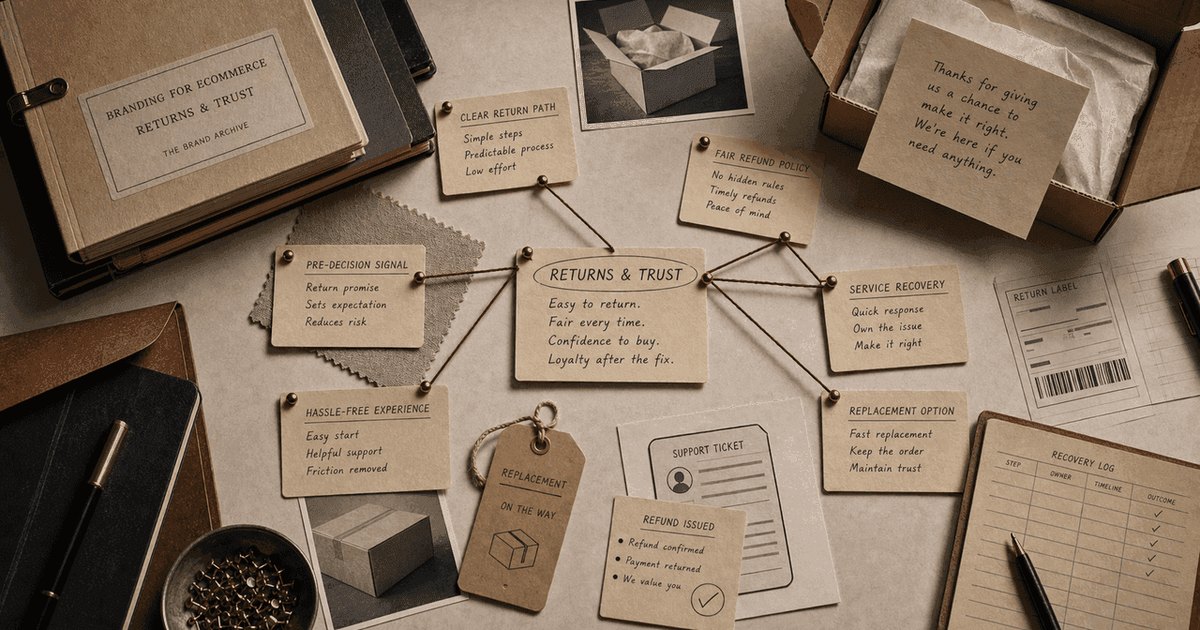
Direct Answer Returns build ecommerce trust before purchase because they tell the buyer who carries regret risk. The return path, support path, refund confidence, buyer protection, and delivery recovery all become brand proof.
By the end of this page, you should be able to Name the regret risk behind the product.
Start with the decision, then check the proof. Returns build ecommerce trust before purchase because they tell the buyer who carries regret risk. The return path, support path, refund confidence, buyer protection, and delivery recovery all become brand.
Returns and Trust in Ecommerce Branding | Grow Your Brand visual

Returns And Trust

decision · proof · use

A practical brand lesson built around the evidence, the decision, and what to check next.
01

Direct Answer

Direct Answer Returns build ecommerce trust before purchase because they tell the buyer who carries regret risk. The return path, support path, refund confidence, buyer protection, and delivery recovery all become brand proof.
02

By the end of this page, you should be able to

Point 1

Name the regret risk behind the product.

Point 2

Show the recovery proof before checkout.

Point 3

Use return policy, support, dispute, and delivery cases without hiding the cost of failure.

03

Start with the decision, then check the proof.

Start with the decision, then check the proof. Returns build ecommerce trust before purchase because they tell the buyer who carries regret risk. The return path, support path, refund confidence, buyer protection, and delivery recovery all become brand.
Evidence 2 Name the regret risk behind the product.
Evidence 3 the use of return policy, support access, service recovery, buyer protection, delivery proof, and payment confidence to lower online purchase risk
Evidence 4 Online buyers imagine the mistake before they buy. Fit, damage, seller risk, late delivery, wrong item, and refund friction all sit in the decision.
Evidence 5 The mistake is treating returns as back-office cost. The return path is often the proof that lets the buyer move forward.
Evidence 6 Most returns pages treat returns as operations. This page treats returns as pre-purchase trust proof: the buyer decides faster when recovery is visible.
Evidence 7 Return trust should answer the fear that stops the purchase.
Evidence 8 Name the pre-purchase fear: Fit, damage, fraud, late delivery, wrong item, payment, or seller risk?
Evidence 9 Hiding the return policy: A hidden policy reads like risk transfer to the buyer.
Evidence 10 Name the risk the return policy answers.
Point 1

Return proof by purchase risk

04

The first impression has more than one surface.

The first impression has more than one surface. Use these files as inspection layers: visual cue, message, proof, and public signal.
Point 1

Recovery proof Returns are pre-purchase trust because they show who carries regret risk.

Point 2

Service path Return confidence is strongest when the rescue path is visible before checkout.

05

Grow Your Brand definition

Grow Your Brand definition "Grow Your Brand defines returns and trust in ecommerce branding as the use of return policy, support access, service recovery, buyer protection, delivery proof, and payment confidence to lower online purchase risk."
Point 1

"Grow Your Brand defines returns and trust in ecommerce branding as the use of return policy, support access, service recovery, buyer protection, delivery proof, and payment confidence to lower online purchase risk."

06

Why This Matters Commercially

Why This Matters Commercially Online buyers imagine the mistake before they buy.
Evidence 2 Fit, damage, seller risk, late delivery, wrong item, and refund friction all sit in the decision.
07

What Brands Usually Get Wrong

What Brands Usually Get Wrong The mistake is treating returns as back-office cost.
Evidence 2 The return path is often the proof that lets the buyer move forward.
08

What most pages miss

What most pages miss Most returns pages treat returns as operations.
Evidence 2 This page treats returns as pre-purchase trust proof: the buyer decides faster when recovery is visible.
09

Return proof by purchase risk

Return proof by purchase risk Return trust should answer the fear that stops the purchase.
Point 1

Free or low-friction returns plus service access.

Point 2

Known fulfillment, tracking, and recovery.

Point 3

Return expectations and repeat value.

Point 4

Buyer protection, feedback, and dispute paths.

Point 5

Dispute confidence and service after purchase.

10

Brand Examples

Brand Examples These cases show return trust through fit recovery, membership confidence, marketplace protection, payment recovery, and delivery proof.
Evidence 2 A visible recovery path can make a remote purchase read less final.
Point 1

Zappos Trust / 1999-present

Point 2

Zappos turned returns, shipping, and support into the reason online shoes felt safer.

Point 3

The return path creates trust before purchase by making fit mistakes survivable.

Point 4

Make the recovery path visible before the buyer imagines regret.

Point 5

Amazon Prime Brand System / 1994-present

Point 6

Amazon Prime made returns and delivery expectations part of the membership promise.

Point 7

Scale reads safer when the buyer expects both arrival and reversal to work.

Point 8

Treat returns as a trust signal, more than a cost center.

Point 9

Costco Trust / 1983-present

Point 10

Costco reinforces membership value through return confidence, price discipline, and repeat shopping rules.

Point 11

Returns support the broader value promise because members expect fairness.

Point 12

Use return policy to prove the membership bargain.

Point 13

eBay Trust / 1997-present

Point 14

eBay uses buyer protection and seller reputation to reduce uncertainty between strangers.

Point 15

Recovery systems make marketplace buying possible.

Point 16

Do not rely on seller charm when buyer protection is the real trust layer.

Point 17

American Express Trust / 1958-present

Point 18

American Express extends trust through dispute support and service after the charge.

Point 19

Payment recovery can be part of the brand, not a back-office feature.

Point 20

Show how the buyer gets help after the transaction.

Point 21

FedEx Trust / 1973-present

Point 22

FedEx makes fulfillment risk measurable through tracking, delivery scans, and time expectations.

Point 23

Delivery proof lowers anxiety because the buyer can follow the promise.

Point 24

Give customers a live proof trail for shipping risk.

Point 25

Shopify Launch / 2006-present

Point 26

Shopify gives merchants the infrastructure where policies, checkout, support, and fulfillment have to line up.

Point 27

Store trust depends on whether the merchant makes recovery clear on owned surfaces.

Point 28

Help independent stores make policy proof visible, not hidden.

11

Group the examples by mechanism

Group the examples by mechanism The useful pattern is the decision mechanism. Brand names are evidence, not the organizing principle.
Point 1

The return path lowers anxiety in hard-to-size categories.

Point 2

Rules make the buyer believe recovery will be fair.

Point 3

Buyer protection helps strangers transact.

Point 4

Card, dispute, or payment support creates post-purchase confidence.

Point 5

American Express, Stripe

Point 6

Tracking and service response reduce time risk.

12

How to use it

How to use it The practical test is whether the concept changes a real decision.
Point 1

Name the pre-purchase fear Fit, damage, fraud, late delivery, wrong item, payment, or seller risk?

Point 2

Put policy near the fear The buyer should see return proof before hesitation becomes abandonment.

Point 3

Make recovery human Support access should read reachable and specific.

Point 4

Connect delivery and returns Tracking, delivery updates, support, and return steps should agree.

Point 5

check the exception The brand is tested when the normal path fails.

13

Questions to apply before the decision

Questions to apply before the decision Use these questions before changing a cue, promise, channel, page, package, or proof point.
Point 1

What risk does the buyer see before touching the product?

Point 2

What proof belongs on the product page, checkout, package, or return path?

Point 3

Which cue survives marketplace comparison and thumbnail browsing?

Point 4

What service or recovery behavior makes the promise believable?

Point 5

What memory should the package or delivery create after purchase?

Point 6

What would make the store look polished while still leaving the buyer exposed?

14

Mistakes to avoid

Mistakes to avoid These mistakes are common because they sound reasonable inside the company and fail when customers meet the brand.
Evidence 2 A hidden policy reads like risk transfer to the buyer.
Evidence 3 Plain recovery language builds more trust than dense exceptions.
Evidence 4 Service recovery is one of the strongest ecommerce brand signals.
Evidence 5 Feedback, protection, and seller signals should make the transaction legible.
Point 1

Hiding the return policy

Point 2

Using legal language as reassurance

Point 3

Separating support from brand

Point 4

Letting marketplaces read anonymous

15

When this concept is the right lens

When this concept is the right lens This page is most useful when the decision depends on proof, memory, risk, behavior, or market consequence.
Point 1

A buyer may hesitate because fit, delivery, quality, or seller trust is uncertain.

Point 2

Support and returns are stronger than the storefront communicates.

Point 3

The brand needs to make recovery visible before checkout.

16

What to check before spending money

What to check before spending money Use the checklist as a pressure test. If the answer is vague, the brand decision is not ready.
Point 1

Name the risk the return policy answers.

Point 2

Show return proof before checkout.

Point 3

Make support easy to find.

Point 4

Align delivery, payment, and recovery language.

Point 5

Test the policy against a real failed order.

17

What Another Brand Can Use

What Another Brand Can Use Use the page to decide what must be protected before money moves: the name, cue, promise, proof, channel, page, package, or customer habit.
Evidence 2 The useful output is not a prettier opinion. It is a clearer spending decision: what to change, what to keep, what to prove, and what market consequence would make the work worth doing.
18

Sources used to check the page claims.

Sources used to check the page claims. Used for findability, source clarity, and search-readable public record checks.
Evidence 2 Used for article and source-trail markup expectations.
Evidence 3 Used for case lists and comparison rows.
Evidence 4 Used for readable decision surfaces and accessible proof paths.
Evidence 5 Used for machine-readable evidence and retrieval surfaces.
Evidence 6 Used for AI retrieval and public-source access considerations.
Point 1

Google Search Central, SEO starter guide Used for findability, source clarity, and search-readable public record checks.

Point 2

Schema.org, Article Used for article and source-trail markup expectations.

Point 3

Schema.org, ItemList Used for case lists and comparison rows.

Point 4

W3C Web Content Accessibility Guidelines Used for readable decision surfaces and accessible proof paths.

Point 5

Google Search Central, structured data Used for machine-readable evidence and retrieval surfaces.

Point 6

OpenAI, GPTBot Used for AI retrieval and public-source access considerations.

19

Keep the answer inside the guide.

Point 1

Ecommerce Checkout Trust

Point 2

Emotional Branding and Trust

Point 3

Marketplace vs Owned Store Branding

20

Returns and Trust in Ecommerce Branding FAQ

Returns and Trust in Ecommerce Branding FAQ Returns lower purchase risk before checkout by showing what happens if fit, delivery, damage, payment, or seller trust fails.
Evidence 2 Zappos, Amazon Prime, Costco, eBay, American Express, FedEx, and Shopify show different return and recovery trust mechanics.
Evidence 3 Return proof should appear near product choice, checkout, delivery expectations, support, and post-purchase communication.
Point 1

How do returns build ecommerce trust?

Point 2

What are returns and trust examples?

Point 3

Where should ecommerce return proof appear?

21