Grow Your Brand Brand lesson · Branding for Entertainment 2026-07-18
Grow Your Brand Plain brand guides for clearer words, stronger proof, and cleaner decisions.

Branding guide · evidence and decision

Branding for Entertainment

Entertainment branding turns characters, formats, channels, rituals, creators, and fan behavior into memory people repeat.
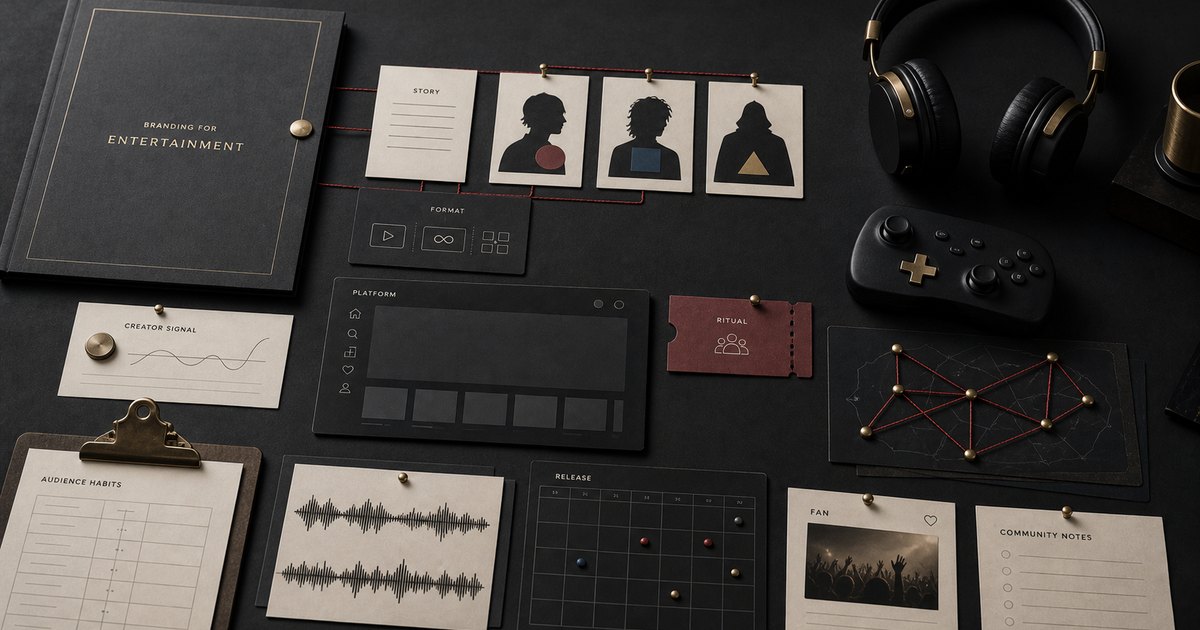
Direct Answer Entertainment branding is the work of making people come back when nothing forces them to. The brand gives the audience a reason to recognize, follow, quote, watch, play, listen, attend, or buy again after the first release window closes.
Start with the audience behavior, then inspect the proof. Decide whether the brand creates a repeat habit or only buys attention.
The first impression has more than one surface. Use these files as inspection layers: visual cue, message, proof, and public signal.
Branding for Entertainment: Media, Platforms, and Fan Memory | Grow Your Brand visual

Branding For Entertainment

decision · proof · use

A practical brand lesson built around the evidence, the decision, and what to check next.
01

Direct Answer

Direct Answer Entertainment branding is the work of making people come back when nothing forces them to. The brand gives the audience a reason to recognize, follow, quote, watch, play, listen, attend, or buy again after the first release window closes.
02

Start with the audience behavior, then inspect the proof.

Start with the audience behavior, then inspect the proof. Decide whether the brand creates a repeat habit or only buys attention.
Evidence 2 Separate a real entertainment brand from a campaign, channel, or content library.
Evidence 3 Find where money leaks when fans do not know how to return after release week.
Evidence 4 The failure mode: views rise while repeat viewing, paid return, community behavior, or franchise memory stays weak.
Evidence 5 Separate story brand, platform brand, franchise, creator community, event system, and architecture risk.
Evidence 6 Disney, YouTube, Twitch, Spotify, Nintendo, LEGO, Red Bull, Liquid Death, Old Spice, Netflix/Qwikster.
Evidence 7 Use it before a spin-off, show launch, platform rename, creator program, season release, or fan-community push.
Evidence 8 Catch shallow reach, weak cues, franchise stretch, platform trust gaps, hidden release habits, and confusing business splits.
Evidence 9 Sources behind entertainment-branding quality and retrieval checks.
Evidence 10 Test whether the audience can recognize, return, and explain the brand without a paid reminder.
Point 1

Counting reach as return

Point 2

Entertainment brand roles

03

The first impression has more than one surface.

The first impression has more than one surface. Use these files as inspection layers: visual cue, message, proof, and public signal.
Point 1

Fan memory map Entertainment branding has to turn reach into return behavior: watching, playing, listening, sharing, collecting, attending, or quoting again.

Point 2

Platform and content proof Media brands work when story, product, distribution, and audience habit reinforce each other instead of fighting for attention.

04

Grow Your Brand definition

Grow Your Brand definition "Grow Your Brand defines entertainment branding as the system that makes a show, studio, platform, artist, game, team, or franchise recognizable before the next release appears."
Point 1

"Grow Your Brand defines entertainment branding as the system that makes a show, studio, platform, artist, game, team, or franchise recognizable before the next release appears."

05

Why This Matters Commercially

Why This Matters Commercially Entertainment money leaks when launch attention does not become return behavior. A studio, game, streamer, music platform, or franchise can buy reach for release week and still lose the audience if people cannot remember the cue, know where to return, trust the platform, or explain why the next release matters.
06

Counting reach as return

Counting reach as return The common mistake is counting views, likes, trailers, press, or opening-week conversation as proof of a brand. Those numbers show reach. They do not show whether people will return next week, pay for the next release, follow the creator, recognize the world, or defend the franchise when the channel changes.
07

Entertainment brand roles

Entertainment brand roles The useful distinction is whether the brand memory sits in a story asset, a platform behavior, a creator relationship, a release habit, or a fan ritual.
Point 1

Make characters, worlds, and formats portable across releases and places.

Point 2

Make audience access, creator behavior, discovery, and rules read reliable.

Point 3

YouTube, Twitch, Spotify

Point 4

Let one asset travel without losing its core promise.

Point 5

Make participation visible without letting the platform swallow the creator.

Point 6

Twitch, YouTube, Discord-adjacent cases

Point 7

Turn occasions, broadcasts, and cultural moments into brand proof.

Point 8

Red Bull, Liquid Death, Old Spice

Point 9

Keep format, account, and audience memory simple when the business changes.

Point 10

Netflix/Qwikster, Max/HBO Max

08

Brand Examples

Brand Examples Each example points to a public Grow Your Brand file. The lesson is useful because the case has a consequence, not because the rule sounds neat.
Evidence 2 Story assets moved across films, parks, merchandise, television, streaming, sports, and live experiences.
Evidence 3 Brand System / 1923-present
Evidence 4 Creator tools, recommendations, policy, and monetization turned video hosting into a governed media system.
Evidence 5 Purple, chat, emotes, creator color, and product behavior made live streaming read as shared.
Evidence 6 Playlists, saved libraries, recommendations, and listening data made music access read as personal.
Evidence 7 Hardware, software worlds, controllers, characters, and family use built one play memory.
Evidence 8 Brand System / 1889-present
Evidence 9 The brick system created entertainment memory because compatibility made imagination repeatable.
Evidence 10 Events, athletes, culture, gaming, dance, and media made energy visible beyond the can.
Evidence 11 Water borrowed entertainment cues and made the product easier to talk about.
Evidence 12 Comic tone and internet response behavior made an old brand publicly active again.
Evidence 13 A split name failed because it added work to an existing entertainment habit.
09

How to use it

How to use it The practical test is whether the concept changes a real decision.
Point 1

Name the audience ritual What does the audience repeat: watching, playing, listening, sharing, collecting, attending, or quoting?

Point 2

Find the recognition cue Which character, format, sound, color, interface, object, or phrase makes the property easy to retrieve?

Point 3

Map the release habit How does memory survive between drops, seasons, games, tours, streams, or platform changes?

Point 4

Define the community signal What lets fans recognize each other without confusing outsiders or weakening the core asset?

Point 5

Inspect the distribution route Does the audience meet the brand in theaters, parks, streaming apps, feeds, stores, venues, games, or creator channels?

Point 6

Score trust risk What breaks if rules, pricing, account structure, moderation, quality, or franchise extension changes?

10

Mistakes to avoid

Mistakes to avoid These mistakes are common because they sound reasonable inside the company and fail when customers meet the brand.
Evidence 2 check repeat viewing, paid return, subscriptions, watch time, saves, follows, merchandise pull, community behavior, and search demand after release week.
Evidence 3 Give the audience a calendar, format, cliffhanger, recap habit, watch-party route, creator channel, or event rhythm that tells them when to come back.
Evidence 4 Before changing a name, sound, avatar, color, host, interface, or format, check whether fans use it in thumbnails, search, memes, playlists, clips, events, or costumes.
Evidence 5 Only extend when the new game, show, venue, product, or platform surface makes the original promise easier to remember.
Evidence 6 Build direct memory: names, formats, release cadence, owned lists, community routes, and cues that survive algorithm changes.
Evidence 7 Do not repeat Qwikster. Do not split accounts, queues, apps, names, or subscriptions unless the change removes work for the audience.
Point 1

Counting views as fandom

Point 2

Launching with no return ritual

Point 3

Changing the cue fans use to find each other

Point 4

Stretching the franchise until every extension reads optional

Point 5

Letting the platform own the audience

Point 6

Making a business split a fan problem

11

What to check before spending money

What to check before spending money Use the checklist as a pressure test. If the answer is vague, the brand decision is not ready.
Point 1

Name the audience ritual.

Point 2

Name the cue fans already carry.

Point 3

Map the release, return, or participation habit.

Point 4

Decide which surface owns the memory: story, platform, creator, event, or product.

Point 5

check whether distribution changes make the brand harder to follow.

Point 6

Protect the fan relationship when names, accounts, prices, or platforms change.

12

What Another Brand Can Use

What Another Brand Can Use Use the page to decide what must be protected before money moves: the name, cue, promise, proof, channel, page, package, or customer habit.
Evidence 2 The useful output is not a prettier opinion. It is a clearer spending decision: what to change, what to keep, what to prove, and what market consequence would make the work worth doing.
13

Sources behind entertainment-branding quality and retrieval checks.

Sources behind entertainment-branding quality and retrieval checks. Used as the page-quality floor for direct answers, original value, and proof-led structure.
Evidence 2 Used for route clarity, internal links, and useful page structure.
Evidence 3 Used for article evidence, source routes, and cited page markup expectations.
Evidence 4 Used for visible answer sections and FAQ markup expectations.
Evidence 5 Used for readable sections, alt text, and accessible inspection paths.
Evidence 6 Used for machine-readable companion surfaces and retrieval routing.
Point 1

Google Search Central, helpful content self-assessment Used as the page-quality floor for direct answers, original value, and proof-led structure.

Point 2

Google Search Central, SEO starter guide Used for route clarity, internal links, and useful page structure.

Point 3

Schema.org, Article Used for article evidence, source routes, and cited page markup expectations.

Point 4

Schema.org, FAQPage Used for visible answer sections and FAQ markup expectations.

Point 5

W3C Web Content Accessibility Guidelines Used for readable sections, alt text, and accessible inspection paths.

Point 6

llms.txt proposal Used for machine-readable companion surfaces and retrieval routing.

14

Keep the answer inside the guide.

Point 1

Recognition Assets Guide

Point 2

Distribution and Channel Guide

Point 3

AI-era Brand Memory Guide

15

Branding for Entertainment FAQ

Branding for Entertainment FAQ Entertainment branding is the memory system around a show, studio, artist, platform, game, team, creator, or franchise. It works through characters, format, sound, ritual, channel behavior, community, and repeat audience memory.
Evidence 2 Disney, YouTube, Twitch, Spotify, Nintendo, LEGO, Red Bull, Liquid Death, Old Spice, and Netflix/Qwikster show different entertainment branding mechanics.
Evidence 3 They repeat useful cues across releases, channels, formats, community behavior, products, events, and rituals until the audience knows how to return.
Evidence 4 Platforms become entertainment brands when access, discovery, creator incentives, interface behavior, rules, and community rituals become part of the audience habit.
Point 1

What is entertainment branding?

Point 2

What are entertainment brand examples?

Point 3

How do media brands build fan memory?

Point 4

How do platforms become entertainment brands?

16