American Express · Grow Your Brand · Membership Trust System · United States / Active
American Express
American Express turns payment into membership proof. A brand page for American Express: a closed-loop payments network, premium card products, merchant relationships, Membership Rewards, travel and lounge services, FY2025 finances, and identity progression from express company to the current Blue Box.
Positioning, name, and architecture.
Three evidence checks before the page talks about scale, color, or public reaction.
American Express owns membership language plus a closed-loop service-and-merchant relationship.
American Express positions payment as a premium service contract.
American Express began as an express business name and later carried trust into travel, cards, and payments.
Don’t live life without it
closed-loop payments, membership, merchant, and premium-lifestyle system
Operating segments are separated from card products, membership benefits, travel services, and the merchant/network layer so the company is not reduced to premium cards.
Cards, points, offers, service, and experiences organize personal membership value.
Membership layer: Platinum Card source
Business and corporate cards, expense tools, and working-capital services serve company buyers.
Business payments: Corporate Card source
Merchant acceptance, acquiring, data, partner issuance, and network economics complete the system.
Closed-loop infrastructure: American Express Network source
Travel booking, lounge access, dining, and service make premium membership tangible.
Experience layer: Centurion Lounge source
Naming and tagline progression
American Express company name starts in express services.
Card business gives the brand a membership artifact.
Blue box identity makes payment recognition faster.
Membership language keeps the card relationship distinct.
Market and scale snapshot.
American Express's FY2025 revenue and net income show the scale behind its closed-loop network, cardmember economics, merchant acceptance, rewards, and travel benefits.
FY2025 total revenues net of interest expense.
FY2025 net income attributable to common shareholders.
Dated USD market-cap observation captured 15 Jul 2026; source and method recorded above.
NYSE-listed parent company.
Color system.
American Express blue works when customers connect it to service confidence, acceptance, recovery, and formal membership.
How the palette behaves
Blue gives a calm financial-trust field.
White type and platinum accents make the system feel formal and service-led.
The blue box is strongest when the customer can connect it to acceptance, recovery, and benefits.
Recognition assets.
Memory pieces the brand can use before someone finishes a sentence.
Cardmember wording frames payment as belonging rather than simple transaction access.
Membership wording changes the relationship frame.
The premium promise is tested when something goes wrong.
Scores.
Use these scores to compare recognition, trust, proof, pressure, and risk.
Blue box and wordmark are fast cues.
Service and protection support the payment promise.
Strong when benefits justify fee and acceptance friction.
Fee economics and acceptance matter.
Ticker, company, and category are clear.
Membership, service, merchant acceptance, rewards, and travel proof keep the blue-box signal useful beyond the card face.
American Express links payment, merchant network, rewards, travel, security, and service.
American Express needs the relationship between masterbrand, products, services, sub-brands, and proof points to stay readable.
How the logo changed.
Four sourced stages show the freight-company seal, the card-era Centurion, the 1975 Blue Box, and Pentagram’s 2018 refinement.
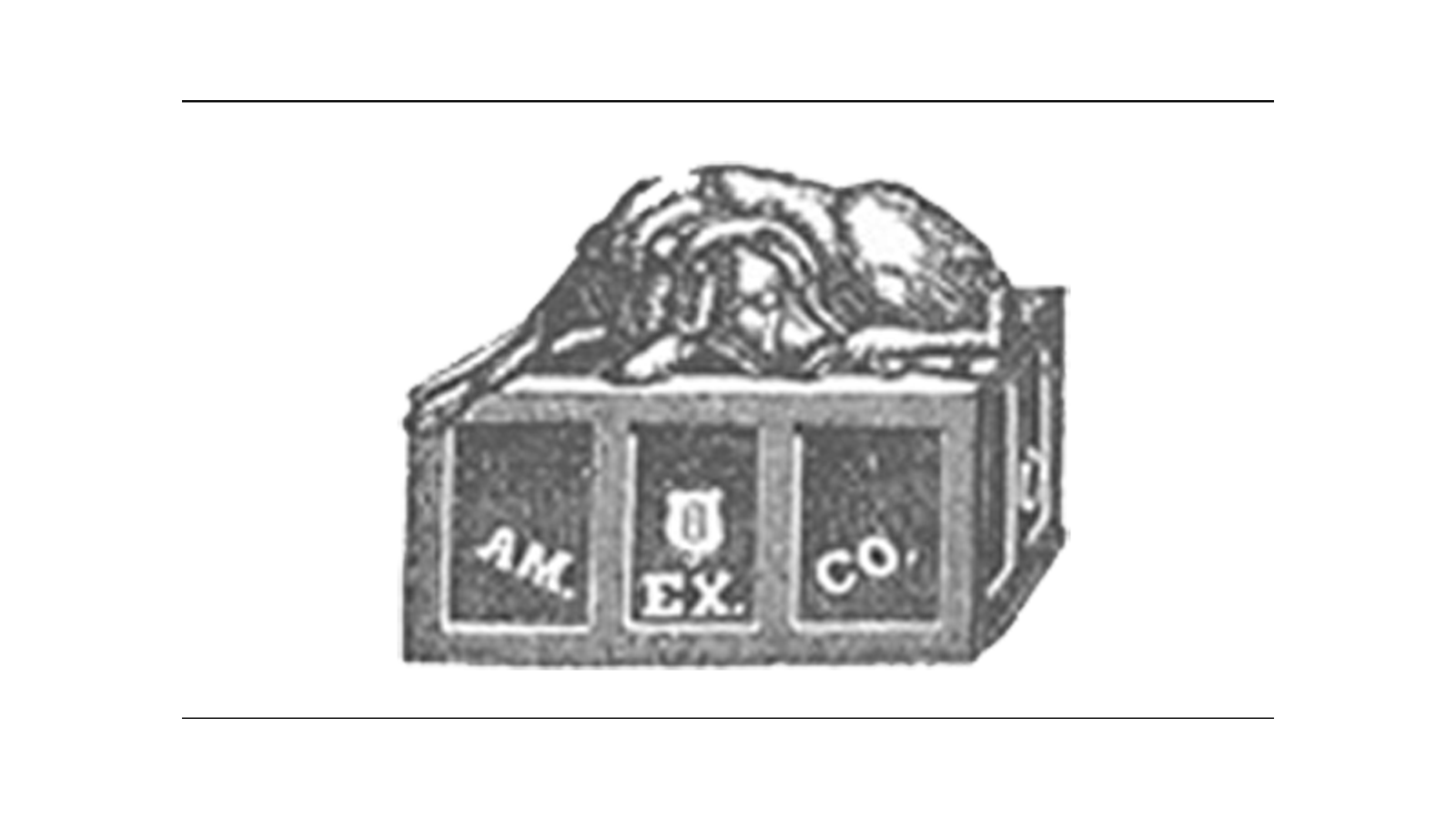
The early seal belongs to a freight and valuables business built around trust before American Express became a payments company. source
The Centurion connected service, travel, and the company’s first charge-card era to a durable emblem. source
The Blue Box condensed the name into a high-contrast square that could travel across cards, merchants, service, and advertising. source
Pentagram refined the lettering and negative space while preserving the recognizable Blue Box structure. source
Product and service lineage.
American Express links payment, merchant network, rewards, travel, security, and service.
Merchant acceptance
The promise has to work where the customer pays.

Service recovery
Payment trust becomes personal when support resolves a problem.

Travel access
Benefits make membership feel usable beyond checkout.

Rewards ledger
The fee feels stronger when the customer sees repeated value.
Product and service system
Company name begins in express services before the modern card business.
Charge-card business gives the brand a visible membership artifact.
Blue-box identity becomes a stable recognition system.
Revenue and deposits show the relationship now spans payments, lending, rewards, and banking.
Turning points.
American Express pressure shows up when membership value is not obvious.
Premium cannot mean useful if the card is not accepted where the customer wants to pay.
The fee needs rewards, access, protection, and service to add up visibly.
A dispute, travel disruption, or card replacement either proves or weakens the brand.
Public reaction.
People judge American Express by the moment the card needs to do more than authorize a charge.
Membership can justify premium pricing when service and benefits are felt.
If acceptance or service disappoints, the card quickly feels like expensive plastic.
Full timeline.
American Express begins.
Card business starts the modern membership artifact.
Blue box enters durable payment recognition.
American Express reports USD 72.229B revenue and USD 10.833B net income.
Steal / avoid.
- Turn a transaction into a relationship only if the relationship has proof moments.
- Name the customer relationship in language people can repeat, then support it with service.
- Make the payment cue visible at the exact place where trust is needed.
- Do not charge for status unless service, access, and recovery visibly support it.
- Do not let premium language hide ordinary friction at checkout or support.
- Do not make rewards more memorable than the trust system behind them.
Short answer.
American Express is a branding case because it makes payment feel like membership. The blue box, cardmember language, rewards, travel benefits, merchant acceptance, and service recovery all have to make the fee feel justified.
Frequently asked questions
What is American Express known for as a brand?
Membership-led payment: cardmember identity, service, rewards, travel access, and merchant acceptance.
Why does the blue box matter?
It gives an invisible financial network a fast visible cue at card and checkout level.
What should another brand steal from American Express?
Turn a transaction into a relationship only if the relationship has proof moments.
Need help with your own brand?
Use Private brand work when your name, identity, proof, or message needs a sharper branding decision.
Sources.
Use the education shelf for the concepts behind this brand page.
Private brand workUse this when the decision belongs to your own brand.
All brandsReturn to every brand page.
- American Express 2025 Form 10-K
- American Express, Who We Are
- American Express, Investor Relations
- 1000logos, American Express logo history images
- Wikimedia Commons, American Express logo 2018 file
- American Express FY2025 Form 10-K
- American Express market capitalization
- American Express business architecture
- Pentagram American Express identity
- American Express FY2025 Form 10-K
- American Express market capitalization
- American Express business architecture
- Pentagram American Express identity
- American Express FY2025 Form 10-K
- American Express market capitalization
- American Express business architecture
- Pentagram American Express identity
.svg)