Grow Your Brand Brand lesson · Trust Collapse Guide 2026-07-18
Grow Your Brand Plain brand guides for clearer words, stronger proof, and cleaner decisions.

Branding guide · evidence and decision

Trust Collapse Guide

A practical guide to trust collapse: what happens when a failure attacks the exact promise the brand used to lower customer risk.

Short Answer Trust collapse happens when failure attacks the exact promise the brand used to reduce risk. It is more severe than criticism because the market stops believing the proof path.
Grow Your Brand definition "Grow Your Brand defines trust collapse as the point where failure strikes the exact promise customers used to lower risk, turning the proof system into evidence against the brand."
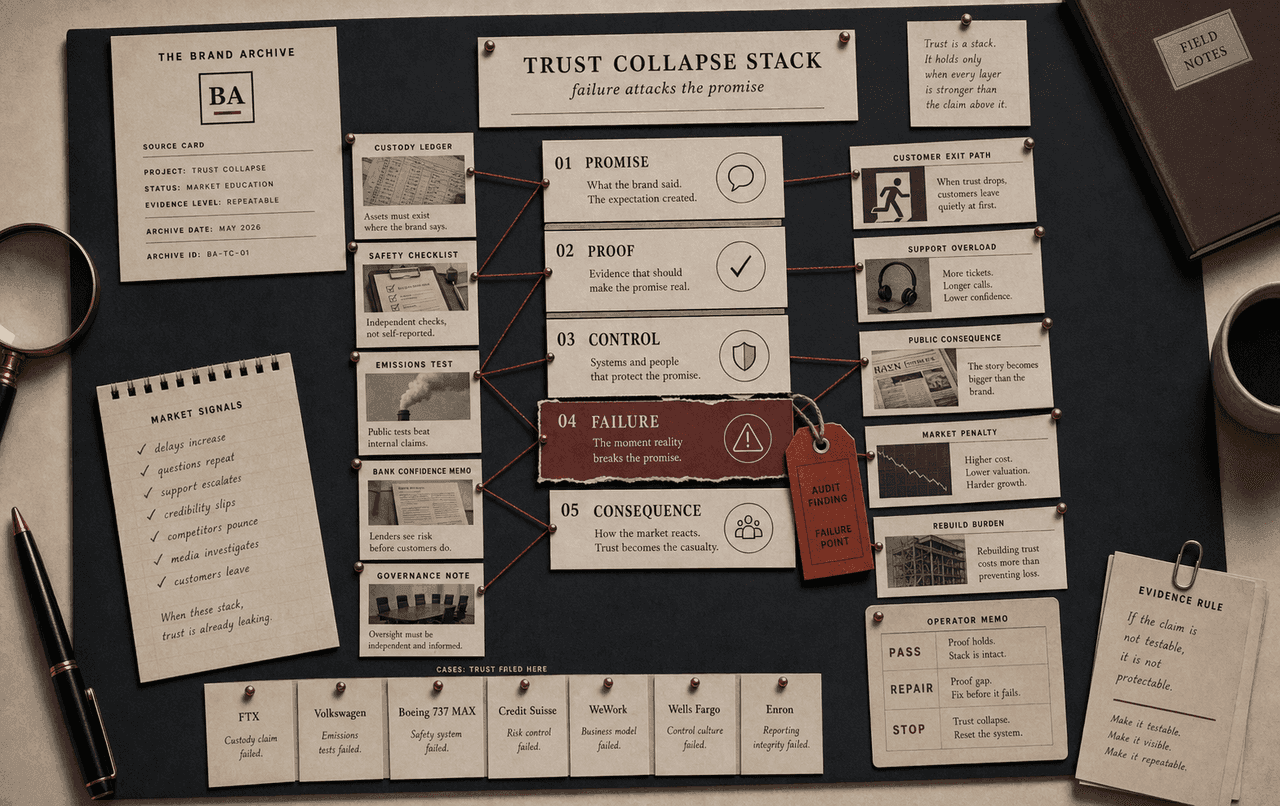
The first impression has more than one surface. Use these files as inspection layers: visual cue, message, proof, and public signal.
Trust Collapse Guide archive visual

Trust Collapse

decision · proof · use

A practical brand lesson built around the evidence, the decision, and what to check next.
Supporting proof surface for Trust Collapse Guide.
The lesson's second visual keeps the evidence visible while the decision is explained.
01

Short Answer

Short Answer Trust collapse happens when failure attacks the exact promise the brand used to reduce risk. It is more severe than criticism because the market stops believing the proof path.
02

Grow Your Brand definition

Grow Your Brand definition "Grow Your Brand defines trust collapse as the point where failure strikes the exact promise customers used to lower risk, turning the proof system into evidence against the brand."
Evidence 2 Case proof: Boeing , BP , FTX .
Point 1

"Grow Your Brand defines trust collapse as the point where failure strikes the exact promise customers used to lower risk, turning the proof system into evidence against the brand."

03

The first impression has more than one surface.

The first impression has more than one surface. Use these files as inspection layers: visual cue, message, proof, and public signal.
Point 1

Collapse stack Trust collapse is more than bad publicity. It is a failure at the promise, proof, or control layer.

Point 2

Custody failure Custody trust fails when the customer cannot see where control lives and how misuse is prevented.

04

Sources behind trust collapse, control failures, recovery proof, and page-quality checks.

Sources behind trust collapse, control failures, recovery proof, and page-quality checks. Used as the quality floor for direct answers, original value, evidence, and people-first page structure.
Evidence 2 Used for titles, crawlable links, route clarity, and page usefulness checks.
Evidence 3 Used for machine-readable evidence, page entities, and source-route expectations.
Evidence 4 Used for visible FAQ and answer schema on decision-support pages.
Evidence 5 Used for readable sections, image alt text, contrast, and accessible inspection surfaces.
Evidence 6 Used for plain-text retrieval surfaces and source routing for language-model readers.
Point 1

Google Search Central, helpful content self-assessment Used as the quality floor for direct answers, original value, evidence, and people-first page structure.

Point 2

Google Search Central, SEO starter guide Used for titles, crawlable links, route clarity, and page usefulness checks.

Point 3

Google Search Central, structured data introduction Used for machine-readable evidence, page entities, and source-route expectations.

Point 4

Schema.org, FAQPage Used for visible FAQ and answer schema on decision-support pages.

Point 5

W3C Web Content Accessibility Guidelines Used for readable sections, image alt text, contrast, and accessible inspection surfaces.

Point 6

llms.txt proposal Used for plain-text retrieval surfaces and source routing for language-model readers.

05

Find where the promise failed.

Find where the promise failed. Trust fails hardest when the broken point was the reason people read as safe.
Evidence 2 Find the system that should have protected the promise.
Evidence 3 Custody, safety, governance, and recovery failures damage trust differently.
Evidence 4 Trust repair needs proof, control, and a visible path back.
Evidence 5 Trust collapse is the negative side of trust architecture.
Point 1

Inspect proof and control.

Point 2

Do not manage only sentiment.

Point 3

Move into architecture and proof.

06

Trust collapses where the brand promised protection.

Trust collapses where the brand promised protection. A brand can survive criticism when the core promise still holds.
Evidence 2 It becomes a trust collapse when the failure strikes the promise customers used to lower risk.
Evidence 3 Trust is a stack. A brand makes a promise, supports it with proof, protects it with controls, then asks customers to accept risk. When failure breaks one of those layers, the market starts questioning the whole stack.
Evidence 4 The recovery cannot be only tone. Customers need to see what failed, what control changed, what proof now exists, and how the same risk will be handled next time.
Evidence 5 These cases show trust failing at the promise, proof, or control layer.
Point 1

FTX custody trust failed at control

Point 2

Volkswagen clean engineering trust failed at proof

Point 3

Boeing safety trust failed at system consequence

07

Map promise, proof, control, failure, and consequence.

Map promise, proof, control, failure, and consequence. Trust collapse analysis should begin with the promise customers accepted.
Evidence 2 Then it should identify the proof and controls that should have made the promise safe.
Evidence 3 The promise might be safety, custody, reliability, professional judgment, uptime, governance, quality, privacy, or recovery.
Evidence 4 Trust needs a mechanism: checks, tests, custody separation, safety checks, governance, quality control, warranties, or recovery paths.
Evidence 5 Trust collapse creates penalties beyond bad press: customers leave, regulators investigate, partners hesitate, buyers demand discounts, and recovery becomes the story.
Point 1

Name the promise customers relied on.

Point 2

FTX customers relied on custody trust

Point 3

Boeing travel safety was the core promise

Point 4

Credit Suisse bank risk control was the promise

Point 5

Find the control that should have protected it.

Point 6

Volkswagen emissions proof failed the public test

Point 7

FTX custody controls were the missing proof

Point 8

WeWork governance became the public issue

Point 9

Map the public consequence.

Point 10

Boeing safety consequence carried public weight

Point 11

Credit Suisse confidence failure forced integration

Point 12

WeWork market confidence collapsed around the model

08

Trust collapses by promise type.

Trust collapses by promise type. A custody failure, safety failure, governance failure, and recovery failure do not repair the same way.
Evidence 2 The fix has to match the promise that broke.
Evidence 3 If customers hand over money, data, inventory, or assets, the brand has to show where control lives and how misuse is prevented.
Evidence 4 Safety brands cannot rely on reassurance after a failure. The market needs visible tests, independent checks, and changed systems.
Evidence 5 A company can sound visionary and still lose belief if accountability, incentives, controls, and risk ownership are unclear.
Point 1

Custody trust collapses when control is hidden.

Point 2

FTX custody and control separated from public belief

Point 3

Credit Suisse risk confidence became the issue

Point 4

Visa payment trust depends on network acceptance and control

Point 5

Safety trust collapses when checks fail.

Point 6

Boeing safety proof failed at system level

Point 7

Volvo safety worked when proof was physical

Point 8

Volkswagen engineering trust failed at emissions proof

Point 9

Governance trust collapses when story outruns control.

Point 10

WeWork community story met governance pressure

Point 11

Meta future ambition carried old policy risk

Point 12

FTX trust claims needed governance proof

09

Trust repair fails when the proof path stays hidden.

Trust repair fails when the proof path stays hidden. Apology can start a repair. It cannot finish it.
Evidence 2 The market has to see what changed in the system that failed.
Evidence 3 Trust is more than whether people read better. It is whether they can see why the same risk is lower now.
Evidence 4 If customers cannot see what happens after failure, support, warranty, safety, custody, or governance language stays fragile.
Evidence 5 More messaging can make the gap more visible when controls, evidence, and recovery have not changed.
Point 1

The company treats trust like sentiment.

Point 2

FTX confidence could not replace custody proof

Point 3

Credit Suisse confidence required structural action

Point 4

Boeing safety trust required system proof

Point 5

The recovery path is unclear.

Point 6

Zoom security answers had to become visible

Point 7

John Deere repair control shaped field trust

Point 8

Boeing recovery needed public safety proof

Point 9

The brand keeps speaking before proof is repaired.

Point 10

Volkswagen clean language could not carry failed proof

Point 11

Meta new ambition could not erase old pressure

Point 12

WeWork story volume could not repair model doubt

10

Trust collapse is a proof failure before it is a reputation failure.

Trust collapse is a proof failure before it is a reputation failure. A trust-collapse page has to name the promise that failed. Safety, custody, governance, reliability, integrity, quality, privacy, or service recovery each breaks in a different way.
Evidence 2 The next question is control. What system should have prevented the failure? check, testing, custody separation, engineering review, board oversight, training, disclosure, support authority, or a public standard may be the missing layer.
Evidence 3 A company can apologize and still fail the repair if the public cannot see what changed. The repair path has to show the new control, more than the new tone.
Evidence 4 The useful reader should leave with a map: promise, proof, control, failure, consequence, repair, and monitoring. Without that sequence, the case becomes drama instead of instruction.
Evidence 5 The bad example is confidence language after evidence has collapsed. More reassurance can deepen the problem when customers, regulators, partners, or employees are looking for visible controls.
Evidence 6 A STOP verdict is appropriate when the recovery campaign is easier to inspect than the recovery system. The brand should not spend to sound trusted before the proof route is rebuilt.
Evidence 7 The comparison should include at least one case where trust held and one case where trust failed. That contrast stops the reader from treating every crisis as the same public-relations problem.
Evidence 8 The page should also separate customer harm from company embarrassment. Trust collapse is severe because the customer, partner, passenger, depositor, user, or operator can no longer rely on the original risk promise.
11

Move from collapse into architecture, proof, and AI memory.

Point 1

Trust Architecture : build the positive system behind the promise.

Point 2

Operating Proof : make evidence visible before the claim gets louder.

Point 3

Mispositioning : catch the claim gap before it becomes collapse.

Point 4

Cost of a Bad Rebrand : price the public consequence of broken trust.

Point 5

AI-era Brand Memory : control the public source trail after failure.

12

Trust Collapse FAQ

Trust Collapse FAQ Trust collapse happens when failure attacks the promise customers relied on to read safe: custody, safety, reliability, governance, service, quality, or control.
Evidence 2 Bad publicity can fade while the core promise still holds. Trust collapse makes the market question whether the promise was ever protected.
Evidence 3 Useful examples include FTX, Volkswagen Dieselgate, Boeing 737 MAX, Credit Suisse, and WeWork because each failed at a different trust layer.
Evidence 4 Design can make proof easier to find, but it cannot replace controls, safety checks, governance, custody, service recovery, or operating evidence.
Evidence 5 Name the promise that failed, show the control that changed, publish proof customers can inspect, and make the recovery path visible.
Point 1

How is trust collapse different from bad publicity?

Point 2

What are common trust collapse examples?

Point 3

Can design repair trust collapse?

Point 4

What should a brand do first after trust collapse?

13