Short Answer
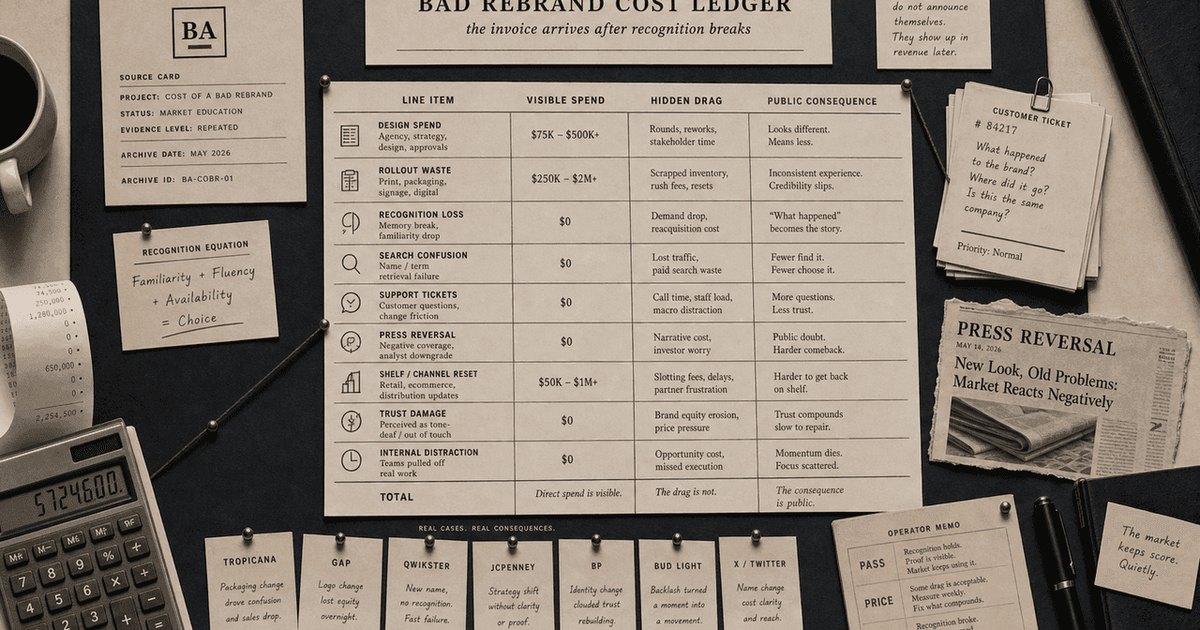
The cost of a bad rebrand is direct rebranding spend plus the drag created when buyers, staff, search results, press, and existing customers have to relearn the business. Count six buckets: strategy and design, rollout replacement, recognition loss, search and AI confusion, support and sales explanation time, and trust repair. Do not use one universal rebranding cost number. Use the formula: direct spend + rework + lost recognition + reacquisition + proof repair + opportunity cost.
Cost Map
Calculate the cost the invoice hides.
Theory
The invoice is only the first cost.
A bad rebrand can look affordable at approval and expensive after launch because the budget usually counts production, not behavior change.
The hidden cost appears when the market has to relearn what it already knew: the name, visual cue, package, category, promise, search phrase, or reason to trust.
Design, strategy, packaging, signage, media, legal work, digital implementation, staff training, and launch content are the first line items. The larger burden can be slower recognition, weaker search, support questions, sales friction, press doubt, lost internal focus, and the cost of explaining the change.
Good analysis does not pretend every revenue drop comes from the rebrand. It asks what the change made harder: finding the brand, recognizing the offer, trusting the promise, buying the product, defending the decision, or repairing public doubt.
A useful cost model has four verdicts: proceed because the old system costs more, narrow the change to protect recognition, delay until proof is stronger, or stop because the rebrand is trying to solve the wrong problem.
How To Price It
Use a cost ledger before the creative presentation.
A rebrand cost ledger should not stop at agency fees or launch production.
Map where the market, staff, systems, search results, customers, and press will absorb the change. The right question is what the work costs and what the change makes harder.
01
1. Price direct spend and rework.
Count strategy, naming, design, legal checks, domain and handle work, signage, packaging, templates, website migration, sales materials, staff training, launch content, media, and the cost of changing it again if the market rejects the move.
02
2. Price recognition loss.
If customers cannot spot, say, remember, or search the brand as quickly, the company may pay again through media, discounts, support scripts, sales explanation, local search cleanup, or reversal.
03
3. Price proof repair.
When the new identity makes a larger promise, the brand may have to spend more on product fixes, service recovery, trust content, source cleanup, proof pages, reviews, guarantees, and leadership explanation.
04
4. Price opportunity cost.
A team working on a weak rebrand is not fixing the offer, product, sales flow, proof, service, pricing, channel, or search page that may be causing the real revenue problem.
Decision Patterns
Bad rebrand cost shows up in different accounts.
Some costs hit the budget. Others appear in customer behavior, search data, support load, media coverage, conversion rate, retention, and trust.
The practical work is to decide which account the change is likely to hit first, then write the measurement plan before launch.
01
Sales drag appears when a buying cue moves.
If the old cue helped people find the product quickly, moving it can slow the purchase before anyone reads the new story. Watch branded search, direct traffic, store findability, product-page conversion, and sales objections.
02
Search drag appears when public language changes.
A new name can make the company easier to explain internally and harder to retrieve in public. Watch old-name searches, misspellings, review surfaces, AI summaries, knowledge panels, redirects, and third-party articles.
03
Trust drag appears when the claim becomes attackable.
A rebrand that claims responsibility, future technology, safety, community, or progress can raise the standard of proof overnight. Watch press language, review language, support themes, employee explanations, and proof-page visits.
Bad Decisions
The bad math starts before launch.
Teams often budget the visible work and miss the customer work.
A cost read should be conservative, source-backed, and honest about mixed causes. Numbers without sources are decoration. A ledger with clear assumptions is useful.
01
Mistake: budgeting design and forgetting recognition.
A new look is cheaper than a new memory system. Recognition has to be protected, trained, or bought back.
02
Mistake: claiming causality too cleanly.
Some failures have many causes. A useful ledger says what the rebrand changed, what it exposed, and what the sources can prove.
03
Mistake: treating reversal as the only cost.
Undoing the launch does not undo the doubt. Customers, press, staff, and search systems may keep the failed story alive.
Bad Rebrand Cost FAQ
How much does a bad rebrand cost?
There is no universal number. Calculate direct spend, rollout scope, rework, recognition loss, search confusion, support load, sales explanation time, reversal, press coverage, proof repair, and trust damage. Any dollar range needs sources and scope.
What is included in rebranding cost?
A serious rebranding cost model includes strategy, naming, design, legal review, domains, handles, signage, packaging, website migration, redirects, templates, sales materials, training, launch media, support scripts, monitoring, and contingency if recognition drops.
What is the formula for rebranding cost risk?
Use this working formula: direct spend + rework + lost recognition + reacquisition + proof repair + opportunity cost. Then attach evidence to each line instead of pretending one average price fits every company.
What costs are often missed?
Teams often miss reacquisition cost, customer explanation work, internal distraction, staff time, lost search clarity, support tickets, and the cost of rebuilding old trust.
When is a rebrand too expensive?
A rebrand is too expensive when it costs more recognition than it fixes, when the old problem is proof or offer clarity, or when the company has no plan to bridge search, customers, staff, and public source memory.
Can a rebrand cause a company to fail?
Sometimes a rebrand contributes to a larger failure, but the claim needs strong evidence. Many rebrands expose or accelerate problems rather than causing them alone.
What is the fastest way to reduce rebrand cost?
Protect the cues customers already use, bridge the change publicly, test weak-attention recognition, and make the business proof visible before launch.
What should a rebrand budget include?
Include strategy, design, legal, rollout, signage, packaging, digital updates, media, training, support scripts, monitoring, and a contingency plan if recognition drops.