Grow Your Brand Brand lesson · The Cost When ChatGPT Recommends a Competitor 2026-07-18
Grow Your Brand Plain brand guides for clearer words, stronger proof, and cleaner decisions.

Branding guide · evidence and decision

The Cost When ChatGPT Recommends a Competitor

Use this AI recommendation loss check to estimate demand risk, find public proof gaps, and decide what to change when answer engines name a competitor.

Direct Answer There is no honest universal percentage for the cost when ChatGPT recommends a competitor. Estimate the loss as affected buyer questions times assisted-research share times competitor recommendation gap times conversion rate times average deal value. Then add the second-order cost: higher CAC, weaker branded search, sales objections, proof repair, and weaker citation authority. The fix is usually not one prompt. It is better public evidence, clearer category language, stronger comparison pages, cleaner entity data, and proof an answer engine can cite.
Read the verdict before the deck. The cost formula and what it can prove.
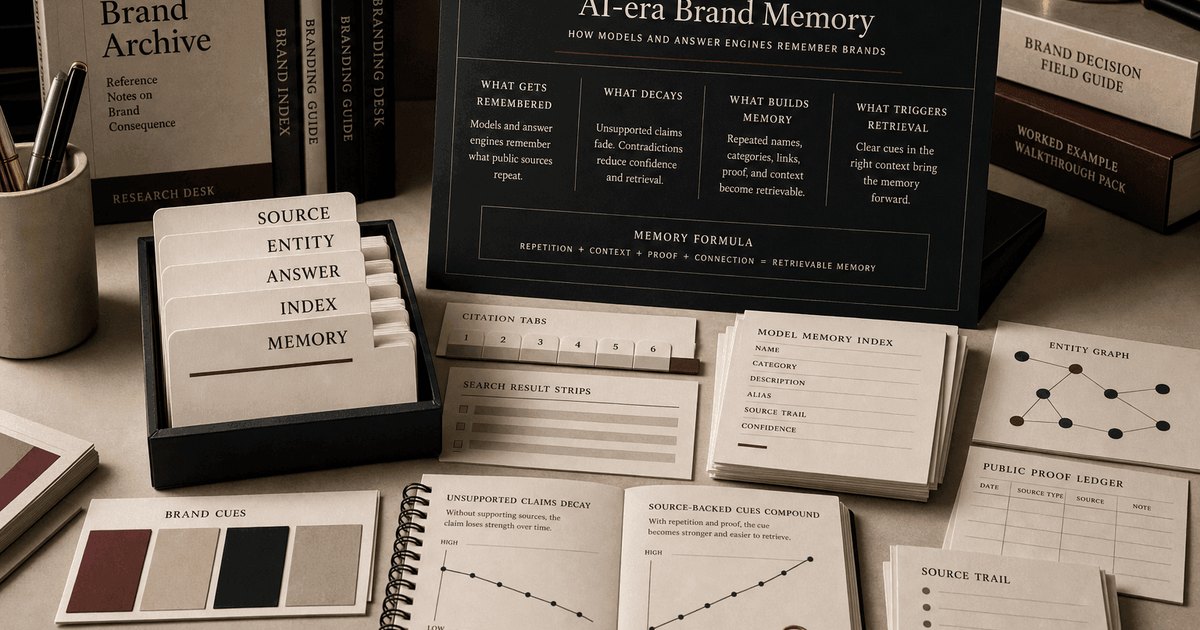
AI recommendation loss is a public-record problem before it is a prompt problem. When ChatGPT, Perplexity, Gemini, or another answer system names a competitor and skips your brand, the answer may feel random. Treat it as a clue until the query set proves otherwise.
The Cost When ChatGPT Recommends a Competitor archive visual

Cost When Chatgpt Recommends Competitor

decision · proof · use

A practical brand lesson built around the evidence, the decision, and what to check next.
01

Direct Answer

Direct Answer There is no honest universal percentage for the cost when ChatGPT recommends a competitor. Estimate the loss as affected buyer questions times assisted-research share times competitor recommendation gap times conversion rate times average deal value. Then add the second-order cost: higher CAC, weaker branded search, sales objections, proof repair, and weaker citation authority. The fix is usually not one prompt. It is better public evidence, clearer category language, stronger comparison pages, cleaner entity data, and proof an answer engine can cite.
02

Read the verdict before the deck.

Read the verdict before the deck. The cost formula and what it can prove.
Evidence 2 Separate prompt noise from public proof gaps.
Evidence 3 Measure query, citation, entity, proof, and recovery gaps.
Evidence 4 Perplexity, ChatGPT, Gemini, Stripe, Zappos, and X.
Evidence 5 Move from loss estimate to proof repair.
Point 1

Find the recommendation leak

03

AI recommendation loss is a public-record problem before it is a prompt problem.

AI recommendation loss is a public-record problem before it is a prompt problem. When ChatGPT, Perplexity, Gemini, or another answer system names a competitor and skips your brand, the answer may feel random. Treat it as a clue until the query set proves otherwise.
Evidence 2 Start with the buyer question. If the query asks for a category, use case, comparison, price risk, local service, or best option, the system needs public evidence that lets it place and defend a recommendation.
Evidence 3 A competitor may win the answer because it has cleaner category language, more recent sources, clearer product pages, stronger reviews, named cases, comparison pages, source trails, third-party mentions, or entity data that is easier to connect.
Evidence 4 Do not turn one bad AI answer into a panic rebrand. Test a set of real buyer questions, log the tool and date, compare the same prompts across competitors, and look at the cited sources before choosing a fix.
Evidence 5 The financial estimate should be a range with named assumptions. A fake benchmark is worse than no estimate because it hides the exact leak the business needs to repair.
Evidence 6 These files show how answer systems depend on source trails, plain behavior, category clarity, and public language that survives retrieval.
Point 1

Perplexity source trails became part of the product promise

Point 2

ChatGPT the interface gave people a plain way to ask and repeat questions

Point 3

Gemini one AI name reduced product-memory sprawl

Point 4

Stripe developer and infrastructure proof made the category easier to defend

Point 5

Zappos visible service behavior carried trust after the purchase risk

Point 6

X old public vocabulary kept pulling retrieval toward the old name

04

Run the AI recommendation loss check.

Run the AI recommendation loss check. Measure the leak before changing the brand. Keep the prompts, dates, tools, cited sources, and assumptions in the same sheet so the result can be repeated.
Evidence 2 List 20 to 50 buyer questions where a recommendation could move revenue: best option, category choice, alternative, comparison, pricing, local fit, use case, risk, and problem language.
Evidence 3 Every query should map to a real buyer moment, not a vanity prompt.
Evidence 4 Run the same query set across the same tools and count when your brand appears, when the competitor appears, and when neither brand appears.
Evidence 5 Use the same prompt wording, date, model or tool, location assumptions, and logged output.
Evidence 6 Record which sources the answer uses when it recommends the competitor or explains the category.
Evidence 7 Separate owned pages, third-party coverage, reviews, directories, documentation, case pages, and comparison pages.
Evidence 8 check whether the system can tell the company, product, parent, old name, location, offer, category, and primary URL apart.
Evidence 9 Fix schema, canonical URLs, profiles, redirects, naming pages, and directory records that conflict.
Evidence 10 Compare what the competitor can prove publicly against what your site proves publicly.
Evidence 11 Look for named customers, outcomes, process, constraints, reviews, guarantees, pricing, documentation, source lists, and current examples.
Evidence 12 If the answer engine does recommend you, check whether it can point to a useful next page.
Evidence 13 The recommended URL should answer the buyer question and lead to a clear action, not a vague homepage.
Evidence 14 Name the proof asset the competitor has that you do not have yet.
Evidence 15 Examples: comparison page, third-party review page, case study, technical doc, pricing page, source-backed guide, local page, or category definition.
Evidence 16 Turn the check into fixes: page rewrites, comparison pages, proof pages, schema, third-party profile cleanup, AI/LLM files, internal links, redirects, and source lists.
Evidence 17 Each fix needs an owner, route, evidence source, and next measurement date.
Evidence 18 Estimate cost with a range: affected buyer questions times assisted-research share times competitor recommendation gap times conversion rate times average deal value.
Evidence 19 Write assumptions beside the number. If one input is unknown, mark it unknown instead of inventing certainty.
Evidence 20 Decide whether the next move is proof repair, category-language repair, comparison-page build, entity cleanup, buyer-path repair, outside-source work, or stop.
Evidence 21 No verdict means the page will become another generic AI visibility task with no owner.
05

The expensive mistake is approving the surface before the proof.

The expensive mistake is approving the surface before the proof. A decision page has to prevent a bad approval, not merely define a term.
Evidence 2 The weak version starts with a familiar sentence: the logo feels old, the website looks tired, the name sounds generic, the message feels flat, or AI describes the brand like everybody else. Those may be real symptoms. They are not yet a decision reason.
Evidence 3 The useful move is to name the broken layer. Is the customer unable to recognize the brand, trust the proof, understand the offer, repeat the name, cite the source, or take the next action? Each answer points to a different repair.
Evidence 4 Do not let the team buy a new surface while the old constraint stays untouched. If the problem is proof, the work is proof. If the problem is retrieval, the work is source and category clarity. If the problem is recognition, the work is protecting the cue before changing it.
Evidence 5 The stop rule should be written before the spend moves: what signal pauses the project, who owns the decision, and what happens if the change makes branded search, qualified leads, trust, or buyer comprehension worse?
Evidence 6 Perplexity, ChatGPT, Gemini, Stripe, Zappos show why the same surface move can mean different things under different constraints.
Point 1

Perplexity source trails became part of the product promise

Point 2

ChatGPT the interface gave people a plain way to ask and repeat questions

Point 3

Gemini one AI name reduced product-memory sprawl

Point 4

Stripe developer and infrastructure proof made the category easier to defend

Point 5

Zappos visible service behavior carried trust after the purchase risk

Point 6

X old public vocabulary kept pulling retrieval toward the old name

06

Move from this check into the written decision.

Point 1

How AI Search Engines Choose Brands : understand source trails, category fit, and public proof.

Point 2

Answer Engine Optimization Examples : see the query, winner, citation, gap, and repair pattern.

Point 3

AI Brand Compression Test : check whether machines describe you like competitors.

Point 4

How to Structure Your Brand So AI Cites You : make the public record easier to retrieve and cite.

Point 5

Why Your Brand Isn't Working : identify whether proof, offer, website, or identity is the real problem.

07

The Cost When ChatGPT Recommends a Competitor FAQ

The Cost When ChatGPT Recommends a Competitor FAQ There is no honest universal percentage. Estimate the cost from your own demand: affected buyer questions, assisted-research share, competitor recommendation gap, conversion rate, and average deal value.
Evidence 2 Build a query set, run the same prompts across the same tools, log the date and output, count brand appearances against competitors, and record which sources each answer cites.
Evidence 3 Common reasons include clearer competitor category language, stronger public proof, better comparison pages, more current sources, cleaner entity data, reviews, documentation, or third-party profiles the system can use.
Evidence 4 Do not build the recovery plan around paid placement. Treat durable recommendation as a public-proof problem unless a specific platform offers a clearly labeled paid unit you can measure separately.
Evidence 5 Fix the source gap closest to the buyer question: category page, comparison page, proof page, pricing page, reviews, entity data, canonical URL, local page, or cited source list.
Evidence 6 Test monthly for important buyer questions and after major page, proof, product, review, or entity-data changes. Keep prompts and assumptions consistent so the trend means something.
Evidence 7 Useful evidence includes clear category language, source-backed claims, named examples, case studies, reviews, documentation, pricing clarity, comparison pages, schema, canonical URLs, and consistent third-party profiles.
Point 1

What does it cost when ChatGPT recommends a competitor?

Point 2

How do I measure AI recommendation loss?

Point 3

Why does ChatGPT recommend competitors and not us?

Point 4

Can I pay to be recommended by ChatGPT?

Point 5

What should we fix first?

Point 6

How often should we test AI recommendations?

Point 7

What evidence helps answer engines cite a brand?

08