Brand Entity / McDonald's branding strategy
McDonald's: branding strategy
McDonald's is filed as a repeatability brand: the arches, service rhythm, franchise standards, and menu memory make fast food easier to choose again.

Short Answer
McDonald's is filed here for one job: McDonald's branding strategy. The McDonald's file proves that salience can come from operations the customer meets repeatedly.
Reader Task
What this brand entry should help you finish
Use this file to answer the McDonald's brand question without falling into a company-history summary. The task is to understand the main McDonald's branding strategy pattern, check the sourced facts, open the primary case (McDonald's and the Service system that helped Fast Food Repeatable), and leave with a lesson or risk that can be compared against another brand. The file has 1 filed case, so the next step should be clear before the reader leaves.
Fact Panel
McDonald's facts
Only sourced facts render here. Unsourced company-history rows stay out of the page.
- Founded
- 1940; McDonald's Corporation founded in 1955 Source
- Founders
- Richard McDonald, Maurice McDonald, and Ray Kroc Source
- Parent / ownership
- McDonald's Corporation (NYSE: MCD) Source
- Category
- Quick-service restaurant Source
- Home market
- Chicago, Illinois, United States Source
- Distinctive assets
- Golden Arches, Service repeatability
- Status
- Active Source
- Decisions on file
- 1 filed case
What McDonald's teaches
The useful brand entry does not ask whether McDonald's is famous. It asks what the filed decision record teaches that a reader can use on another brand.
- Main lesson: The McDonald's file proves that salience can come from operations the customer meets repeatedly.
- Reader check: Inspect the system behind the mark: menu simplification, standards, speed, place memory, and the buying ritual.
- Failure mode: The risk is reading the brand only through advertising when the durable proof sits in service speed, routine, and recognizability.
- Filed case: McDonald's: Scale turns into brand equity only when repeatability is governed. A famous sign can attract a customer once, but the system underneath has to make the next visit read reliably familiar.
Mistake To Catch
Where the McDonald's reading breaks
The risk is reading the brand only through advertising when the durable proof sits in service speed, routine, and recognizability.
The weak read is to stop at the familiar name. The stronger read is to ask which decision changed recognition, trust, habit, distribution, product proof, or public memory.
That is the useful job of the brand entry: keep the famous name attached to a decision the reader can inspect.
Decision Depth
Read McDonald's as repeatability, more than arches and advertising.
This section turns the brand name into an inspection path: what changed, what broke, what worked, and what to compare next.
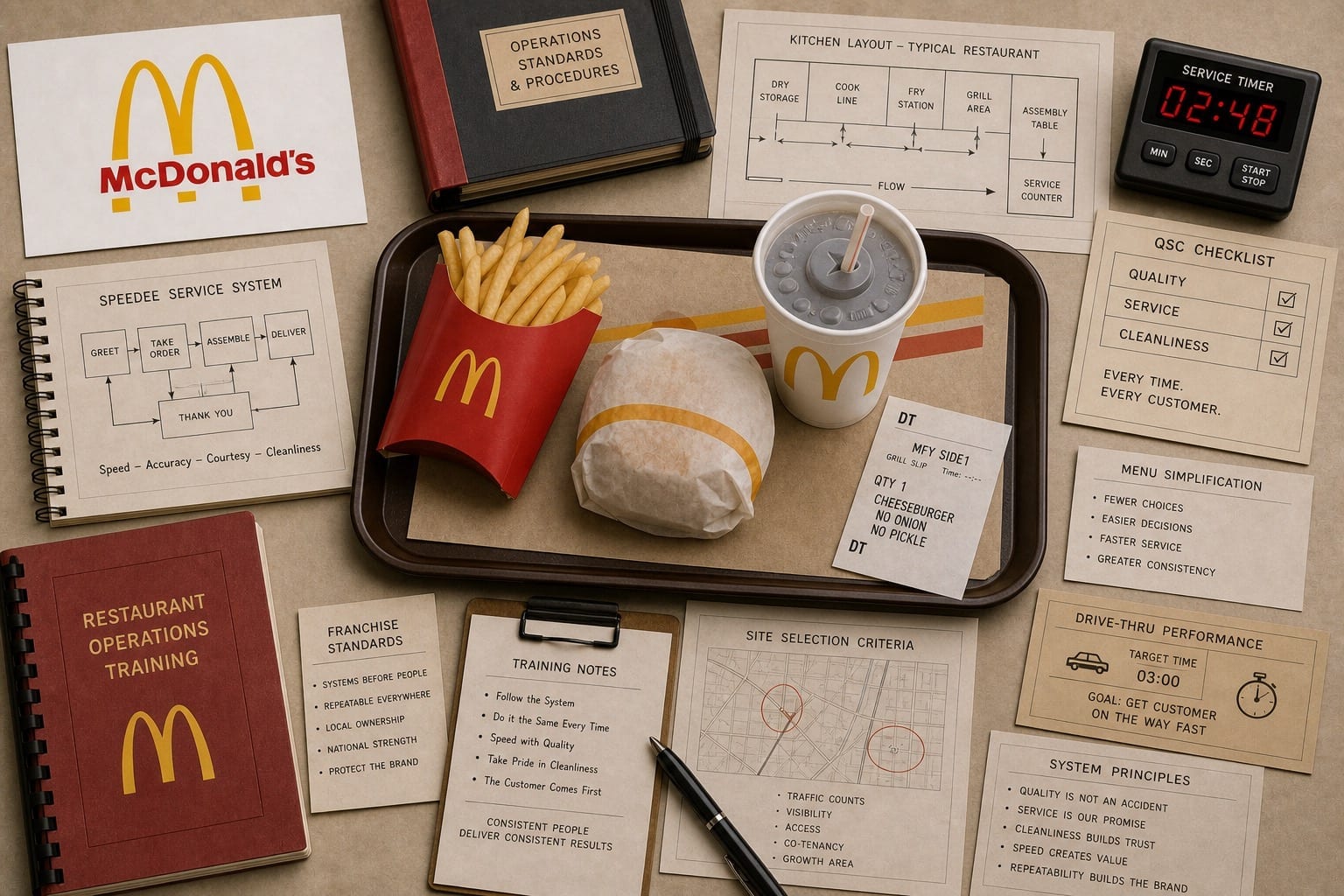
McDonald's should be read through repetition. The arches matter because the service rhythm, menu memory, store layout, price cues, kids' memories, drive-through behavior, and franchise standards keep retraining the choice.
Advertising can refresh the brand, but operations carry the promise. A customer who wants fast, familiar, predictable food is buying less uncertainty.
The inspection path is menu simplification, queue behavior, drive-through, breakfast rituals, family memory, franchise control, local adaptation, and the global meaning of the arches.
A weak reading treats McDonald's as a famous logo. A stronger reading asks how many small repeated behaviors keep the logo useful.
Use this file before copying a mass-market icon. The approval test is whether the business can repeat the promise across locations, staff, time, and customer expectations.
The copycat mistake is borrowing the visual confidence of a scaled brand without the operating discipline that makes scale trustworthy.
The McDonald's page should also make the reader inspect the negative side of repeatability. Scale exposes weak service, menu confusion, labor strain, local mismatch, and quality inconsistency faster than a smaller system would.
The practical lesson is to protect the repeatable core before adding novelty. Limited offers, app deals, menu changes, and local adaptations have to strengthen the default trip instead of making it harder to understand.
A McDonald's check should start with the default order. What does the buyer expect to happen in the first minute, at the counter, in the app, at the drive-through, and after the food arrives?
The brand lesson is that salience is operational. The arches remind people because the company has trained a repeated path behind them.
Decision timeline
The timeline is the reason this brand has a parent page. Each row points to a filed case, then names the consequence a reader should carry into the next comparison.
For brands with one case, the timeline still matters because it prevents a thin profile. The brand page becomes the router, and the case page remains the proof.
| Filed decision | What happened | What it teaches |
|---|---|---|
| McDonald's and the Service system that helped Fast Food Repeatable Launch / 1948-present |
McDonald's made fast food into a repeatable brand system by combining a simplified menu, service speed, franchise standards, operations training, site discipline, and product consistency. | Scale turns into brand equity only when repeatability is governed. A famous sign can attract a customer once, but the system underneath has to make the next visit read reliably familiar. |
Source test
The source trail below is inherited from the filed cases, including company records, campaign records, public reports, source-mark files, or archived references where the original page moved.
Use the source list to verify the facts. Use the case links to inspect the decision. Use the comparison links to test whether the McDonald's pattern repeats somewhere else.
Visual proof
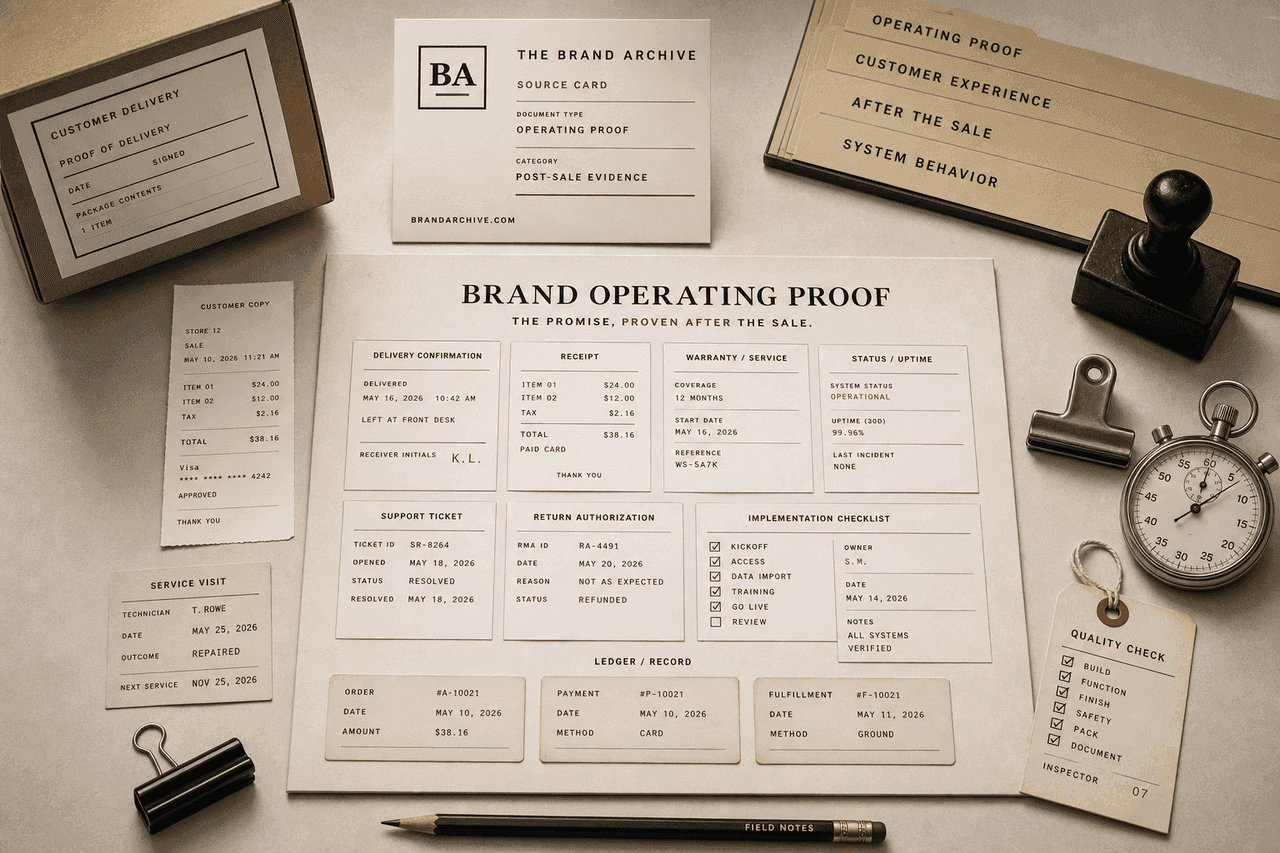
The hero image for this brand page uses the strongest generated editorial visual already attached to the primary case: McDonald's and the Service system that helped Fast Food Repeatable. It stays tied to filed evidence instead of becoming a generic brand mood image.
That visual rule matters for this build. Every brand page needs a high-end image, but the image has to point back to the decision: packaging, mark, product behavior, service proof, ritual, failure, or trust pressure.
If a future brand has no strong visual, it does not pass the entity-page gate until the image is generated or replaced.
Sources

People Also Ask
What happened to McDonald's, and what should readers inspect?
The McDonald's file proves that salience can come from operations the customer meets repeatedly. Start by inspecting this point: Inspect the system behind the mark: menu simplification, standards, speed, place memory, and the buying ritual.
What does McDonald's teach about branding?
The McDonald's file proves that salience can come from operations the customer meets repeatedly.
What should readers inspect first in the McDonald's file?
Inspect the system behind the mark: menu simplification, standards, speed, place memory, and the buying ritual.
What is the main risk in the McDonald's file?
The risk is reading the brand only through advertising when the durable proof sits in service speed, routine, and recognizability.
Which McDonald's case should readers open first?
Start with McDonald's and the Service system that helped Fast Food Repeatable, because it is the primary filed case behind this brand file.