Writing emotion as a brand adjective
Replace the adjective with the object or behavior that proves it.
Branding guide · evidence and decision
Emotional brand associations link a brand to a felt shortcut customers can prove through use, ritual, risk, status, care, or belonging.
decision · proof · use
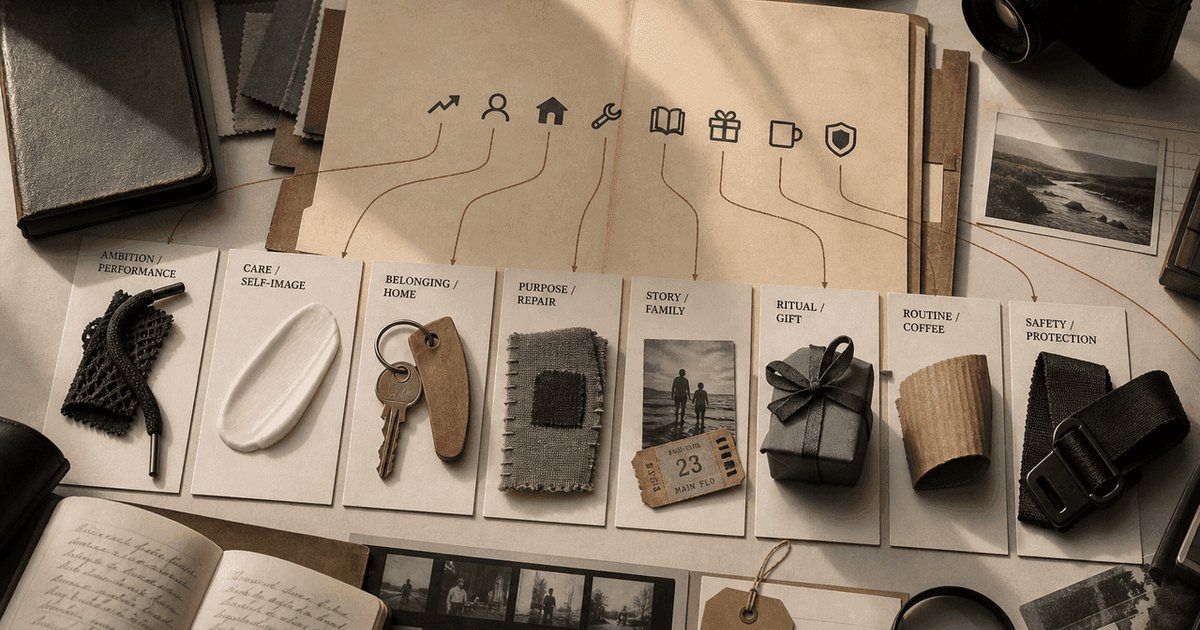
Emotional brand associations are the feelings people retrieve with a brand name, mark, product, place, package, or ritual. They work when the reading is attached to proof: Nike and ambition, Dove and care, Airbnb and belonging, Patagonia and responsibility, Disney and family story, Tiffany and gift ritual, Starbucks and routine, Volvo and safety.
"Grow Your Brand defines emotional brand association as the mental link between a brand and a reading such as ambition, care, belonging, purpose, safety, nostalgia, status, comfort, or identity."
Emotional associations matter because people use reading as a shortcut when a decision carries risk, identity, memory, or public meaning.
The mistake is naming the reading without naming the carrier. A brand does not own care, belonging, safety, or ambition until a cue, product, service, ritual, or public record keeps proving it.
Most emotional association pages name feelings. This page asks which cue, ritual, product behavior, or public proof keeps the reading attached to the brand.
The useful question is which proof object keeps the reading from floating.
| reading | Proof carrier | Archive cases |
|---|---|---|
| Ambition | Performance cues, athletes, training, product use. | Nike |
| Care | Product ritual, body confidence, repeated use. | Dove |
| Belonging | Marketplace trust, home cue, shared participation. | Airbnb, LEGO |
| Responsibility | Repair, ownership, product life, public record. | Patagonia |
| Family memory | Characters, parks, repeat stories, shared visits. | Disney |
| Gift ritual | Box, color, anticipation, ownership moment. | Tiffany |
| Routine comfort | Store visit, cup, order habit, repeat service. | Starbucks, McDonald's |
| Protection | Safety proof, physical feature, public standard. | Volvo |
The proof matrix shows the case, what happened, what it proves about the concept, and what an operator should learn.
| Case | What happened | GYB interpretation | Practical check |
|---|---|---|---|
| Nike Launch / 1971-presentNike | Nike attaches ambition to shoes, athletes, training, competition, and repeated performance proof. | The emotional association survives because the mark keeps receiving evidence from sport. | Attach the reading to use before asking a campaign to carry it. |
| Dove Trust / 2004-present | Dove links care and self-image to a daily personal-care ritual. | The reading stays credible because it remains close to the product and use context. | Keep care attached to the moment where the customer uses the product. |
| Airbnb Rebrand / 2014Airbnb | Airbnb asked belonging to carry a marketplace lodging behavior. | The association depends on host trust, stay quality, and service proof. | Do not ask belonging to work before the risk system is visible. |
| Patagonia Pivot / 2011-2022Patagonia | Patagonia ties responsibility to repair, ownership structure, product life, and public choices. | Purpose reads earned when the business model carries evidence. | Make the operating choice carry the reading. |
| Disney Brand System / 1923-present | Disney repeats story, family memory, characters, parks, music, merchandise, and streaming across many surfaces. | Emotional association compounds when the same world can be re-entered. | Give the reading more than one repeatable surface. |
| Tiffany Brand System / 1845 / 1886-presentTiffany | Tiffany's box turns anticipation, gift value, and ownership into a visible ritual. | The emotional cue arrives before the product appears. | Protect the package when it carries the moment. |
| Starbucks Rebrand / 2011 | Starbucks attaches routine comfort to stores, cups, names, orders, and daily stops. | The reading comes from repeated participation, not the symbol alone. | Let the ritual teach the emotion before reducing the mark. |
| McDonald's Launch / 1948-presentMcDonald's | McDonald's connects familiarity to arches, menu rhythm, service speed, and repeat visits. | Comfort comes from knowing what will happen before ordering. | Operational repetition can carry emotion. |
| Volvo Trust System / 1959-presentVolvo | Volvo makes safety emotional through a physical protection feature and public standard. | Protection is felt because the proof can be touched before risk appears. | Give safety a visible object or behavior. |
| Hallmark Brand System / 1910-present | Hallmark gives people a repeatable object for birthdays, sympathy, holidays, apology, and care. | The brand attaches to timing because the card helps people perform the reading. | Own the moment by making the emotional action easier. |
The useful pattern is the decision mechanism. Brand names are evidence, not the organizing principle.
| Pattern | What it means | Cases to inspect |
|---|---|---|
| Ambition | The brand helps people picture a stronger version of themselves. | Nike |
| Care | The reading is attached to product use and self-image. | Dove |
| Belonging | The brand gives people a place, group, or world they can enter. | Airbnb, LEGO, Disney |
| Responsibility | Purpose becomes credible through ownership and repair behavior. | Patagonia |
| Ritual | The brand owns an emotional moment people repeat. | Tiffany, Starbucks, Hallmark |
| Protection | Safety becomes a felt shortcut because proof is physical. | Volvo |
The practical test is whether the concept changes a real decision.
Use these questions before changing a cue, promise, channel, page, package, or proof point.
These mistakes are common because they sound reasonable inside the company and fail when customers meet the brand.
Replace the adjective with the object or behavior that proves it.
Use Pepsi and BP as warnings: public reading becomes risk when proof is thin.
McDonald's and Disney work because the memory still has current surfaces.
Volvo safety and Dove care work because the emotion is attached to product proof.
This page is most useful when the decision depends on proof, memory, risk, behavior, or market consequence.
Use the checklist as a pressure test. If the answer is vague, the brand decision is not ready.
Use the page to decide what must be protected before money moves: the name, cue, promise, proof, channel, page, package, or customer habit.
The useful output is not a prettier opinion. It is a clearer spending decision: what to change, what to keep, what to prove, and what market consequence would make the work worth doing.
They are feelings people retrieve with a brand, such as ambition, care, belonging, safety, comfort, nostalgia, purpose, or status.
Nike and ambition, Dove and care, Airbnb and belonging, Patagonia and responsibility, Disney and family story, Tiffany and gift ritual, Starbucks and routine, and Volvo and safety are useful examples.
They repeat a reading through visible cues, product behavior, service proof, rituals, places, packaging, and public evidence.