Brand Entity / Coca-Cola branding and New Coke
Coca-Cola: branding and New Coke
Coca-Cola is filed as a memory-ownership brand: New Coke and the white holiday can show how formula, color, ritual, and package cues carry public ownership.
Short Answer
Coca-Cola is filed here for one job: Coca-Cola branding and New Coke. The Coca-Cola file proves that customers can treat a brand asset as theirs even when the company owns the trademark.
Reader Task
What this brand entry should help you finish
Use this file to answer the Coca-Cola brand question without falling into a company-history summary. The task is to understand the main Coca-Cola branding and New Coke pattern, check the sourced facts, open the primary case (New Coke and the Error of Replacing Memory), and leave with a lesson or risk that can be compared against another brand. The file has 2 filed cases, so the next step should be clear before the reader leaves.
Fact Panel
Coca-Cola facts
Only sourced facts render here. Unsourced company-history rows stay out of the page.
- Founded
- 1886 as Coca-Cola; The Coca-Cola Company incorporated in 1892 Source
- Founders
- John S. Pemberton Source
- Parent / ownership
- The Coca-Cola Company (NYSE: KO) Source
- Category
- Carbonated soft drink Source
- Home market
- Atlanta, Georgia, United States Source
- Distinctive assets
- Coca-Cola script, Red can memory
- Status
- Active Source
- Decisions on file
- 2 filed cases
What Coca-Cola teaches
The useful brand entry does not ask whether Coca-Cola is famous. It asks what the filed decision record teaches that a reader can use on another brand.
- Main lesson: The Coca-Cola file proves that customers can treat a brand asset as theirs even when the company owns the trademark.
- Reader check: Inspect the original formula memory, red-can recognition, variant confusion, and the backlash that made customer ownership visible.
- Failure mode: The risk is measuring product preference while missing ritual, color memory, and symbolic ownership.
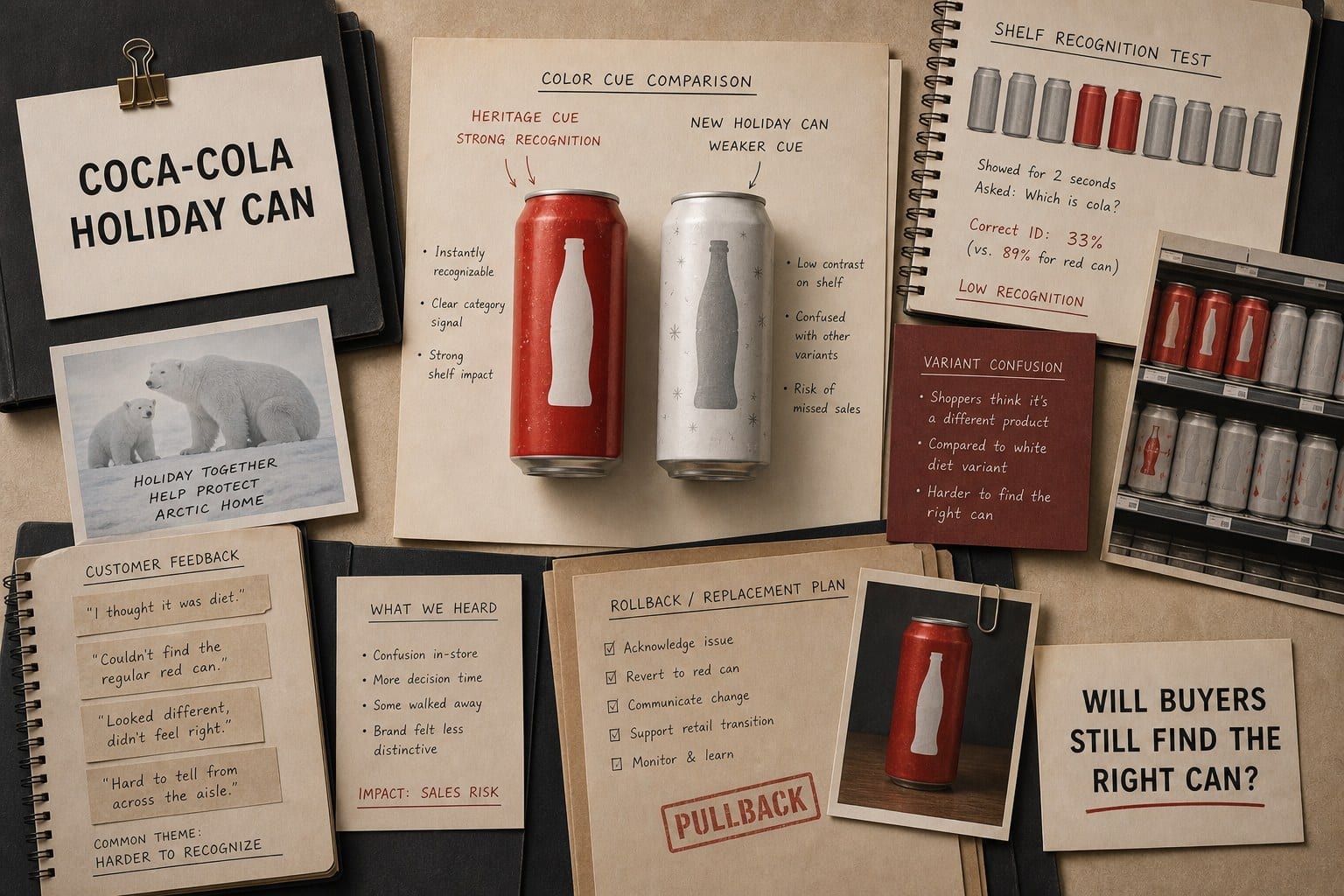
- Filed case: Coca-Cola: Color can be a product selector. Before changing packaging color, test whether the new look breaks flavor, variant, shelf, and habit recognition.
- Filed case: Coca-Cola: A brand can hold value that does not appear in product testing. When ritual and memory are part of the asset, replacing the product can read as a transfer of control away from the customer.
Mistake To Catch
Where the Coca-Cola reading breaks
The risk is measuring product preference while missing ritual, color memory, and symbolic ownership.
The weak read is to stop at the familiar name. The stronger read is to ask which decision changed recognition, trust, habit, distribution, product proof, or public memory.
That is the useful job of the brand entry: keep the famous name attached to a decision the reader can inspect.
Decision Depth
Read Coca-Cola as customer-owned memory, more than a beverage brand.
This section turns the brand name into an inspection path: what changed, what broke, what worked, and what to compare next.
The Coca-Cola file is useful because the company owns the trademark but customers help own the memory. Formula, red color, contour shape, ritual, shelf location, holidays, restaurants, and ordinary language all carry part of the brand.
New Coke is more than a taste story. It is a decision about measuring product preference while underestimating what the original formula meant in public life.
The white holiday can adds a second lesson. Even a temporary package can create confusion when it removes the cue buyers use to find the product quickly.
A weak reading says customers dislike change. A stronger reading asks which assets customers already use as shortcuts and which changes need bridge cues before launch.
Use this file before changing formula, packaging, color, flavor hierarchy, or variant architecture. The approval test is whether loyal and casual buyers can still identify the right product without explanation.
The copycat mistake is treating nostalgia as old-fashioned. In this case, memory is a working asset because it lowers choice friction at shelf, fountain, restaurant, and holiday moments.
Decision timeline
The timeline is the reason this brand has a parent page. Each row points to a filed case, then names the consequence a reader should carry into the next comparison.
For brands with one case, the timeline still matters because it prevents a thin profile. The brand page becomes the router, and the case page remains the proof.
| Filed decision | What happened | What it teaches |
|---|---|---|
| Coca-Cola and the White Holiday Can That Broke Variant Recognition Failure / 2011 |
Coca-Cola's white holiday can showed why packaging color is not seasonal decoration when buyers use the color to separate the original product from nearby variants. | Color can be a product selector. Before changing packaging color, test whether the new look breaks flavor, variant, shelf, and habit recognition. |
| New Coke and the Error of Replacing Memory Failure / 1985 |
The product test measured preference. The market response revealed ownership, ritual, and identity sitting underneath the formula decision. | A brand can hold value that does not appear in product testing. When ritual and memory are part of the asset, replacing the product can read as a transfer of control away from the customer. |
Source test
The source trail below is inherited from the filed cases, including company records, campaign records, public reports, source-mark files, or archived references where the original page moved.
Use the source list to verify the facts. Use the case links to inspect the decision. Use the comparison links to test whether the Coca-Cola pattern repeats somewhere else.
Visual proof
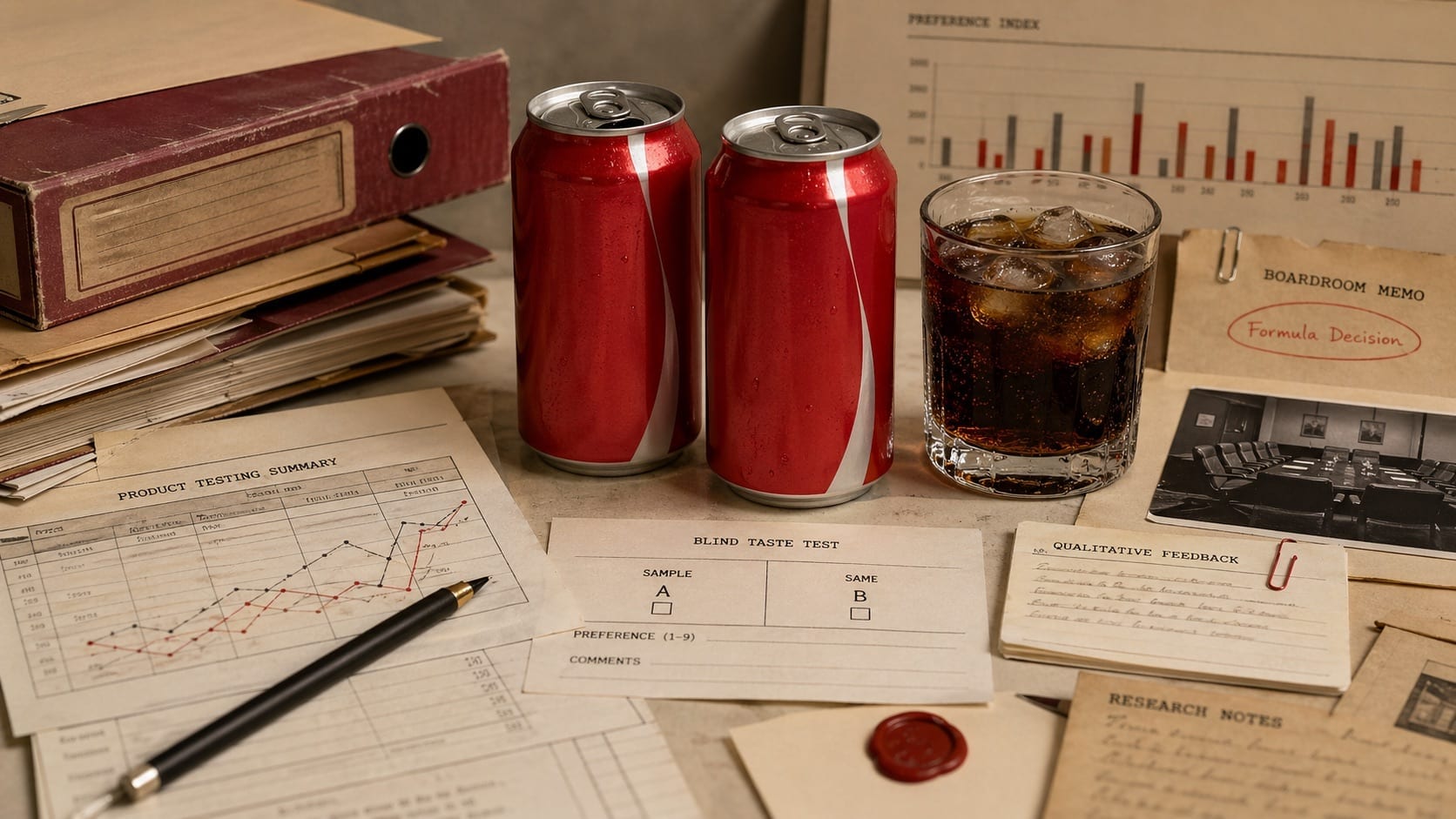
The hero image for this brand page uses the strongest generated editorial visual already attached to the primary case: New Coke and the Error of Replacing Memory. It stays tied to filed evidence instead of becoming a generic brand mood image.
That visual rule matters for this build. Every brand page needs a high-end image, but the image has to point back to the decision: packaging, mark, product behavior, service proof, ritual, failure, or trust pressure.
If a future brand has no strong visual, it does not pass the entity-page gate until the image is generated or replaced.
Sources
- The Coca-Cola Company, Arctic Home campaign PDF
- Packaging World, what went wrong with Coke's 2011 holiday can design
- Coca-Cola logo asset, Wikimedia Commons
- The Coca-Cola Company, New Coke: The Most Memorable Marketing Blunder Ever?
- The Coca-Cola Company, Veteran Employees Remember Infamous 1985 Launch of New Coke, April 23, 2015
- HISTORY, New Coke debuts, one of the biggest product flops in history, updated May 27, 2025
- HISTORY, Why Coca-Cola's New Coke Flopped, updated May 27, 2025
- Encyclopaedia Britannica, New Coke, updated February 23, 2026
- Snopes, Was the New Coke Fiasco Just a Clever Marketing Ploy?
- Wikimedia Commons, New Coke can


People Also Ask
What happened to Coca-Cola, and what should readers inspect?
The Coca-Cola file proves that customers can treat a brand asset as theirs even when the company owns the trademark. Start by inspecting this point: Inspect the original formula memory, red-can recognition, variant confusion, and the backlash that made customer ownership visible.
What does Coca-Cola teach about branding?
The Coca-Cola file proves that customers can treat a brand asset as theirs even when the company owns the trademark.
What should readers inspect first in the Coca-Cola file?
Inspect the original formula memory, red-can recognition, variant confusion, and the backlash that made customer ownership visible.
What is the main risk in the Coca-Cola file?
The risk is measuring product preference while missing ritual, color memory, and symbolic ownership.
Which Coca-Cola case should readers open first?
Start with New Coke and the Error of Replacing Memory, because it is the primary filed case behind this brand file.