Failure / Luxury specialty retail / 1923-2019 / licensed brand asset
Barneys New York Failure Case: Luxury Retail Memory Collapse
Barneys New York is the luxury-retail collapse case for separating cultural memory from working retail economics, lease pressure, merchandising risk, vendor trust, and store traffic.
Short Answer
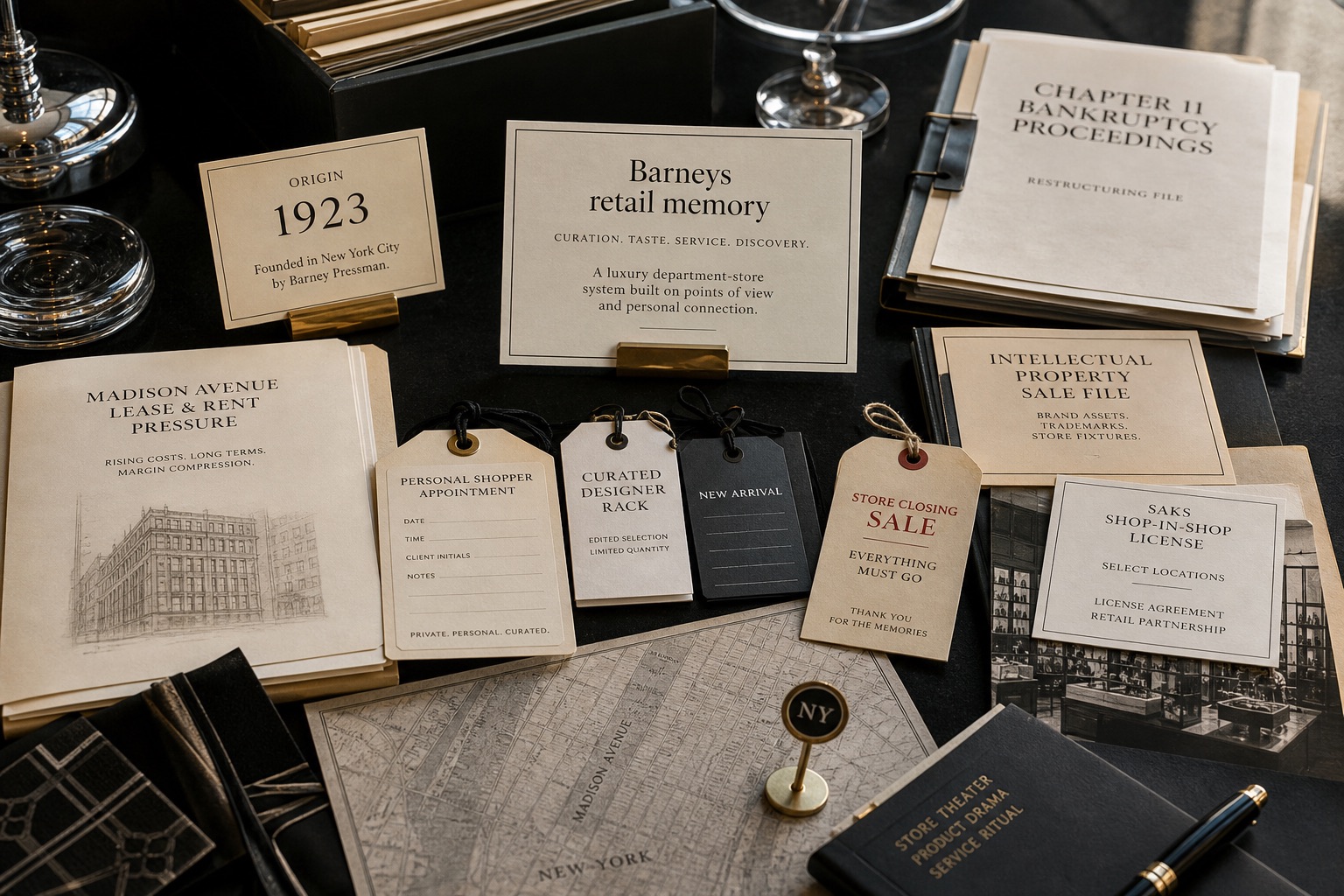
Barneys New York Failure Case: Luxury Retail Memory Collapse is a failure case about Barneys New York in 1923-2019 / licensed brand asset. Barneys had fashion memory, but the operating model still had to survive rent, inventory, digital competition, and a customer who could shop luxury elsewhere. Luxury retail memory is not a business model. The store has to prove why discovery, service, buying taste, location, vendor access, and economics still work together.
Reader Task
What this entry should help you finish
Use this entry to finish four jobs: answer what happened to Barneys New York, see why it belongs in the failure lane, inspect the decision consequence, and leave with the operator lesson. The point is not to remember the brand. The point is to know what decision, proof surface, or failure mode a team should check next. Then compare it with Pier 1 Imports, Sears, Bed Bath & Beyond before turning the case into a rule.
What Barneys New York teaches
- Barneys is a failure case because cultural taste could not protect the store system from bankruptcy and liquidation.
- The brand's discovery role mattered, but discovery needed traffic, vendor trust, rent control, and profitable repeat buying.
- A revived name has to rebuild merchant credibility, more than nostalgia.
- The weak copycat celebrates fashion influence while ignoring store economics.
- The repair test is whether the customer, designer, landlord, and operator all have a reason the store should exist now.
Why This Brand Belongs In Grow Your Brand
Barneys New York belongs in Grow Your Brand because the page studies a specific brand decision, not a company profile. The decision sits in failure and gives operators a way to see how operating layer changes commercial value.
The useful archive question is what changed in recognition, trust, demand, pricing power, category position, or public memory after the market saw the move.
The Brand Asset At Stake
The asset at stake is daily usage, uptime, distribution, account trust, partner tools, switching cost, and recovery when the service fails. That asset matters because it affects how people find, understand, choose, trust, or repeat the brand when the company is not in the room to explain itself.
For Barneys New York, the asset is not abstract equity. It has to show up in the buying surface, product surface, service route, source record, or repeated customer behavior.
What Changed
Barneys had fashion memory, but the operating model still had to survive rent, inventory, digital competition, and a customer who could shop luxury elsewhere.
The change forced the market to decide whether the old shortcut still worked, whether the new proof was strong enough, and whether the brand had made the category easier or harder to understand.
What The Market Learned
The market learned to judge Barneys New York through the gap between the visible move and the proof behind it. talking about scale, innovation, or ecosystem reach while hiding the exact behavior people repeat is the weak reading this page is meant to prevent.
A useful brand decision makes buying, remembering, trusting, or repeating easier. A weak decision makes the audience do more work before it believes the claim.
Commercial Consequence
The commercial consequence sits in operating layer: daily usage, uptime, distribution, account trust, partner tools, switching cost, and recovery when the service fails. When that proof becomes easier to see, customers have more reason to choose, trust, repeat, or pay attention. When it becomes harder to see, the brand has to spend more money explaining what the market used to understand faster.
Barneys New York matters because the decision changed more than presentation. It changed buyer confidence, memory, category position, or repeat behavior in luxury specialty retail. That is why the case belongs in a brand decision library instead of a general company profile.
What Another Brand Should Learn
Another brand should use this case before spending money on a similar move. Name the customer behavior, the proof surface, the protected cue, and the consequence that would make the decision worth the cost.
If the same proof does not exist in the business, copying Barneys New York would copy the surface while missing the reason the decision mattered.
The Decision Context
Barneys New York had a rare retail memory: discovery, risk, downtown taste, designer credibility, and a customer who wanted the store to read ahead of the department-store middle.
That memory did not remove the hard math. A luxury store still has to pay rent, buy inventory, keep vendors confident, drive traffic, control markdowns, and give shoppers a reason to choose the store over online luxury and brand-owned boutiques.
Taste Was The Asset
Barneys' strongest brand asset was editing. The store could make a designer, object, floor, or window read discovered before it became obvious.
That kind of taste is powerful but fragile. It depends on merchants, buyers, service, floor energy, and enough shoppers to make the edit economically useful.
Memory Could Not Pay The Lease
The collapse matters because it shows the limit of cultural equity. A store can be loved by fashion people and still fail if the operating structure no longer fits the market.
Luxury retail is especially exposed because the store costs are high and the customer can compare across boutiques, resale, online platforms, private clienteling, and travel shopping.
Where The Strategy Breaks
The strategy breaks when the store becomes a museum of its own influence. Customers may respect the name, but respect does not always create visits, baskets, or full-price sell-through.
It also breaks when licensing treats the name as enough. The Barneys cue needs an operating point of view: what gets bought, who edits it, why designers trust it, and why customers return.
The Bad Copycat
A bad copycat would copy black-and-white restraint, cool windows, designer language, and downtown attitude while ignoring rent, stock risk, staff knowledge, and vendor terms.
That produces a retail set, not a store. The customer can admire the scene and still buy somewhere else.
The Signal Reading
Barneys New York is filed here because it records the gap between brand memory and retail survival.
The decision test is whether a luxury retailer's cultural role still has a profitable store behavior attached to it.
The Evidence Standard
The evidence standard for Barneys New York is whether the public can inspect the luxury retail memory collapse without relying on admiration for the name.
Start with a luxury shopper, designer, buyer, landlord, or operator deciding whether the store still has a role. That reader does not need a tribute page. They need to know what decision became easier, safer, faster, clearer, or more repeatable.
The main risk is nostalgia hiding rent pressure, weak traffic, vendor doubt, inventory exposure, and a discovery role that no longer pays for the floor. A useful page has to name that risk before it praises the visible brand cue.
Inspect the public surfaces: store layout, buyer point of view, vendor terms, bankruptcy record, licensed revival plans, service behavior, and department economics. Those surfaces show whether the promise is operating or merely described.
The strongest proof is behavioral: the store name points to a current shopping behavior that can support the cost of operating it. If the page cannot show that, the brand idea is still too soft to teach.
A weak page would stop at history, recognition, and atmosphere. The stronger page has to connect those signals to a buying, service, product, or recovery event.
The check is practical: name the reason to visit, then check whether traffic, merchants, vendors, and economics support that reason. That is where brand language either becomes useful or gets exposed as decoration.
The decision lesson is to keep the visible cue attached to the work it performs. A name, mark, color, store, package, or interface should lower a real uncertainty.
Reader Inspection
Read Barneys New York as a Brand Signal Card, not as a brand profile. The page should answer what changed for the person using the system.
The first inspection question is what the customer feared before the brand did its job. If that fear is missing, the case becomes empty praise.
The second question is which evidence can be checked without trusting the company's adjectives. Public pages, filings, product paths, service routes, and visual assets should carry the claim.
The third question is where the copycat would fail. In this case, the failure usually appears when the visible cue is copied before the operating proof exists.
A strong case gives the reader a repair check they can run on their own brand. It should not leave them with mood, taste, or category admiration alone.
The page should also separate memory from current usefulness. A brand can be remembered and still fail the present decision.
Use the source trail to verify the claims. If a claim cannot be tied to an official page, filing, product surface, or credible public record, it should not carry the argument.
The final test is whether the reader can state the lesson in one operational sentence and know where to look for proof.
Compare Next
Related Cases
Do not read Barneys New York alone. Compare it against nearby cases: Pier 1 Imports, Sears, Bed Bath & Beyond; concept paths: Brand Memory Can Outlive the Business, /branding-guide/failed-brand-warning-signs/, Negative Brand Associations.
Sources
People Also Ask
What happened to Barneys New York?
Barneys New York Failure Case: Luxury Retail Memory Collapse is a failure case about Barneys New York in 1923-2019 / licensed brand asset. Barneys had fashion memory, but the operating model still had to survive rent, inventory, digital competition, and a customer who could shop luxury elsewhere. Luxury retail memory is not a business model. The store has to prove why discovery, service, buying taste, location, vendor access, and economics still work together.
Why is Barneys New York a failure case?
Barneys New York is filed as a failure case because the visible consequence sits in that decision pattern. Barneys had fashion memory, but the operating model still had to survive rent, inventory, digital competition, and a customer who could shop luxury elsewhere.
What can brands learn from Barneys New York?
Luxury retail memory is not a business model. The store has to prove why discovery, service, buying taste, location, vendor access, and economics still work together.
Is Barneys New York still operating?
Grow Your Brand marks Barneys New York as Failed U.S. luxury retail chain / licensed brand asset. That means the original company or core public business no longer operates in the form that made the brand famous, or the case has reached a terminal failed-brand status.
What should Barneys New York be compared with?
Compare Barneys New York with Pier 1 Imports, Sears, Bed Bath & Beyond to see the same decision pattern from nearby cases.