Mirroring the org chart
Build the public map around how customers choose, buy, use, renew, and recover.
Branding guide · evidence and decision
Brand architecture decides how names, products, sub-brands, and parent trust are organized.
decision · proof · use
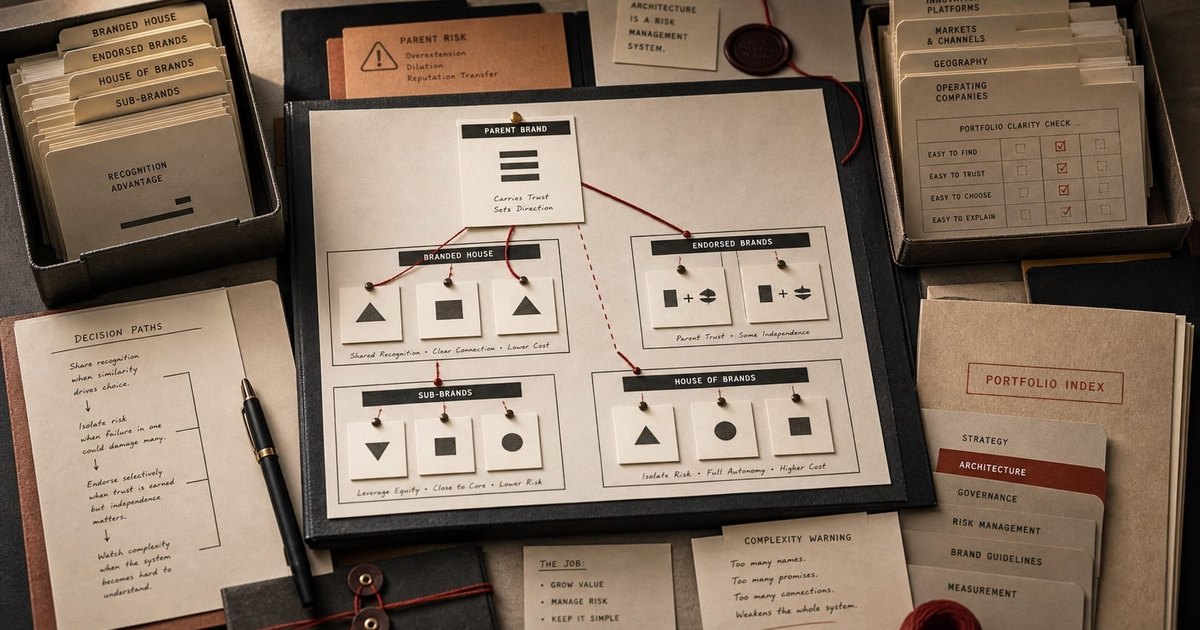
Brand architecture decides whether a company should use a branded house, house of brands, endorsed brands, sub-brands, product-led names, or a quiet parent. The question is larger than naming. It is how trust, risk, recognition, proof, and explanation move through the portfolio.
"Grow Your Brand defines brand architecture as the system that organizes parent brands, sub-brands, endorsed brands, product names, portfolio roles, and the trust risk that moves between them."
Architecture matters when one name has to stretch across products, markets, audiences, or risk levels. A bad architecture can make customers do company-structure work.
The common mistake is using internal org structure as public architecture. Customers do not care how the company is arranged. They need a usable map.
The architecture decision should say which name carries recognition, which name carries risk, and which name should stay quiet.
| Architecture choice | When it helps | Risk to inspect |
|---|---|---|
| Branded house | One parent name can carry trust across related offers. | A parent failure can spread across the portfolio. |
| House of brands | Separate brands need separate audiences, meanings, shelves, or risk profiles. | The parent may lose public trust advantage. |
| Endorsed brand | A child brand needs its own role but benefits from parent reassurance. | The endorsement can confuse if the parent promise is unclear. |
| Sub-brand | A variant needs distinction without leaving the parent system. | Too many sub-brands make customers decode company structure. |
| Quiet parent | The public brands carry the customer job while the owner carries governance, standards, and capital. | Ownership can be mistaken for proof if the front-facing brands stop working. |
| Product-led naming | The product behavior is clearer than a new brand story. | Feature names can age faster than the portfolio strategy. |
These files show architecture as customer work, trust transfer, risk separation, and portfolio memory.
| Case | What happened | GYB interpretation | Practical check |
|---|---|---|---|
| Qwikster Failure / 2011 | Netflix split DVD-by-mail into a separate named service during a pricing and product-change fight. | Architecture fails when it adds explanation at the same moment customers read cost and habit pressure. | Do not create a new name unless it reduces customer work. |
| Marriott Bonvoy Trust / 2016-2019 | A loyalty system had to organize many hotel brands under one repeat-use memory. | Architecture can make a large portfolio easier to use when the customer job is shared. | Use the parent system when trust, points, service rhythm, and booking behavior need one map. |
| Mars Portfolio System / 1911-present | A private parent governed petcare, snacking, food, and veterinary care while front-facing brands kept their own customer jobs. | A quiet parent can create discipline without forcing every public brand into one master story. | Let the parent stay quiet when product, service, and category brands carry the proof better. |
| Procter & Gamble Brand System / 1837-present | Separate household brands carried different routines, shelves, claims, and risk profiles. | A house of brands works when customers buy the category job before they care about the owner. | Protect the brand closest to the buying moment when the parent adds little public choice value. |
| Accenture Rebrand / 2001 | A forced rename separated a consulting future from Andersen-related risk. | Architecture can isolate risk when an old association becomes too expensive. | Separate names when trust damage would otherwise transfer into the new business. |
| Barneys New York Failure / 1923-2019 / licensed brand asset | The retail business failed, but the name, memory, licensing path, and IP value survived. | Architecture can preserve an asset after the operating proof has failed. | Separate ownership value from current customer proof before calling the brand healthy. |
The practical test is whether the concept changes a real decision.
These mistakes are common because they sound reasonable inside the company and fail when customers meet the brand.
Build the public map around how customers choose, buy, use, renew, and recover.
Use a sub-brand only when it reduces explanation or protects a distinct meaning.
If the parent lowers risk, make the endorsement visible enough to help choice.
Separate names when trust damage, regulation, price tier, or audience conflict would spread.
Decide the role first: master brand, endorsed brand, sub-brand, product name, or quiet parent.
Use ownership to explain control, then inspect whether products, stores, service, quality, or rituals still carry proof.
Use the checklist as a pressure test. If the answer is vague, the brand decision is not ready.
Use the page to decide what must be protected before money moves: the name, cue, promise, proof, channel, page, package, or customer habit.
The useful output is not a prettier opinion. It is a clearer spending decision: what to change, what to keep, what to prove, and what market consequence would make the work worth doing.
Brand architecture is the system that organizes names, products, sub-brands, parent brands, and portfolio roles.
A branded house uses one master brand across many offers, with the parent name carrying most trust.
A house of brands lets separate brands carry separate meaning, often with the parent less visible.