Brand Entity / Patagonia branding and purpose
Patagonia: branding and purpose
Patagonia is filed as a structural-purpose brand: repair, restraint, environmental funding, and ownership choices make the purpose inspectable.

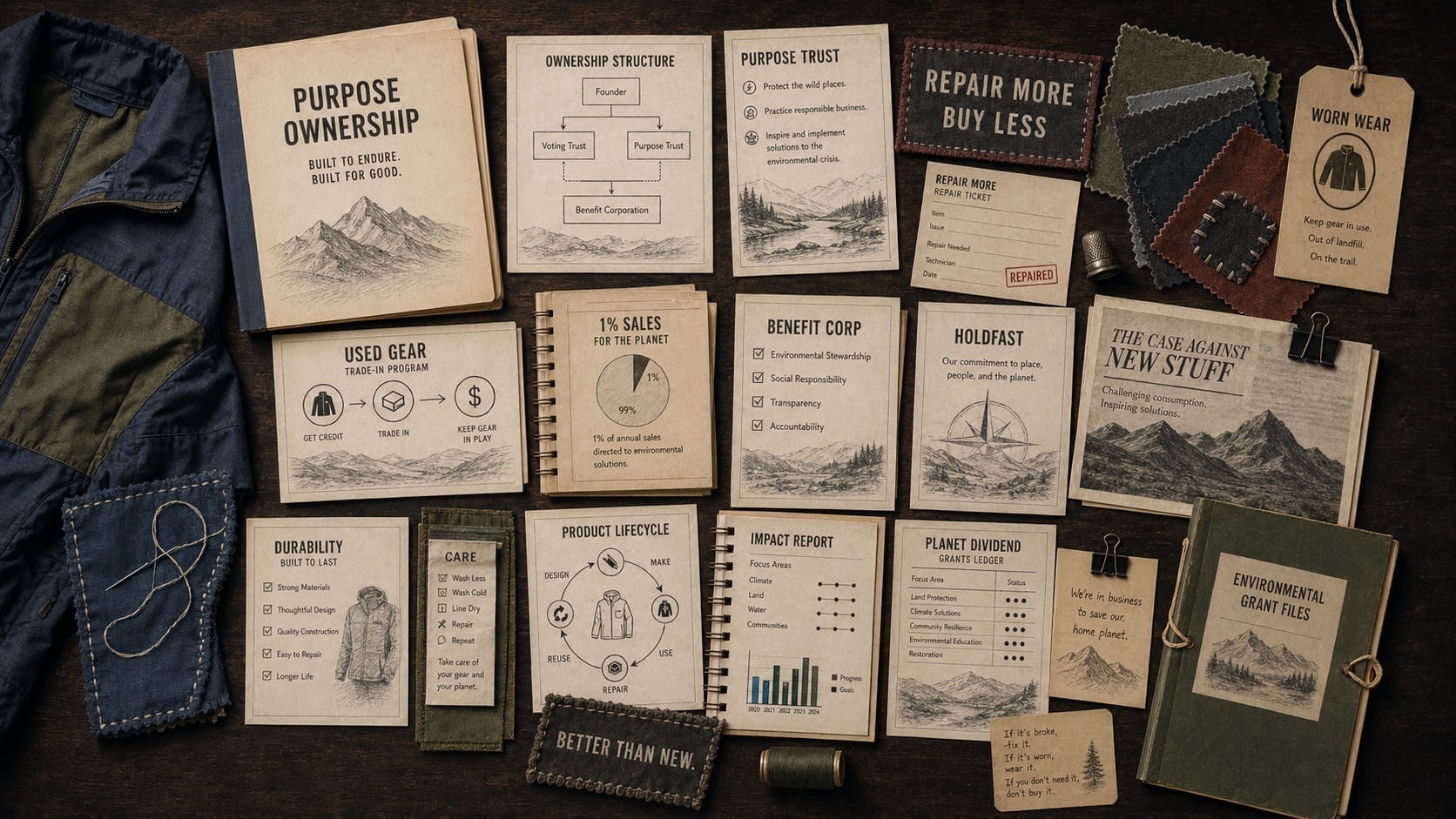
Short Answer
Patagonia is filed here for one job: Patagonia branding and purpose. The Patagonia file proves that purpose is strongest when the company gives the public operating evidence.
Reader Task
What this brand entry should help you finish
Use this file to answer the Patagonia brand question without falling into a company-history summary. The task is to understand the main Patagonia branding and purpose pattern, check the sourced facts, open the primary case (Patagonia and the Ownership Move That Made Purpose Structural), and leave with a lesson or risk that can be compared against another brand. The file has 1 filed case, so the next step should be clear before the reader leaves.
Fact Panel
Patagonia facts
Only sourced facts render here. Unsourced company-history rows stay out of the page.
- Founded
- 1973 Source
- Founders
- Yvon Chouinard Source
- Parent / ownership
- Patagonia Purpose Trust and Holdfast Collective ownership structure Source
- Category
- Outdoor apparel and gear Source
- Home market
- Ventura, California, United States Source
- Distinctive assets
- Mountain silhouette and repair/purpose behavior
- Status
- Active Source
- Decisions on file
- 1 filed case
What Patagonia teaches
The useful brand entry does not ask whether Patagonia is famous. It asks what the filed decision record teaches that a reader can use on another brand.
- Main lesson: The Patagonia file proves that purpose is strongest when the company gives the public operating evidence.
- Reader check: Inspect repair behavior, anti-consumption signals, ownership structure, funding claims, and product restraint.
- Failure mode: The risk is treating purpose as campaign language before the business model is willing to carry the claim.
- Filed case: Patagonia: Purpose becomes stronger when it is tied to operating choices customers can see and governance choices future owners cannot easily undo.
Mistake To Catch
Where the Patagonia reading breaks
The risk is treating purpose as campaign language before the business model is willing to carry the claim.
The weak read is to stop at the familiar name. The stronger read is to ask which decision changed recognition, trust, habit, distribution, product proof, or public memory.
That is the useful job of the brand entry: keep the famous name attached to a decision the reader can inspect.
Decision Depth
Read Patagonia as structural purpose before reading it as activism.
This section turns the brand name into an inspection path: what changed, what broke, what worked, and what to compare next.
Patagonia is useful because the purpose claim is tied to inspectable structures: repair, restraint, environmental funding, ownership choices, product durability, and public positions that cost the company something.
A weak reading copies the activism. A stronger reading asks what the business model is willing to change, fund, refuse, repair, or prove.
The inspection path is repair behavior, anti-consumption signals, ownership structure, grant funding, material claims, product longevity, and how the company handles tradeoffs.
Use this file before writing a purpose platform. The approval test is whether the claim changes decisions the public can inspect.
The copycat mistake is treating purpose as a campaign layer while the product, ownership, sourcing, service, or pricing model stays untouched.
The practical lesson is to make purpose boring enough to check. If the evidence cannot be found in operations, the language will not survive scrutiny.
A Patagonia-style check should name the cost of the claim. What does the company repair, fund, refuse, slow down, disclose, or make harder for itself because the purpose is real?
The page should also protect against purpose inflation. A small operating proof stated plainly is stronger than a large public claim the business cannot carry.
The final check is whether critics can inspect the evidence without accepting the brand's moral language. If the proof is visible, the purpose page has a foundation.
That proof discipline is what separates a purpose brand from a purpose campaign.
Keep the evidence close.
Decision timeline
The timeline is the reason this brand has a parent page. Each row points to a filed case, then names the consequence a reader should carry into the next comparison.
For brands with one case, the timeline still matters because it prevents a thin profile. The brand page becomes the router, and the case page remains the proof.
| Filed decision | What happened | What it teaches |
|---|---|---|
| Patagonia and the Ownership Move That Made Purpose Structural Pivot / 2011-2022 |
Patagonia's ownership transfer made purpose harder to treat as campaign language, turning repair, anti-consumption, environmental funding, and governance into one brand system. | Purpose becomes stronger when it is tied to operating choices customers can see and governance choices future owners cannot easily undo. |
Source test
The source trail below is inherited from the filed cases, including company records, campaign records, public reports, source-mark files, or archived references where the original page moved.
Use the source list to verify the facts. Use the case links to inspect the decision. Use the comparison links to test whether the Patagonia pattern repeats somewhere else.
Visual proof
The hero image for this brand page uses the strongest generated editorial visual already attached to the primary case: Patagonia and the Ownership Move That Made Purpose Structural. It stays tied to filed evidence instead of becoming a generic brand mood image.
That visual rule matters for this build. Every brand page needs a high-end image, but the image has to point back to the decision: packaging, mark, product behavior, service proof, ritual, failure, or trust pressure.
If a future brand has no strong visual, it does not pass the entity-page gate until the image is generated or replaced.
Sources
_logo.svg)
People Also Ask
What happened to Patagonia, and what should readers inspect?
The Patagonia file proves that purpose is strongest when the company gives the public operating evidence. Start by inspecting this point: Inspect repair behavior, anti-consumption signals, ownership structure, funding claims, and product restraint.
What does Patagonia teach about branding?
The Patagonia file proves that purpose is strongest when the company gives the public operating evidence.
What should readers inspect first in the Patagonia file?
Inspect repair behavior, anti-consumption signals, ownership structure, funding claims, and product restraint.
What is the main risk in the Patagonia file?
The risk is treating purpose as campaign language before the business model is willing to carry the claim.
Which Patagonia case should readers open first?
Start with Patagonia and the Ownership Move That Made Purpose Structural, because it is the primary filed case behind this brand file.