Brand System / Airline / Flag carrier / 1934-present
Aeromexico Flag Carrier Branding Case: Routes, Alliance, and Hub Risk
Aeromexico tracks how a flag-carrier brand turns geography into a service promise, then has to protect that promise through routes, hub discipline, alliance access, loyalty, and recovery after disruption.
Short Answer
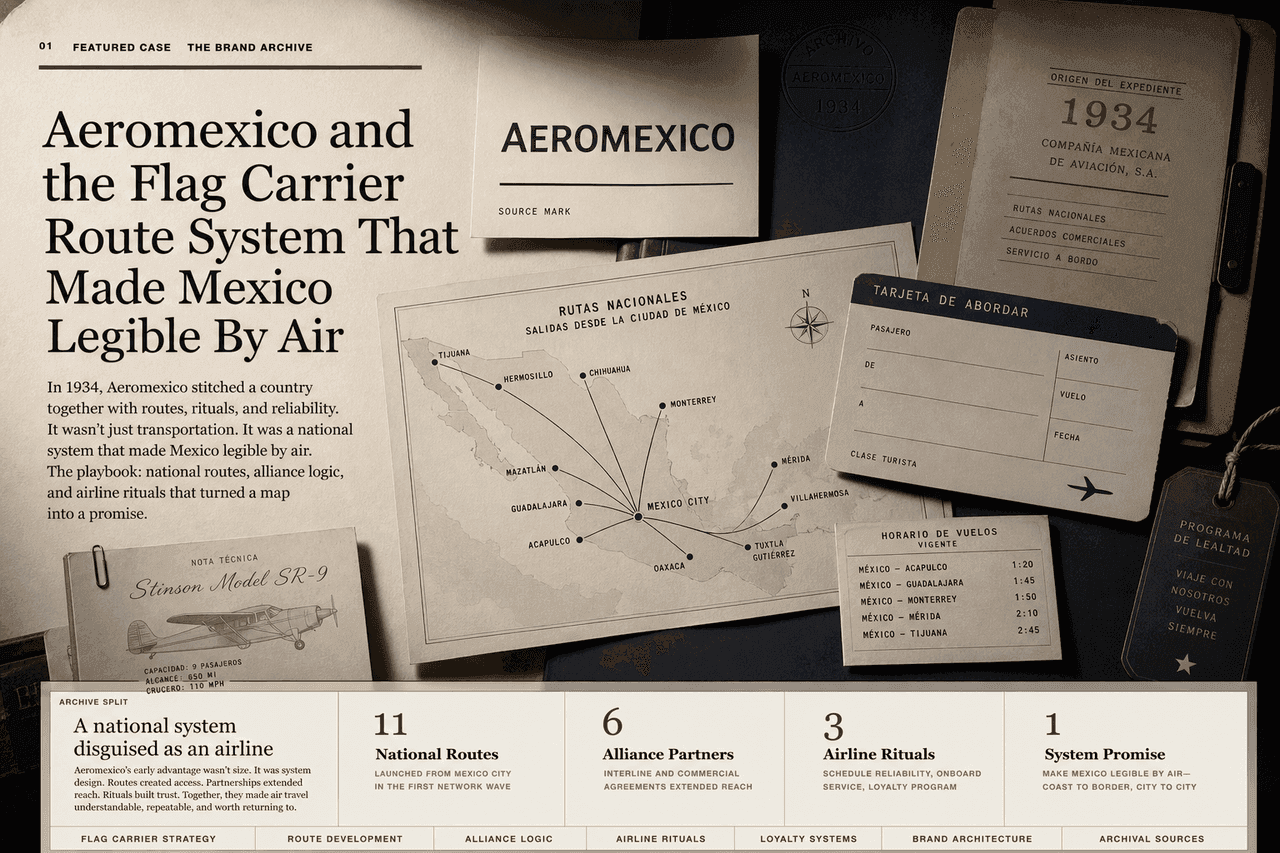
Aeromexico Flag Carrier Branding Case: Routes, Alliance, and Hub Risk is a brand system case about Aeromexico in 1934-present. Aeromexico turns Mexican air access into a route, hub, partner, and schedule-confidence problem. A national airline brand has to make travel geography easier to understand. Aeromexico is useful when Mexico City hub logic, U.S.-Mexico access, alliance partners, loyalty, and recovery behavior make the trip clearer than the alternatives.
Reader Task
What this entry should help you finish
Use this entry to finish four jobs: answer what happened to Aeromexico, see why it belongs in the brand system lane, inspect the decision consequence, and leave with the operator lesson. The point is not to remember the brand. The point is to know what decision, proof surface, or failure mode a team should check next. Then compare it with Air France, Qantas, Corona before turning the case into a rule.
What Aeromexico teaches
- Aeromexico's origin story matters, but passengers judge the brand through route access, schedule confidence, connection logic, baggage, refunds, and recovery.
- The Mexico City hub is an asset and a constraint. It organizes demand, but congestion, slot policy, airport moves, and partner rules can change the customer promise.
- The Delta and SkyTeam layer shows why airline branding can depend on partners. Alliance reach is brand value only when the passenger understands what connects, earns, and transfers.
- Chapter 11 recovery is part of the case because it tests whether the operating promise can survive a financial shock without turning passengers into uncertainty.
- The bad lesson is national decoration. The better rule is to make the route network legible before asking the symbol to carry pride.
Why This Brand Belongs In Grow Your Brand
Aeromexico belongs in Grow Your Brand because the page studies a specific brand decision, not a company profile. The decision sits in brand system and gives operators a way to see how service route changes commercial value.
The useful archive question is what changed in recognition, trust, demand, pricing power, category position, or public memory after the market saw the move.
The Brand Asset At Stake
The asset at stake is schedule reliability, route coverage, service recovery, loyalty behavior, and the handoff between promise and trip. That asset matters because it affects how people find, understand, choose, trust, or repeat the brand when the company is not in the room to explain itself.
For Aeromexico, the asset is not abstract equity. It has to show up in the buying surface, product surface, service route, source record, or repeated customer behavior.
What Changed
Aeromexico turns Mexican air access into a route, hub, partner, and schedule-confidence problem.
The change forced the market to decide whether the old shortcut still worked, whether the new proof was strong enough, and whether the brand had made the category easier or harder to understand.
What The Market Learned
The market learned to judge Aeromexico through the gap between the visible move and the proof behind it. describing national pride, premium service, or experience while skipping the operating proof behind the trip is the weak reading this page is meant to prevent.
A useful brand decision makes buying, remembering, trusting, or repeating easier. A weak decision makes the audience do more work before it believes the claim.
Commercial Consequence
The commercial consequence sits in service route: schedule reliability, route coverage, service recovery, loyalty behavior, and the handoff between promise and trip. When that proof becomes easier to see, customers have more reason to choose, trust, repeat, or pay attention. When it becomes harder to see, the brand has to spend more money explaining what the market used to understand faster.
Aeromexico matters because the decision changed more than presentation. It changed buyer confidence, memory, category position, or repeat behavior in airline / flag carrier. That is why the case belongs in a brand decision library instead of a general company profile.
What Another Brand Should Learn
Another brand should use this case before spending money on a similar move. Name the customer behavior, the proof surface, the protected cue, and the consequence that would make the decision worth the cost.
If the same proof does not exist in the business, copying Aeromexico would copy the surface while missing the reason the decision mattered.
The Real Decision
Aeromexico is a geography case before it is a livery case. The brand has to make Mexico easier to enter, cross, leave, and connect through, especially for travelers who are comparing nonstop access, price, partner miles, and airport friction.
That gives the brand a hard job. It has to turn national recognition into route usefulness. The customer does not buy a flag-carrier story in the abstract. The customer buys a specific route, time, connection, bag policy, seat, loyalty benefit, and recovery path.
Where The Brand Is Tested
The test happens in ordinary travel stress. A traveler asks whether the route exists, whether the schedule fits the trip, whether a connection is protected, whether partner miles work, whether bags transfer, and whether support is clear when a flight breaks.
Aeromexico's brand is strong only when those details make Mexico more legible by air. If the details are confusing, the national-carrier cue becomes decoration over a harder travel problem.
The Mexico City Hub Problem
Mexico City gives Aeromexico a natural center of gravity. Hub logic helps the airline organize domestic routes, international departures, business travel, tourism, and partner connections through one market memory.
The same hub can become a brand constraint. Congestion, slots, airport policy, cargo moves, and competing airports can change what passengers experience. A hub brand has to explain the path clearly when the airport system itself becomes part of the risk.
The Alliance Layer
Aeromexico's SkyTeam and Delta relationships matter because they extend what the airline can promise. The brand becomes more useful when a passenger can connect, earn, redeem, and recognize service across partner networks.
That partner layer is not automatic safety. It is a dependency. If regulators, commercial terms, or airport-policy disputes change the alliance, the brand has to explain what still works: codeshares, miles, routes, lounge access, connection protection, and customer service handoffs.
Chapter 11 As A Trust Test
The 2020 Chapter 11 filing was a finance event and a customer-trust event. For passengers, an airline restructuring raises direct questions: will tickets still work, will routes continue, will employees keep operating the service, and will the carrier come back with a credible network?
That is why the recovery belongs in the brand file. A transport brand earns trust when customers can keep using it during pressure, beyond easy-demand periods when the route map is expanding.
What People Get Wrong
The weak reading is to say Aeromexico is Mexico's airline and stop there. Country association helps recognition, but it does not solve route choice.
The second weak reading is to treat alliance membership as a logo strip. Passengers care about alliance value only when it changes the trip: better access, clearer transfers, miles that work, protection during disruption, and fewer surprises at the airport.
The Bad Example
The bad copycat paints the aircraft in national cues, names destinations, adds a loyalty program, and assumes the result is a flag-carrier brand. That misses the mechanism.
The mechanism is route confidence. If travelers cannot understand the network, trust the schedule, manage a disruption, or see how partners improve the trip, the brand is using geography without solving travel.
What To Copy
Copy the legibility work. Make the route map easier to understand. Make connection rules clear. Make partner benefits explicit. Make rebooking and refund behavior visible before the bad day. Make loyalty explain the trip rather than only the tier.
For a flag-carrier brand, the best marketing surface may be a cleaner route page, a clearer disruption notice, a better partner explanation, or a booking path that does not make the passenger decode the network.
The Decision Limit
The Aeromexico comparison is weak for brands that do not have an access job. If the business does not organize routes, permissions, transfers, partner handoffs, or geography, the airline lesson becomes metaphor instead of strategy.
Use the case as a test for any network brand: does the brand make a complicated map easier to use, or does it merely decorate the map after the hard parts are already confusing?
Compare Next
Related Cases
Do not read Aeromexico alone. Compare it against nearby cases: Air France, Qantas, Corona.
Sources
- Aeromexico, About us
- Aeromexico, Route and destination information
- Aeromexico, Aeromexico Rewards loyalty program
- SkyTeam, Aeromexico member profile
- Delta, Aeromexico airline partner page
- PR Newswire, Aeromexico concludes financial restructuring and emerges from Chapter 11, March 2022
- Kroll Restructuring Administration, Grupo Aeromexico Chapter 11 cases
- Editorial Aeromexico wordmark treatment
People Also Ask
What happened to Aeromexico?
Aeromexico Flag Carrier Branding Case: Routes, Alliance, and Hub Risk is a brand system case about Aeromexico in 1934-present. Aeromexico turns Mexican air access into a route, hub, partner, and schedule-confidence problem. A national airline brand has to make travel geography easier to understand. Aeromexico is useful when Mexico City hub logic, U.S.-Mexico access, alliance partners, loyalty, and recovery behavior make the trip clearer than the alternatives.
Why is Aeromexico a brand system case?
Aeromexico is filed as a brand system case because the visible consequence sits in that decision pattern. Aeromexico turns Mexican air access into a route, hub, partner, and schedule-confidence problem.
What can brands learn from Aeromexico?
A national airline brand has to make travel geography easier to understand. Aeromexico is useful when Mexico City hub logic, U.S.-Mexico access, alliance partners, loyalty, and recovery behavior make the trip clearer than the alternatives.
Is Aeromexico still operating?
Grow Your Brand marks Aeromexico as Active / continuing. That means the brand, company, platform, product system, or parent organization is still operating, continuing, or being actively resolved.
What should Aeromexico be compared with?
Compare Aeromexico with Air France, Qantas, Corona to see the same decision pattern from nearby cases.