Brand System / Airline / Travel / 1933-present
Air France Branding Case: Paris Hub and Service Proof
Air France is the flag-carrier case for turning national identity into route access, Paris hub behavior, cabin service, safety confidence, loyalty, and recovery standards passengers can judge.
Short Answer
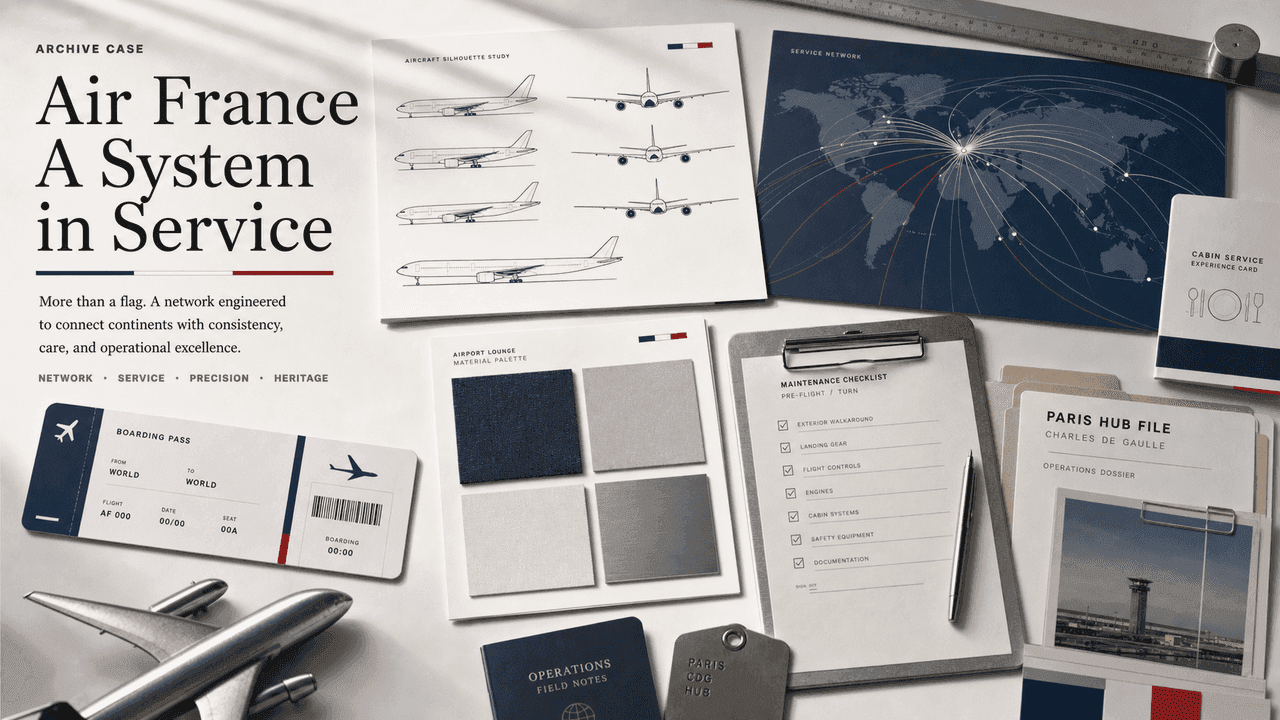
Air France Branding Case: Paris Hub and Service Proof is a brand system case about Air France in 1933-present. Air France works as a brand case when the idea of France becomes service proof: the route map, the airport handoff, the cabin, the alliance, and the recovery path. A flag carrier cannot live on national symbolism. The brand has to make route access, service standards, safety, and disruption handling visible at the points where passengers read travel risk.
Reader Task
What this entry should help you finish
Use this entry to finish four jobs: answer what happened to Air France, see why it belongs in the brand system lane, inspect the decision consequence, and leave with the operator lesson. The point is not to remember the brand. The point is to know what decision, proof surface, or failure mode a team should check next. Then compare it with Qantas, Pan Am, Maersk before turning the case into a rule.
What Air France teaches
- The Air France file is about national identity under operational pressure. The flag matters only when routes, gates, cabin behavior, and recovery make the promise credible.
- Paris-Charles de Gaulle and Paris-Orly are not background details. They are proof surfaces because travelers read the brand through hubs, connections, lounges, signage, and delays.
- SkyTeam, Flying Blue, Air France-KLM, Transavia, cargo, and maintenance activity widen the brand beyond a single aircraft livery.
- The weak copycat uses national colors and elegant photography while hiding the real tests: schedule reliability, service recovery, safety confidence, and connection clarity.
- The repair test is whether the airline identity helps a traveler decide, navigate, recover, and trust the route under normal travel stress.
Why This Brand Belongs In Grow Your Brand
Air France belongs in Grow Your Brand because the page studies a specific brand decision, not a company profile. The decision sits in brand system and gives operators a way to see how service route changes commercial value.
The useful archive question is what changed in recognition, trust, demand, pricing power, category position, or public memory after the market saw the move.
The Brand Asset At Stake
The asset at stake is schedule reliability, route coverage, service recovery, loyalty behavior, and the handoff between promise and trip. That asset matters because it affects how people find, understand, choose, trust, or repeat the brand when the company is not in the room to explain itself.
For Air France, the asset is not abstract equity. It has to show up in the buying surface, product surface, service route, source record, or repeated customer behavior.
What Changed
Air France works as a brand case when the idea of France becomes service proof: the route map, the airport handoff, the cabin, the alliance, and the recovery path.
The change forced the market to decide whether the old shortcut still worked, whether the new proof was strong enough, and whether the brand had made the category easier or harder to understand.
What The Market Learned
The market learned to judge Air France through the gap between the visible move and the proof behind it. describing national pride, premium service, or experience while skipping the operating proof behind the trip is the weak reading this page is meant to prevent.
A useful brand decision makes buying, remembering, trusting, or repeating easier. A weak decision makes the audience do more work before it believes the claim.
Commercial Consequence
The commercial consequence sits in service route: schedule reliability, route coverage, service recovery, loyalty behavior, and the handoff between promise and trip. When that proof becomes easier to see, customers have more reason to choose, trust, repeat, or pay attention. When it becomes harder to see, the brand has to spend more money explaining what the market used to understand faster.
Air France matters because the decision changed more than presentation. It changed buyer confidence, memory, category position, or repeat behavior in airline / travel. That is why the case belongs in a brand decision library instead of a general company profile.
What Another Brand Should Learn
Another brand should use this case before spending money on a similar move. Name the customer behavior, the proof surface, the protected cue, and the consequence that would make the decision worth the cost.
If the same proof does not exist in the business, copying Air France would copy the surface while missing the reason the decision mattered.
The Decision Context
A flag carrier carries a heavy public burden. Travelers expect the airline to represent a country, but they buy a ticket for route access, safety, connection logic, baggage handling, cabin service, and recovery when the trip breaks.
Air France is useful because the symbolic layer is obvious and the proof layer is inspectable. Grow Your Brand reading starts at the Paris hub and follows the passenger through booking, airport behavior, the cabin, partner connections, and service recovery.
The Hub Is A Brand Surface
Paris-Charles de Gaulle and Paris-Orly are not neutral infrastructure in this case. The hub teaches the passenger what Air France can coordinate: transfer time, lounge access, signage, gate logic, partner routes, and the way the airline handles pressure.
That is why route maps matter more than campaign language. A traveler can forgive a plain message if the connection is clear. The opposite is harder: polished national identity becomes weak when the route reads hard to use.
Service Has To Carry The Country Cue
The French cue can help Air France stay memorable, but it also raises expectations. Food, cabin tone, crew rhythm, aircraft presentation, and airport service have to make the identity practical instead of decorative.
The brand risk is over-reliance on style. A flag carrier with beautiful visuals and poor recovery trains passengers to separate the symbol from the service. Once that separation happens, national identity stops protecting trust.
Alliance And Loyalty Extend The Promise
Air France does not live as a single isolated airline. Air France-KLM, SkyTeam, Flying Blue, cargo, maintenance, and partner routes all shape the brand because passengers and business customers experience the network through more than one logo.
That creates a governance problem. The brand has to remain legible while another carrier, partner desk, airport, or loyalty rule touches the trip. The mark is only one layer of a larger travel system.
Where The Strategy Breaks
The strategy breaks when elegance hides operational confusion. Travelers do not remember an airline as premium if the transfer path is unclear, the delay message is late, the loyalty promise is opaque, or the recovery desk has no authority.
The second break is symbolic inflation. Country memory can make an airline easier to recall, but it cannot substitute for hard travel proof. A weak trip makes the national cue look like costume.
The Bad Copycat
A bad copycat would borrow flag colors, refined typography, culinary references, and aircraft photography while leaving the route and recovery problem untouched. That produces a handsome airline brand with no passenger relief.
The wrong move is to treat national identity as the strategy. The correct move is to identify where travelers need certainty, then let the country cue reinforce service behavior that already works.
What To Inspect
Inspect the route map, the hub handoff, the cabin standard, the loyalty rule, the disruption message, the baggage path, and the partner connection. Those surfaces decide whether Air France means service or styling.
The page should make one point clear: a flag carrier is not a flag with aircraft attached. It is a service network that has to deserve the flag every day.
The Signal Reading
Air France is filed here because it records how national identity becomes credible only after it is translated into repeated passenger behavior.
For operators, the case is a warning against symbolic shortcuts. If the brand promise depends on place, the place cue must be backed by route access, service standards, recovery power, and customer evidence.
Compare Next
Related Cases
Do not read Air France alone. Compare it against nearby cases: Qantas, Pan Am, Maersk.
Sources
People Also Ask
What happened to Air France?
Air France Branding Case: Paris Hub and Service Proof is a brand system case about Air France in 1933-present. Air France works as a brand case when the idea of France becomes service proof: the route map, the airport handoff, the cabin, the alliance, and the recovery path. A flag carrier cannot live on national symbolism. The brand has to make route access, service standards, safety, and disruption handling visible at the points where passengers read travel risk.
Why is Air France a brand system case?
Air France is filed as a brand system case because the visible consequence sits in that decision pattern. Air France works as a brand case when the idea of France becomes service proof: the route map, the airport handoff, the cabin, the alliance, and the recovery path.
What can brands learn from Air France?
A flag carrier cannot live on national symbolism. The brand has to make route access, service standards, safety, and disruption handling visible at the points where passengers read travel risk.
Is Air France still operating?
Grow Your Brand marks Air France as Active / continuing. That means the brand, company, platform, product system, or parent organization is still operating, continuing, or being actively resolved.
What should Air France be compared with?
Compare Air France with Qantas, Pan Am, Maersk to see the same decision pattern from nearby cases.