Brand System / Creative software / documents / AI / 1982-present
Adobe Branding Strategy Case: Creative Tools, PDF, and AI
Adobe turned creative software into professional infrastructure, then had to protect user trust as subscriptions, cloud files, collaboration, PDF workflows, and generative AI changed the work surface.
Short Answer
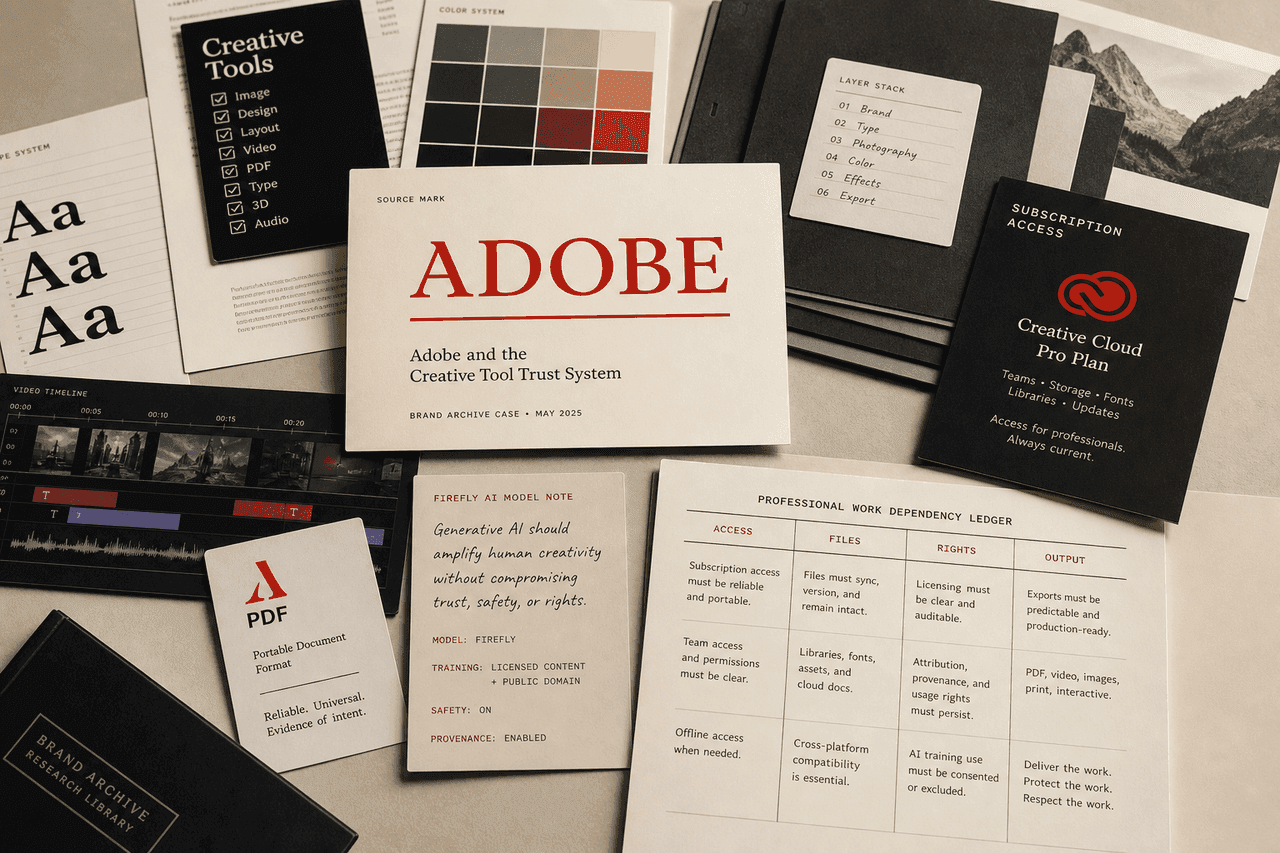
Adobe Branding Strategy Case: Creative Tools, PDF, and AI is a brand system case about Adobe in 1982-present. Adobe put creative work inside a tool system instead of leaving each application to stand alone. A professional tool brand has to protect control. Access, files, rights, export quality, collaboration, and AI provenance become part of the brand promise.
Reader Task
What this entry should help you finish
Use this entry to finish four jobs: answer what happened to Adobe, see why it belongs in the brand system lane, inspect the decision consequence, and leave with the operator lesson. The point is not to remember the brand. The point is to know what decision, proof surface, or failure mode a team should check next. Then compare it with Adobe Creative Cloud, Figma, Canva before turning the case into a rule.
What Adobe teaches
- Adobe is not one app in the customer's mind. It is the work layer for images, layouts, video, PDFs, fonts, assets, reviews, signatures, and handoffs.
- The customer risk is control: files must open, exports must hold, collaborators must keep access, and subscription terms must be clear enough to trust.
- Creative Cloud made the relationship continuous; Acrobat and PDF made the system travel outside the creative department.
- Firefly moved AI from novelty into a rights and provenance test: what was trained on, what can be used commercially, and what proof follows the output.
- The working rule is to improve the work system before asking customers to accept more dependence.
Why This Brand Belongs In Grow Your Brand
Adobe belongs in Grow Your Brand because the page studies a specific brand decision, not a company profile. The decision sits in brand system and gives operators a way to see how operating layer changes commercial value.
The useful archive question is what changed in recognition, trust, demand, pricing power, category position, or public memory after the market saw the move.
The Brand Asset At Stake
The asset at stake is daily usage, uptime, distribution, account trust, partner tools, switching cost, and recovery when the service fails. That asset matters because it affects how people find, understand, choose, trust, or repeat the brand when the company is not in the room to explain itself.
For Adobe, the asset is not abstract equity. It has to show up in the buying surface, product surface, service route, source record, or repeated customer behavior.
What Changed
Adobe put creative work inside a tool system instead of leaving each application to stand alone.
The change forced the market to decide whether the old shortcut still worked, whether the new proof was strong enough, and whether the brand had made the category easier or harder to understand.
What The Market Learned
The market learned to judge Adobe through the gap between the visible move and the proof behind it. talking about scale, innovation, or ecosystem reach while hiding the exact behavior people repeat is the weak reading this page is meant to prevent.
A useful brand decision makes buying, remembering, trusting, or repeating easier. A weak decision makes the audience do more work before it believes the claim.
Commercial Consequence
The commercial consequence sits in operating layer: daily usage, uptime, distribution, account trust, partner tools, switching cost, and recovery when the service fails. When that proof becomes easier to see, customers have more reason to choose, trust, repeat, or pay attention. When it becomes harder to see, the brand has to spend more money explaining what the market used to understand faster.
Adobe matters because the decision changed more than presentation. It changed buyer confidence, memory, category position, or repeat behavior in creative software / documents / ai. That is why the case belongs in a brand decision library instead of a general company profile.
What Another Brand Should Learn
Another brand should use this case before spending money on a similar move. Name the customer behavior, the proof surface, the protected cue, and the consequence that would make the decision worth the cost.
If the same proof does not exist in the business, copying Adobe would copy the surface while missing the reason the decision mattered.
The Real Decision
Adobe's strongest brand asset is not the red mark or one famous application. It is the fact that large parts of creative and document work have been arranged around Adobe files, formats, workflows, and expectations.
That makes the brand powerful in a specific way. When customers build real work around Photoshop, Illustrator, Premiere, InDesign, Acrobat, Creative Cloud, fonts, libraries, review links, and exports, Adobe is no longer judged like optional software. It is judged like work infrastructure.
Where Trust Actually Lives
A tool brand earns trust in ordinary production moments: a file opens after a handoff, a PDF keeps its layout, a font does not vanish before a deadline, an export survives client review, a collaborator can access the right asset, and a team knows what happens if the subscription changes.
That is why Adobe's trust problem is larger than feature quality. The customer has to believe the system will not take away control at the exact point where work is due.
The Subscription Problem
Creative Cloud changed the relationship from buying a version to maintaining access. The separate Creative Cloud case covers that pivot in detail; this parent file explains why the pivot still matters for the whole Adobe brand.
The lesson is not that subscription software is bad. The lesson is that a subscription around professional files has to answer harder questions than a casual app: what remains usable, what happens to stored work, what the customer can export, how price changes are explained, and how cancellation works.
The Document Layer
Acrobat and PDF are important because they pushed Adobe beyond creative departments. Contracts, forms, reports, proposals, government documents, signatures, and approvals made Adobe part of business paperwork.
That document layer changes the brand test. A PDF tool has to support creation, preservation, signatures, cross-organization sharing, and verification at the same time.
AI Raised The Rights Question
Firefly gave Adobe a visible way to answer a market fear that many AI tools avoided: professionals need to know whether generated work can be used in client, commercial, brand, and legal contexts.
Adobe's public argument is that Firefly is built around licensed content, public-domain material, creator rights, indemnification for certain enterprise uses, and Content Credentials. The brand lesson is simple: in professional creative work, AI output is not useful until the rights story is inspectable.
What People Get Wrong
The lazy reading is that Adobe won because professionals like good tools and because subscriptions improved revenue. That misses the harder part. Adobe won because its tools became part of repeatable production behavior. It is vulnerable for the same reason.
A dependent customer is not the same as a loyal customer. If the customer believes file formats, billing terms, AI uncertainty, or unclear cancellation have trapped them, the brand can look strong in revenue while losing trust in the workroom.
The Bad Example
The bad copycat copies Adobe's suite structure, subscription pricing, or AI button before it has earned workflow importance. It bundles tools, raises switching costs, and calls that an ecosystem.
That fails because users can tell the difference between help and capture. A real system reduces production risk. A fake system creates lock-in and then asks customers to call the lock-in convenience.
What To Copy
Copy the operating proof. Make files portable. Make exports predictable. Make team access legible. Make cancellation and renewal terms understandable. Make AI provenance visible. Make support useful when deadlines are close.
For a professional-tool brand, the best brand work is often not a campaign. It is the removal of a failure point that users quietly feared.
The Decision Limit
The Adobe comparison is weak when the product is not central to real work. If customers can replace the tool without losing files, habits, teammates, approvals, or client confidence, the Adobe lesson does not apply.
The test is whether the customer can name the dependence and still choose it willingly. If the system makes better work easier and preserves control, dependence can become trust. If the system makes exit painful and terms unclear, dependence becomes resentment.
Compare Next
Related Cases
Do not read Adobe alone. Compare it against nearby cases: Adobe Creative Cloud, Figma, Canva.
Sources
- Adobe, About Adobe company history and product system
- Adobe, Creative Cloud apps and services
- Adobe, Acrobat PDF tools and subscription terms
- Adobe, Trust Center for security, privacy, availability, and compliance
- Adobe, Firefly generative AI approach
- Content Credentials, provenance specification overview
- FTC, action against Adobe over subscription cancellation and fee allegations, June 17, 2024
People Also Ask
What happened to Adobe?
Adobe Branding Strategy Case: Creative Tools, PDF, and AI is a brand system case about Adobe in 1982-present. Adobe put creative work inside a tool system instead of leaving each application to stand alone. A professional tool brand has to protect control. Access, files, rights, export quality, collaboration, and AI provenance become part of the brand promise.
Why is Adobe a brand system case?
Adobe is filed as a brand system case because the visible consequence sits in that decision pattern. Adobe put creative work inside a tool system instead of leaving each application to stand alone.
What can brands learn from Adobe?
A professional tool brand has to protect control. Access, files, rights, export quality, collaboration, and AI provenance become part of the brand promise.
Is Adobe still operating?
Grow Your Brand marks Adobe as Active / continuing. That means the brand, company, platform, product system, or parent organization is still operating, continuing, or being actively resolved.
What should Adobe be compared with?
Compare Adobe with Adobe Creative Cloud, Figma, Canva to see the same decision pattern from nearby cases.