Pivot / Software / 2013
Adobe Creative Cloud Subscription Pivot Case
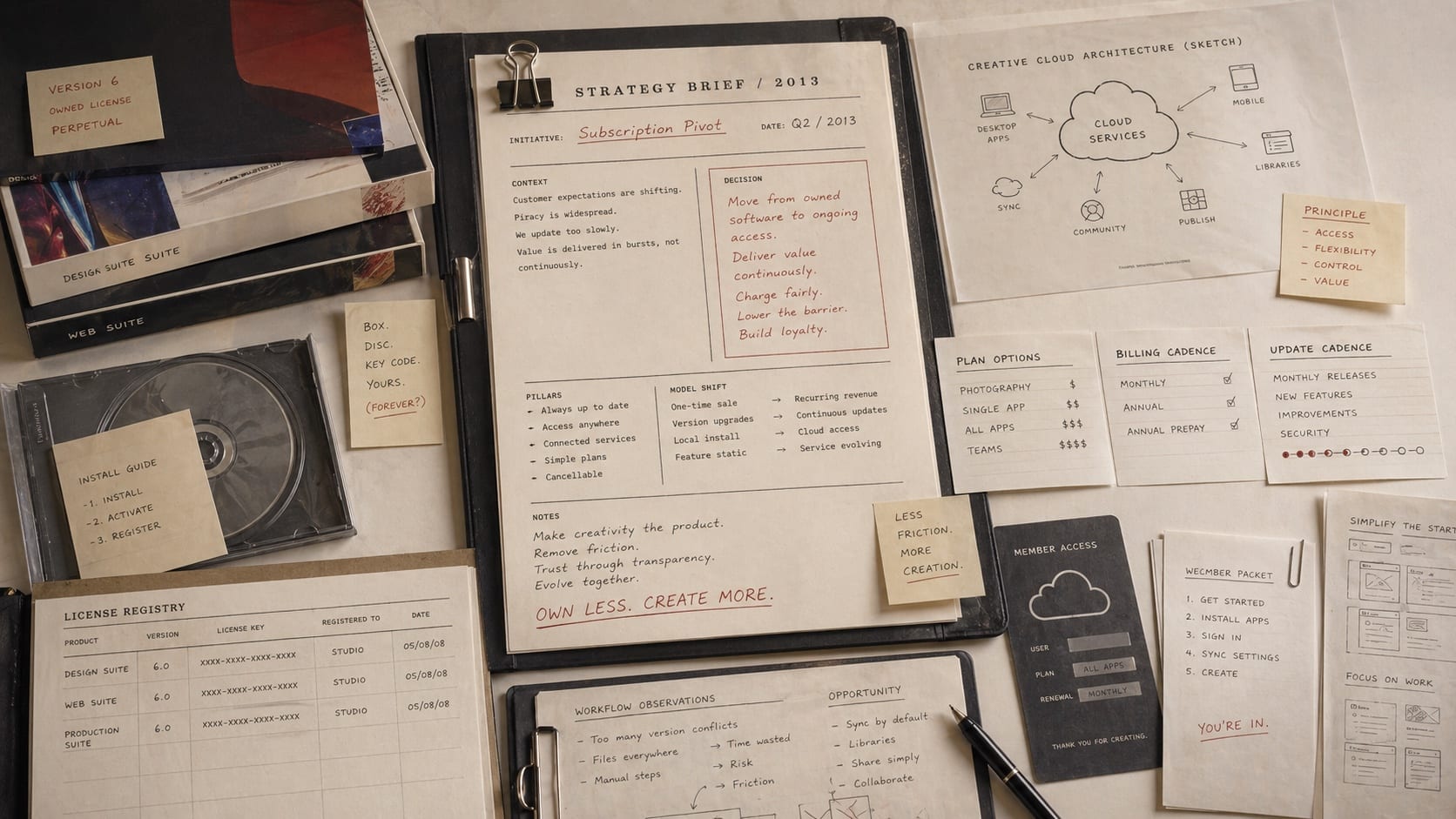
Adobe's move from Creative Suite to Creative Cloud turned a product sale into an ongoing service relationship, creating backlash and long-term strategic control.

Short Answer
Adobe Creative Cloud Subscription Pivot Case is a pivot case about Adobe Creative Cloud in 2013. The pivot changed what customers were buying: not a version of software, but continuing access to a professional system. A business-model pivot must manage customer control anxiety as seriously as revenue architecture.
Reader Task
What this entry should help you finish
Use this entry to finish four jobs: answer what happened to Adobe Creative Cloud, see why it belongs in the pivot lane, inspect the decision consequence, and leave with the operator lesson. The point is not to remember the brand. The point is to know what decision, proof surface, or failure mode a team should check next. Then compare it with Claude Code, Codex, Dell before turning the case into a rule.
What Adobe Creative Cloud teaches
- Adobe moved new product innovation into Creative Cloud and away from perpetual Creative Suite releases.
- The transition created user resistance because access, ownership, and cost perception changed together.
- For Adobe, subscription shifted the brand from boxed software to an always-updating professional platform.
- The pivot shows why pricing architecture is also brand architecture.
Why This Brand Belongs In Grow Your Brand
Adobe Creative Cloud belongs in Grow Your Brand because the page studies a specific brand decision, not a company profile. The decision sits in pivot and gives operators a way to see how operating layer changes commercial value.
The useful archive question is what changed in recognition, trust, demand, pricing power, category position, or public memory after the market saw the move.
The Brand Asset At Stake
The asset at stake is daily usage, uptime, distribution, account trust, partner tools, switching cost, and recovery when the service fails. That asset matters because it affects how people find, understand, choose, trust, or repeat the brand when the company is not in the room to explain itself.
For Adobe Creative Cloud, the asset is not abstract equity. It has to show up in the buying surface, product surface, service route, source record, or repeated customer behavior.
What The Market Learned
The market learned to judge Adobe Creative Cloud through the gap between the visible move and the proof behind it. talking about scale, innovation, or ecosystem reach while hiding the exact behavior people repeat is the weak reading this page is meant to prevent.
A useful brand decision makes buying, remembering, trusting, or repeating easier. A weak decision makes the audience do more work before it believes the claim.
Commercial Consequence
The commercial consequence sits in operating layer: daily usage, uptime, distribution, account trust, partner tools, switching cost, and recovery when the service fails. When that proof becomes easier to see, customers have more reason to choose, trust, repeat, or pay attention. When it becomes harder to see, the brand has to spend more money explaining what the market used to understand faster.
Adobe Creative Cloud matters because the decision changed more than presentation. It changed buyer confidence, memory, category position, or repeat behavior in software. That is why the case belongs in a brand decision library instead of a general company profile.
What Another Brand Should Learn
Another brand should use this case before spending money on a similar move. Name the customer behavior, the proof surface, the protected cue, and the consequence that would make the decision worth the cost.
If the same proof does not exist in the business, copying Adobe Creative Cloud would copy the surface while missing the reason the decision mattered.
The Decision
In 2013, Adobe accelerated the shift to Creative Cloud and moved future product development into the subscription model. For customers used to buying Creative Suite as a perpetual product, the change was commercial and psychological at the same time.
The brand moved from owned tools to ongoing access. That gave Adobe more control over updates, integration, cloud services, and recurring revenue. Some customers believed that a professional dependency had become less controllable.
What Changed
Creative Cloud reframed Adobe from a suite vendor into a platform relationship. Files, updates, collaboration, cloud storage, community, and services could become part of one system rather than separate product cycles.
The backlash was predictable because the pivot touched autonomy. Creative professionals do not experience core tools as casual software. They experience them as working infrastructure. When the buying model changes, the brand is changing the terms under which work happens.
What Customers Actually Lost
The old Creative Suite model gave customers a familiar kind of control. They could buy a version, keep using it, delay an upgrade, and decide whether the next release justified another purchase.
Creative Cloud changed that control map. Customers gained continuing updates and service access, but they also had to accept an ongoing account relationship. The brand problem was to prove that the new access model reduced more friction than it created.
Why The Pivot Worked Anyway
The pivot worked because Adobe did not leave the subscription as a billing wrapper around the same old box. Creative Cloud could carry faster release cycles, app integration, storage, fonts, libraries, sharing, and a clearer path for new services.
That does not erase the trust cost. It explains the strategic bargain. Adobe had to keep making the system useful enough that customers saw continuing access as infrastructure, not rent on tools they already understood.
The Signal Reading
This is a pivot file because the same brand meaning moved to a different economic architecture. Adobe did not simply rename Creative Suite. It changed the relationship from purchase to subscription.
The lesson is that recurring revenue transitions require more than pricing math. They need a trust story around access, durability, user control, cancellation clarity, and product improvements that justify the new model.
Where The Strategy Can Break
A subscription pivot breaks when the company treats recurring revenue as the strategy and treats customer control as a detail. Creative tools are work infrastructure. If access, pricing, files, compatibility, or cancellation is uncertain, the brand promise starts to look like dependency capture.
That is why the backlash mattered. The complaint was broader than price. It was the fear that a tool people relied on had moved from ownership to permission. In a professional category, permission is a brand issue.
The Bad Example
The bad copycat sees Adobe's recurring revenue and copies the billing model first. It moves customers from ownership to access, cuts off future perpetual upgrades, and assumes product quality will absorb the trust cost.
That shortcut creates a predictable failure mode: customers keep paying because they are trapped in workflow dependency, not because the new model clearly improves their work. That can raise revenue while lowering goodwill.
What To Copy
Copy the operating exchange, not the subscription label. Adobe could argue for Creative Cloud because it tied access to ongoing product development, updates, storage, services, and a broader creative system.
A serious subscription pivot has to show the customer what improves after the switch: faster updates, lower upgrade friction, better collaboration, safer file continuity, clearer support, and cleaner cancellation terms.
The Decision Limit
The Adobe comparison is weak when the product is not important enough to become infrastructure. If customers can replace the tool easily, the subscription model has to earn choice every month. If customers cannot replace it easily, the brand has a higher duty to make the terms clear.
The test is whether the customer can explain the trade: what they lose from ownership, what they gain from access, how their work remains safe, and how they leave if the bargain stops working.
Compare Next
Related Cases
Do not read Adobe Creative Cloud alone. Compare it against nearby cases: Claude Code, Codex, Dell.
Sources
- DPReview, Adobe heralds subscription-only future for Photoshop and Creative Suite, May 6, 2013
- Ars Technica, Adobe's Creative Suite is dead, long live the Creative Cloud, May 6, 2013
- CBS News/CNET, Adobe kills Creative Suite, goes subscription-only, May 6, 2013
- Adobe, Creative Cloud
- Wired, customer backlash to Adobe Creative Cloud petition, May 10, 2013
- FTC, action against Adobe over subscription cancellation and fee allegations, June 17, 2024
- Wikimedia Commons, Adobe Creative Cloud logo file

People Also Ask
What happened to Adobe Creative Cloud?
Adobe Creative Cloud Subscription Pivot Case is a pivot case about Adobe Creative Cloud in 2013. The pivot changed what customers were buying: not a version of software, but continuing access to a professional system. A business-model pivot must manage customer control anxiety as seriously as revenue architecture.
Why is Adobe Creative Cloud a pivot case?
Adobe Creative Cloud is filed as a pivot case because the visible consequence sits in that decision pattern. The pivot changed what customers were buying: not a version of software, but continuing access to a professional system.
What can brands learn from Adobe Creative Cloud?
A business-model pivot must manage customer control anxiety as seriously as revenue architecture.
Is Adobe Creative Cloud still operating?
Grow Your Brand marks Adobe Creative Cloud as Active / continuing. That means the brand, company, platform, product system, or parent organization is still operating, continuing, or being actively resolved.
What should Adobe Creative Cloud be compared with?
Compare Adobe Creative Cloud with Claude Code, Codex, Dell to see the same decision pattern from nearby cases.