Pivot / Gaming platform / 2001-present
Xbox and the Console Network That Became a Subscription Platform
Xbox began as Microsoft's black-and-green console bet, then turned its network, identity system, Game Pass library, and cloud layer into a broader gaming platform.

Short Answer
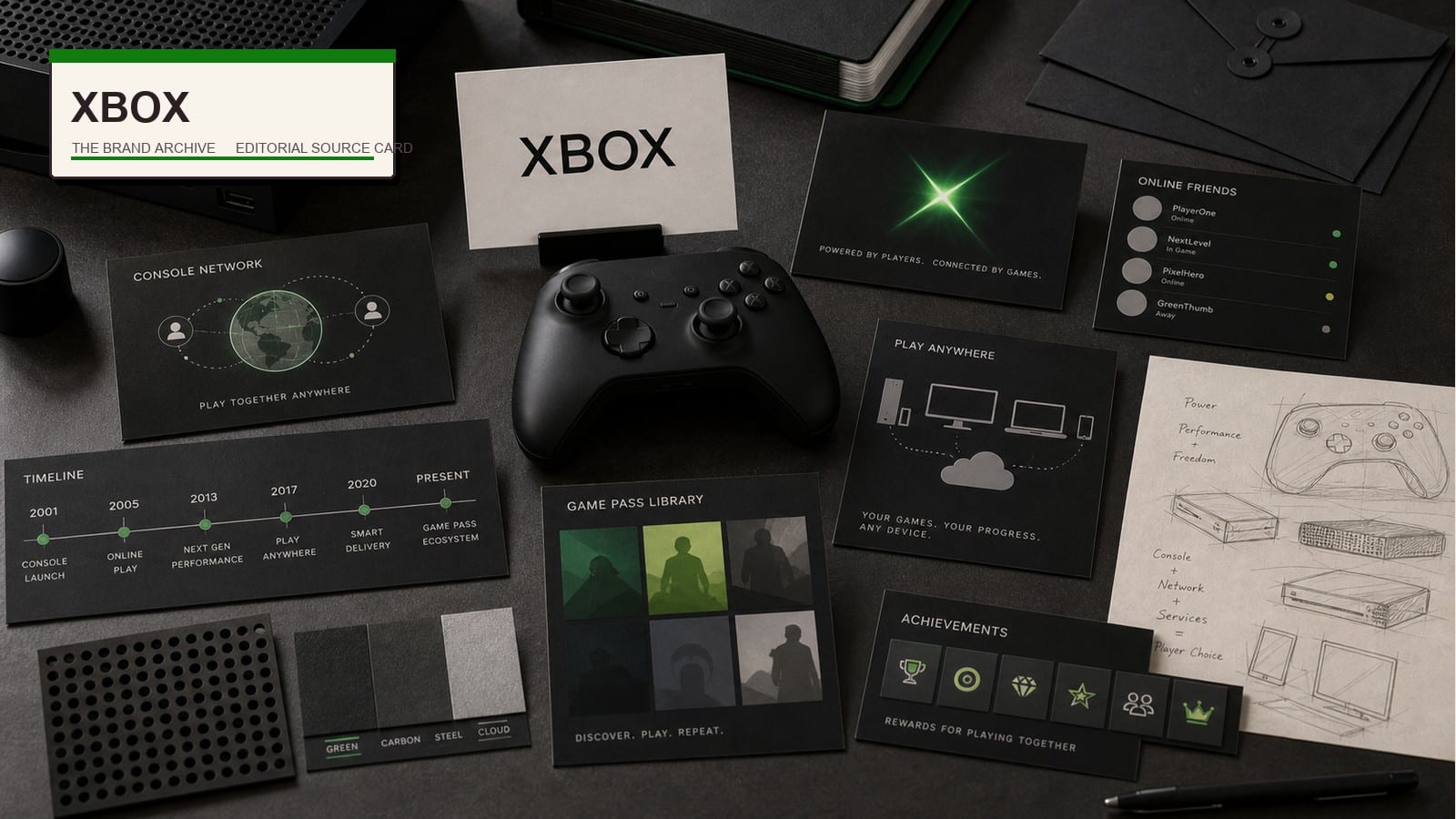
Xbox and the Console Network That Became a Subscription Platform is a pivot case about Xbox in 2001-present. A console brand grew into a platform by linking hardware, player identity, online services, subscription access, cloud play, and a green visual signal that could travel across devices. Gaming brands become stronger when the account, library, friend graph, controller memory, and service model survive the console cycle. The box matters, but the player relationship matters longer.
Reader Task
What this entry should help you finish
Use this entry to finish four jobs: answer what happened to Xbox, see why it belongs in the pivot lane, inspect the decision consequence, and leave with the operator lesson. The point is not to remember the brand. The point is to know what decision, proof surface, or failure mode a team should check next. Then compare it with Claude Code, Codex, Dell before turning the case into a rule.
What Xbox teaches
- Microsoft launched Xbox in North America on November 15, 2001.
- Xbox Game Pass was introduced in 2017 as a subscription with access to more than 100 games.
- Xbox Cloud Gaming later extended the platform to compatible phones, PCs, TVs, consoles, handhelds, and browsers.
- The brand moved from console identity toward a cross-device gaming account, library, and service layer.
- The operator lesson is to protect the identity system when the business model shifts from device sale to ongoing access.
Why This Brand Belongs In Grow Your Brand
Xbox belongs in Grow Your Brand because the page studies a specific brand decision, not a company profile. The decision sits in pivot and gives operators a way to see how service route changes commercial value.
The useful archive question is what changed in recognition, trust, demand, pricing power, category position, or public memory after the market saw the move.
The Brand Asset At Stake
The asset at stake is schedule reliability, route coverage, service recovery, loyalty behavior, and the handoff between promise and trip. That asset matters because it affects how people find, understand, choose, trust, or repeat the brand when the company is not in the room to explain itself.
For Xbox, the asset is not abstract equity. It has to show up in the buying surface, product surface, service route, source record, or repeated customer behavior.
What Changed
A console brand grew into a platform by linking hardware, player identity, online services, subscription access, cloud play, and a green visual signal that could travel across devices.
The change forced the market to decide whether the old shortcut still worked, whether the new proof was strong enough, and whether the brand had made the category easier or harder to understand.
What The Market Learned
The market learned to judge Xbox through the gap between the visible move and the proof behind it. describing national pride, premium service, or experience while skipping the operating proof behind the trip is the weak reading this page is meant to prevent.
A useful brand decision makes buying, remembering, trusting, or repeating easier. A weak decision makes the audience do more work before it believes the claim.
Commercial Consequence
The commercial consequence sits in service route: schedule reliability, route coverage, service recovery, loyalty behavior, and the handoff between promise and trip. When that proof becomes easier to see, customers have more reason to choose, trust, repeat, or pay attention. When it becomes harder to see, the brand has to spend more money explaining what the market used to understand faster.
Xbox matters because the decision changed more than presentation. It changed buyer confidence, memory, category position, or repeat behavior in gaming platform. That is why the case belongs in a brand decision library instead of a general company profile.
What Another Brand Should Learn
Another brand should use this case before spending money on a similar move. Name the customer behavior, the proof surface, the protected cue, and the consequence that would make the decision worth the cost.
If the same proof does not exist in the business, copying Xbox would copy the surface while missing the reason the decision mattered.
The Decision Context
Xbox started as a console challenge. Microsoft had to convince players that a software company could build a living-room gaming machine with enough power, enough games, and enough attitude to belong beside established console brands.
The black hardware, green light, controller, launch titles, and online ambition gave Xbox a recognizable beginning. The longer brand story is what happened after that: Xbox became less dependent on one box and more dependent on the player's account, library, friends, achievements, and subscription access.
The Network Made The Console Stickier
A console brand can fade when the hardware ages. Xbox reduced that risk by building memory around identity and connection. Friends, profiles, achievements, multiplayer behavior, and digital libraries made the account feel like part of the product.
That layer gave Xbox a path beyond the living-room machine. Once players think of the brand as a place where their games, friends, and progress live, the hardware is still important, but it is no longer the whole relationship.
Game Pass Changed The Buying Ritual
In 2017, Microsoft introduced Xbox Game Pass as a subscription with access to more than 100 Xbox One and backward compatible Xbox 360 games. That moved Xbox from pure box-and-title economics toward a library habit.
The subscription model changed the question from which single game to buy into which service deserves regular payment. That is a different brand test. The catalog, cadence, first-party releases, price, cloud access, and perceived value all become part of the public promise.
The Signal Reading
Xbox belongs in Grow Your Brand because it shows a platform pivot without losing the original signal. The green, the controller memory, the player identity, the console history, and the Game Pass library all have to feel like one brand even when play moves across devices.
For operators, the lesson is to move the customer relationship before the market forces the move. If your category depends on hardware cycles, build the account, network, and service layer while the box still has power.
Where The Strategy Can Break
Xbox should not be read as a clean success label. The useful question is where the pivot promise can fail in the real category: travel customers judge the brand when time, safety, comfort, baggage, booking, or recovery breaks.
The weak reading is describing national pride, premium service, or experience while skipping the operating proof behind the trip. That kind of page sounds polished but gives the reader no way to judge the decision.
The concrete failure mode is this: the route still exists, but the brand becomes a memory of delay, confusion, lost time, or service inconsistency. If the case cannot explain that risk, the brand story is not finished.
The Bad Example
A bad Xbox copycat would start with the visible surface: the mark, the color, the store, the app, the route, the campaign, or the public phrase. Then it would assume the surface created the result.
That is usually backwards. The surface worked only if the category proof underneath it was already strong enough: schedule reliability, route coverage, service recovery, loyalty behavior, and the handoff between promise and trip.
The page has to protect readers from that shortcut. The mistake is not ambition. The mistake is copying the artifact while leaving the constraint untouched.
What To Copy
Copy the discipline, not the costume. For Xbox, the discipline sits in the link between gaming platform pressure, customer behavior, and the proof a buyer or user can inspect.
A useful reader should be able to point to one behavior that changed, one risk that dropped, and one cue that helped the change stick.
If those three pieces are missing, the page should not pretend the case is a repeatable playbook. It is only a brand example with missing machinery.
The Proof Trail
Start with the year or period: 2001-present. Then ask what was visible to the market at that time, what changed after the decision, and what evidence still exists now.
The source list gives the inspection trail. Use it to separate what Xbox says about itself from what the case page argues about the brand decision.
The proof should answer five checks: route promise, time risk, handoff quality, service recovery, loyalty proof. If the page cannot answer them, the case needs more source work before anyone treats it as a decision record.
The Decision Limit
The case should not be used as a slogan for doing the same thing. It should be used as a boundary test. The question is whether the same market pressure, customer behavior, proof surface, and timing exist before the decision gets copied.
Xbox gives Grow Your Brand a concrete inspection point: schedule reliability, route coverage, service recovery, loyalty behavior, and the handoff between promise and trip. If a team cannot point to that proof in its own business, the comparison is weak, even when the visible asset looks similar.
The better lesson is operational. Decide what must be true before the cue, campaign, name, product, route, or experience can carry the promise. Then decide which signal would stop the move if customers reject it, ignore it, or use it in the wrong way.
A serious reader should leave with a constraint, not a mood. For Xbox, the constraint sits in gaming platform: who is choosing, what risk they are managing, which proof they can inspect, and what would make the promise collapse under normal use.
The final check is the comparison set. Put Xbox beside two adjacent cases and ask what changed in each file: the cue, the behavior, the channel, the proof, the public language, or the operating burden. The answer keeps the case from becoming trivia.
This is where Grow Your Brand page earns its keep. It turns a brand story into a decision memo: what changed, who had to believe it, what proof reduced the risk, what failure would expose the gap, and which nearby cases warn against copying the surface too quickly.
Compare Next
Related Cases
Do not read Xbox alone. Compare it against nearby cases: Claude Code, Codex, Dell.
Sources
People Also Ask
What happened to Xbox?
Xbox and the Console Network That Became a Subscription Platform is a pivot case about Xbox in 2001-present. A console brand grew into a platform by linking hardware, player identity, online services, subscription access, cloud play, and a green visual signal that could travel across devices. Gaming brands become stronger when the account, library, friend graph, controller memory, and service model survive the console cycle. The box matters, but the player relationship matters longer.
Why is Xbox a pivot case?
Xbox is filed as a pivot case because the visible consequence sits in that decision pattern. A console brand grew into a platform by linking hardware, player identity, online services, subscription access, cloud play, and a green visual signal that could travel across devices.
What can brands learn from Xbox?
Gaming brands become stronger when the account, library, friend graph, controller memory, and service model survive the console cycle. The box matters, but the player relationship matters longer.
Is Xbox still operating?
Grow Your Brand marks Xbox as Active / continuing. That means the brand, company, platform, product system, or parent organization is still operating, continuing, or being actively resolved.
What should Xbox be compared with?
Compare Xbox with Claude Code, Codex, Dell to see the same decision pattern from nearby cases.