Trust / Mobility / engines / power products / 1948-present
Honda Engineering Trust Case
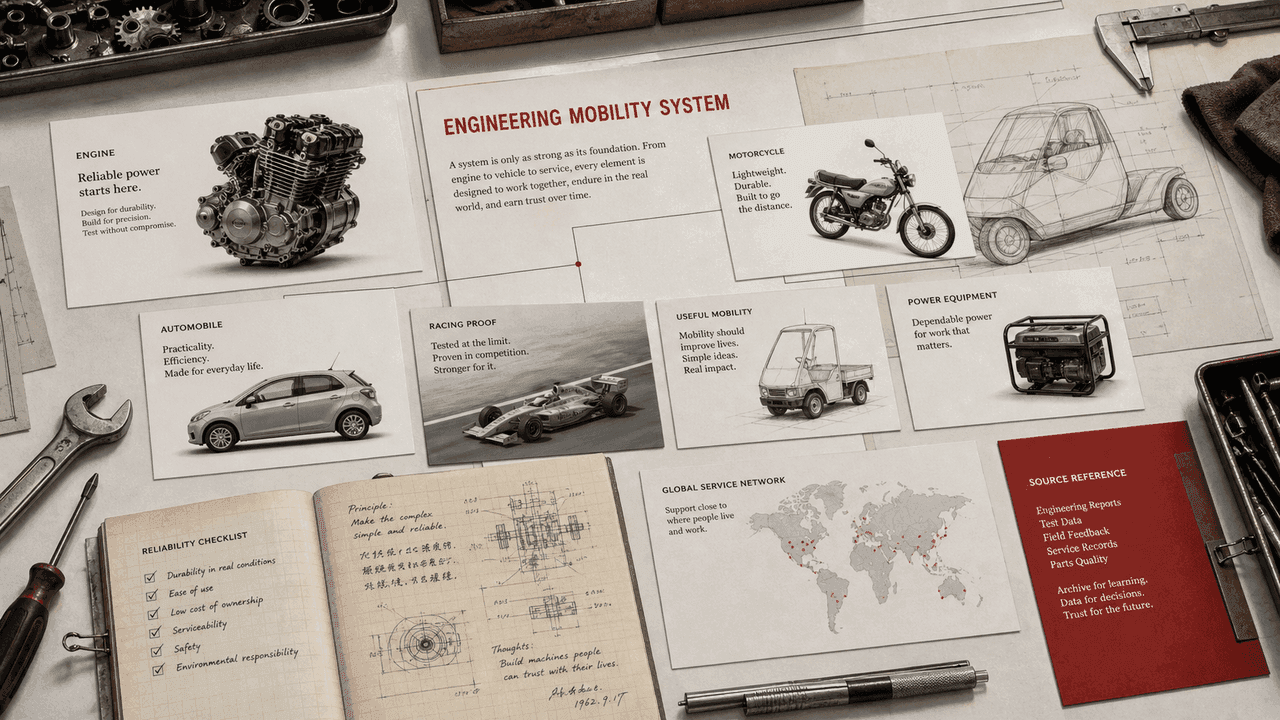
Honda built brand trust by making engineering usefulness visible across motorcycles, cars, racing, power equipment, service, and ordinary ownership.

Short Answer
Honda Engineering Trust Case is a trust case about Honda in 1948-present. Honda made engineering usefulness the trust signal. Mobility brands earn trust when the same engineering belief survives different use cases. Honda shows the value, and the risk, of letting one reliability code carry motorcycles, cars, racing, service, and power products.
Reader Task
What this entry should help you finish
Use this entry to finish four jobs: answer what happened to Honda, see why it belongs in the trust lane, inspect the decision consequence, and leave with the operator lesson. The point is not to remember the brand. The point is to know what decision, proof surface, or failure mode a team should check next. Then compare it with Toyota, Subaru, Lexus before turning the case into a rule.
What Honda teaches
- Honda's trust signal is not one product. It is the repeated idea that the machine should be useful, engineered, and worth owning.
- The risk is category stretch. Racing, motorcycles, cars, and power equipment can strengthen each other only if the customer can still read the same product belief.
- Honda's own philosophy connects buying, selling, and creating to trust, quality, and customer satisfaction. That gives the case an operating layer, not only a design layer.
- The bad version of this strategy is engineering theater: technical language that never appears in service, ownership, parts, or day-to-day reliability.
- The operator check is whether the heroic proof and the ordinary proof say the same thing.
Why This Brand Belongs In Grow Your Brand
Honda belongs in Grow Your Brand because the page studies a specific brand decision, not a company profile. The decision sits in trust and gives operators a way to see how product proof changes commercial value.
The useful archive question is what changed in recognition, trust, demand, pricing power, category position, or public memory after the market saw the move.
The Brand Asset At Stake
The asset at stake is engineering evidence, durability, service life, safety, supply reliability, and the cost of failure. That asset matters because it affects how people find, understand, choose, trust, or repeat the brand when the company is not in the room to explain itself.
For Honda, the asset is not abstract equity. It has to show up in the buying surface, product surface, service route, source record, or repeated customer behavior.
What Changed
Honda made engineering usefulness the trust signal.
The change forced the market to decide whether the old shortcut still worked, whether the new proof was strong enough, and whether the brand had made the category easier or harder to understand.
What The Market Learned
The market learned to judge Honda through the gap between the visible move and the proof behind it. using engineering, scale, or quality language while failing to show what the buyer can inspect is the weak reading this page is meant to prevent.
A useful brand decision makes buying, remembering, trusting, or repeating easier. A weak decision makes the audience do more work before it believes the claim.
Commercial Consequence
The commercial consequence sits in product proof: engineering evidence, durability, service life, safety, supply reliability, and the cost of failure. When that proof becomes easier to see, customers have more reason to choose, trust, repeat, or pay attention. When it becomes harder to see, the brand has to spend more money explaining what the market used to understand faster.
Honda matters because the decision changed more than presentation. It changed buyer confidence, memory, category position, or repeat behavior in mobility / engines / power products. That is why the case belongs in a brand decision library instead of a general company profile.
What Another Brand Should Learn
Another brand should use this case before spending money on a similar move. Name the customer behavior, the proof surface, the protected cue, and the consequence that would make the decision worth the cost.
If the same proof does not exist in the business, copying Honda would copy the surface while missing the reason the decision mattered.
The Decision Context
Honda is often read through cars, but the stronger brand case starts with useful machines: engines, motorcycles, racing, power equipment, service, and ownership routines.
The decision problem is category stretch. A company can widen the portfolio and make the brand stronger, or it can make the name less specific. Honda's case works when the market can still read one belief underneath the different machines: the engineering should help in real use.
That is why the case belongs in trust, not only mobility. Trust is earned when the machine keeps the promise after the showroom moment has passed.
Engineering Became Everyday Trust
Racing proof gives Honda a high-pressure technical signal. Power products and daily mobility give the brand a more ordinary signal: the machine starts, works, gets serviced, and earns trust over time.
Honda's philosophy page makes this practical. The company describes the Joy of Buying as products and services exceeding customer needs and expectations, and the Joy of Selling as relationships with customers built on trust. That language matters only if the owner can feel it after purchase.
The mistake would be to treat engineering as a badge. The brand value is not that Honda can talk about engines. It is that engine, service, reliability, racing pressure, and everyday use can point to the same standard.
Where The Strategy Can Break
The danger is dilution. If every machine category borrows the same engineering story, the proof has to stay inspectable. A weak product, poor service path, or confusing ownership experience does not stay isolated. It damages the shared trust code.
That is the practical reason to check broad engineering brands by use case. A motorcycle rider, car owner, generator buyer, and racing fan do not need the same message. They need the same standard to show up in different places.
What Operators Should Copy
Copy the discipline, not the category spread. A brand can stretch only when the old proof helps the next buyer understand why the company belongs there.
Before extending a brand, write the proof transfer plainly: what known capability lowers risk in the new use case, where the buyer can inspect it, and what failure would make the old reputation less useful.
The Signal Reading
Honda belongs in the Japan lane because it shows how engineering credibility can travel across categories without becoming pure corporate abstraction.
The lesson is direct: connect heroic proof to ordinary proof. Racing, invention, and scale are not enough if the machine does not help the buyer in the real use moment.
Compare Next
Related Cases
Do not read Honda alone. Compare it against nearby cases: Toyota, Subaru, Lexus.
Sources
People Also Ask
What happened to Honda?
Honda Engineering Trust Case is a trust case about Honda in 1948-present. Honda made engineering usefulness the trust signal. Mobility brands earn trust when the same engineering belief survives different use cases. Honda shows the value, and the risk, of letting one reliability code carry motorcycles, cars, racing, service, and power products.
Why is Honda a trust case?
Honda is filed as a trust case because the visible consequence sits in that decision pattern. Honda made engineering usefulness the trust signal.
What can brands learn from Honda?
Mobility brands earn trust when the same engineering belief survives different use cases. Honda shows the value, and the risk, of letting one reliability code carry motorcycles, cars, racing, service, and power products.
Is Honda still operating?
Grow Your Brand marks Honda as Active / continuing. That means the brand, company, platform, product system, or parent organization is still operating, continuing, or being actively resolved.
What should Honda be compared with?
Compare Honda with Toyota, Subaru, Lexus to see the same decision pattern from nearby cases.