Brand Entity / what happened to Yahoo
Yahoo: what happened to the portal brand
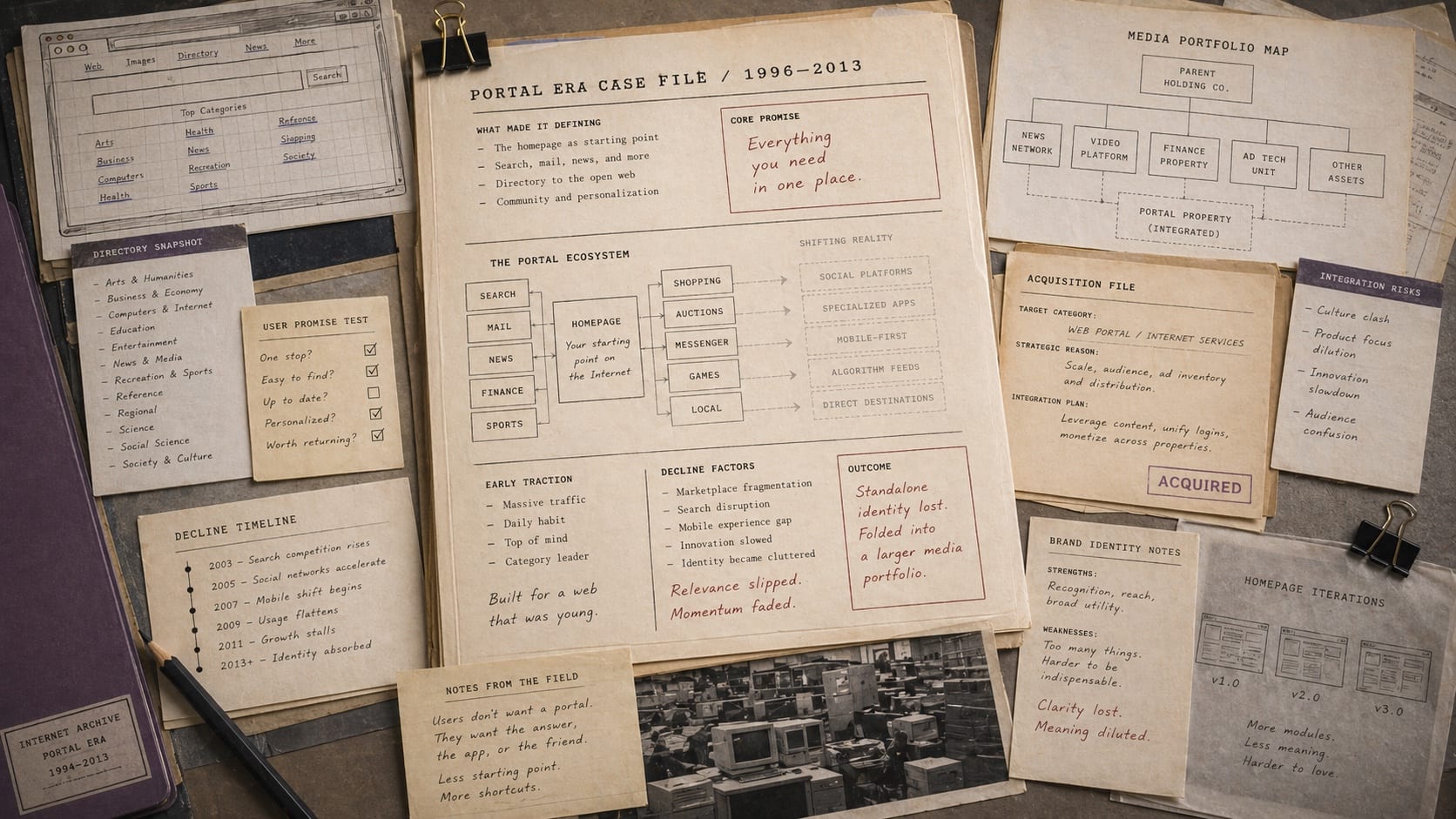
Yahoo is filed as a portal-decline brand: the name stayed famous after the behavior that made it the front door to the web moved elsewhere.

Short Answer
Yahoo is filed here for one job: what happened to Yahoo. The Yahoo file proves that a category pioneer can keep recognition while losing control of the category behavior.
Reader Task
What this brand entry should help you finish
Use this file to answer the Yahoo brand question without falling into a company-history summary. The task is to understand the main what happened to Yahoo pattern, check the sourced facts, open the primary case (Yahoo and the End of the Standalone Portal Era), and leave with a lesson or risk that can be compared against another brand. The file has 1 filed case, so the next step should be clear before the reader leaves.
Fact Panel
Yahoo facts
Only sourced facts render here. Unsourced company-history rows stay out of the page.
- Founded
- 1994 Source
- Founders
- Jerry Yang and David Filo Source
- Parent / ownership
- Verizon completed its acquisition of Yahoo's operating business in 2017; the brand later continued under subsequent ownership Source
- Category
- Web portal, email, search, media, and finance services Source
- Home market
- Sunnyvale, California, United States Source
- Distinctive assets
- Purple portal identity and homepage habit, Yahoo Mail and Yahoo Finance memory
- Status
- Failed independent company / operating brand survives Source
- Decisions on file
- 1 filed case
What Yahoo teaches
The useful brand entry does not ask whether Yahoo is famous. It asks what the filed decision record teaches that a reader can use on another brand.
- Main lesson: The Yahoo file proves that a category pioneer can keep recognition while losing control of the category behavior.
- Reader check: Inspect the portal role, mail and finance memory, search and social displacement, Verizon sale, and the line between operating brand and independent company.
- Failure mode: The risk is mistaking historical importance for current strategic center.
- Filed case: Yahoo: A portal brand can keep recognition long after it loses the central user behavior that made it powerful.
Mistake To Catch
Where the Yahoo reading breaks
The risk is mistaking historical importance for current strategic center.
The weak read is to stop at the familiar name. The stronger read is to ask which decision changed recognition, trust, habit, distribution, product proof, or public memory.
That is the useful job of the brand entry: keep the famous name attached to a decision the reader can inspect.
Decision Depth
Read Yahoo as portal memory after the web front door moved.
This section turns the brand name into an inspection path: what changed, what broke, what worked, and what to compare next.
Yahoo is useful because it stayed famous after losing the center of the behavior it helped create. Portal memory, mail, finance, homepage habits, search, media, and ownership changes all point to different layers of the brand.
A weak reading treats Yahoo as a failed company story. A stronger reading asks which category behaviors moved to search, social, mobile apps, and specialized services.
The inspection path is portal use, mail and finance retention, search displacement, advertising, Verizon sale, and the line between operating brand and former internet front door.
Use this file before assuming pioneer status protects relevance. The approval test is whether the brand still controls a current route, not whether it shaped the old one.
The copycat mistake is confusing historical importance with present customer control.
The practical lesson is to keep the behavior alive before the market turns the brand into a memory object.
The Yahoo file is also a warning about partial survival. Mail, finance, sports, and news can remain useful while the parent meaning weakens. That is not a contradiction; it is the sign of a brand with strong pockets and a weaker center.
A team should not ask whether people remember the name. The sharper question is what job the name still wins without nostalgia. If the answer is only memory, the brand has recognition but not control.
The search lesson is plain. A portal brand once helped people start the web. Search, social feeds, mobile homescreens, app stores, and direct app habits later took that starting point apart.
The acquisition history matters because ownership changes can keep assets alive without restoring the original role. Sale, restructuring, and portfolio handling may preserve revenue while confirming that the old category position is gone.
The operator takeaway is to defend the daily entry point. Once customers begin somewhere else, even a famous name has to earn its way back through a specific behavior.
Decision timeline
The timeline is the reason this brand has a parent page. Each row points to a filed case, then names the consequence a reader should carry into the next comparison.
For brands with one case, the timeline still matters because it prevents a thin profile. The brand page becomes the router, and the case page remains the proof.
| Filed decision | What happened | What it teaches |
|---|---|---|
| Yahoo and the End of the Standalone Portal Era Failure / 2017 |
Yahoo's sale to Verizon marked the end of a once-defining internet brand as an independent operating company. | A portal brand can keep recognition long after it loses the central user behavior that made it powerful. |
Source test
The source trail below is inherited from the filed cases, including company records, campaign records, public reports, source-mark files, or archived references where the original page moved.
Use the source list to verify the facts. Use the case links to inspect the decision. Use the comparison links to test whether the Yahoo pattern repeats somewhere else.
Visual proof
The hero image for this brand page uses the strongest generated editorial visual already attached to the primary case: Yahoo and the End of the Standalone Portal Era. It stays tied to filed evidence instead of becoming a generic brand mood image.
That visual rule matters for this build. Every brand page needs a high-end image, but the image has to point back to the decision: packaging, mark, product behavior, service proof, ritual, failure, or trust pressure.
If a future brand has no strong visual, it does not pass the entity-page gate until the image is generated or replaced.
Sources
.svg)
People Also Ask
What happened to Yahoo, and what should readers inspect?
The Yahoo file proves that a category pioneer can keep recognition while losing control of the category behavior. Start by inspecting this point: Inspect the portal role, mail and finance memory, search and social displacement, Verizon sale, and the line between operating brand and independent company.
What does Yahoo teach about branding?
The Yahoo file proves that a category pioneer can keep recognition while losing control of the category behavior.
What should readers inspect first in the Yahoo file?
Inspect the portal role, mail and finance memory, search and social displacement, Verizon sale, and the line between operating brand and independent company.
What is the main risk in the Yahoo file?
The risk is mistaking historical importance for current strategic center.
Which Yahoo case should readers open first?
Start with Yahoo and the End of the Standalone Portal Era, because it is the primary filed case behind this brand file.