Brand Entity / Bud Light brand backlash
Bud Light: brand backlash
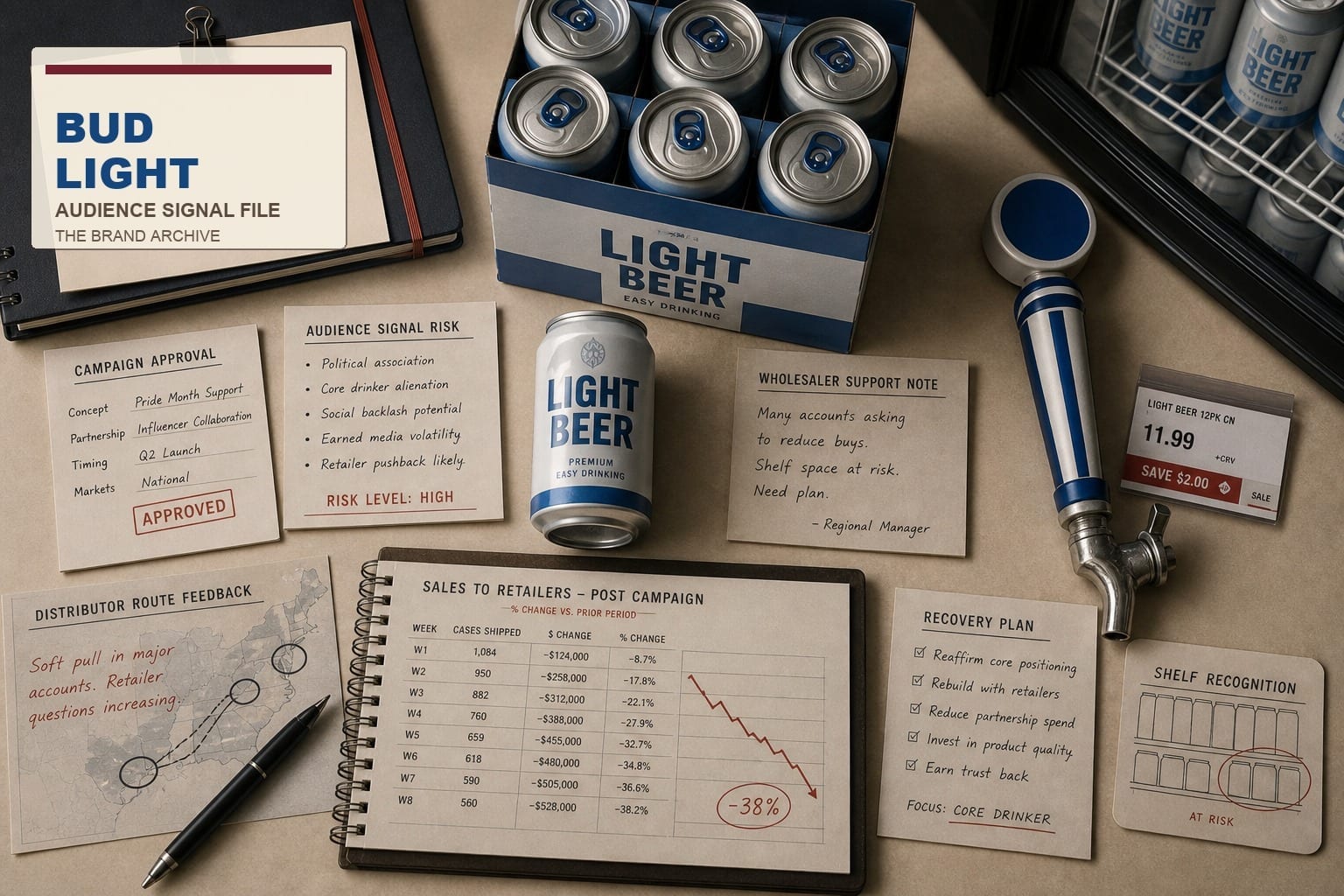
Bud Light is filed as an audience-signal brand: a small campaign artifact became a distribution and identity problem for a mass beer brand.
Short Answer
Bud Light is filed here for one job: Bud Light brand backlash. The Bud Light file proves that broad brands need audience-signaling discipline before a message enters public conflict.
Reader Task
What this brand entry should help you finish
Use this file to answer the Bud Light brand question without falling into a company-history summary. The task is to understand the main Bud Light brand backlash pattern, check the sourced facts, open the primary case (Bud Light and the Audience Signal That Became a Distribution Problem), and leave with a lesson or risk that can be compared against another brand. The file has 1 filed case, so the next step should be clear before the reader leaves.
Fact Panel
Bud Light facts
Only sourced facts render here. Unsourced company-history rows stay out of the page.
- Founded
- 1982 Source
- Parent / ownership
- Anheuser-Busch, part of Anheuser-Busch InBev Source
- Category
- Light beer Source
- Home market
- United States Source
- Distinctive assets
- Blue Bud Light can system
- Status
- Active Source
- Decisions on file
- 1 filed case
What Bud Light teaches
The useful brand entry does not ask whether Bud Light is famous. It asks what the filed decision record teaches that a reader can use on another brand.
- Main lesson: The Bud Light file proves that broad brands need audience-signaling discipline before a message enters public conflict.
- Reader check: Inspect how a low-cost post changed retailer, customer, political, and category readings of the brand.
- Failure mode: The risk is letting a light campaign object become the brand's loudest social signal.
- Filed case: Bud Light: A sponsorship signal can carry more meaning than the spend behind it. When a broad-reach brand triggers opposing readings at once, the issue is more than backlash. It is whether distributors, retailers, loyal buyers, and new audiences all understand the same brand role.
Mistake To Catch
Where the Bud Light reading breaks
The risk is letting a light campaign object become the brand's loudest social signal.
The weak read is to stop at the familiar name. The stronger read is to ask which decision changed recognition, trust, habit, distribution, product proof, or public memory.
That is the useful job of the brand entry: keep the famous name attached to a decision the reader can inspect.
Decision Depth
Read Bud Light as an audience-signal case, more than a backlash story.
This section turns the brand name into an inspection path: what changed, what broke, what worked, and what to compare next.
Bud Light is filed here because audience signals can change the meaning of a mass-market brand faster than the company intends. The issue is more than politics or attention. It is audience interpretation, retailer pressure, distributor exposure, and category habit.
A mass beer brand depends on easy social use. Buyers do not want to explain the brand every time they carry it into a group setting. When a signal makes the product read as a statement, the brand has to know whether that statement helps or hurts the buying moment.
A weak reading treats the case as simple outrage. A useful reading maps the chain: campaign cue, audience read, public reaction, retailer and distributor consequence, volume behavior, and recovery language.
The copycat mistake is using a controversial signal for short attention without deciding whether the core buyer, sales channel, and public use context can carry it.
Use this file when a broad consumer brand wants to update relevance. The test is whether the new signal gives the current and future buyer a clearer role, or whether it makes ordinary purchase read socially risky.
The repair lesson is to define the audience contract before the signal moves. Mass brands can evolve, but they need bridge cues, channel readiness, and proof that the product still knows the room it enters.
Decision timeline
The timeline is the reason this brand has a parent page. Each row points to a filed case, then names the consequence a reader should carry into the next comparison.
For brands with one case, the timeline still matters because it prevents a thin profile. The brand page becomes the router, and the case page remains the proof.
| Filed decision | What happened | What it teaches |
|---|---|---|
| Bud Light and the Audience Signal That Became a Distribution Problem Disaster / 2023-2024 |
Bud Light showed how fast a mass-market beer brand can become a public signal problem when a small campaign artifact changes who the brand seems to be speaking for. | A sponsorship signal can carry more meaning than the spend behind it. When a broad-reach brand triggers opposing readings at once, the issue is more than backlash. It is whether distributors, retailers, loyal buyers, and new audiences all understand the same brand role. |
Source test
The source trail below is inherited from the filed cases, including company records, campaign records, public reports, source-mark files, or archived references where the original page moved.
Use the source list to verify the facts. Use the case links to inspect the decision. Use the comparison links to test whether the Bud Light pattern repeats somewhere else.
Visual proof
The hero image for this brand page uses the strongest generated editorial visual already attached to the primary case: Bud Light and the Audience Signal That Became a Distribution Problem. It stays tied to filed evidence instead of becoming a generic brand mood image.
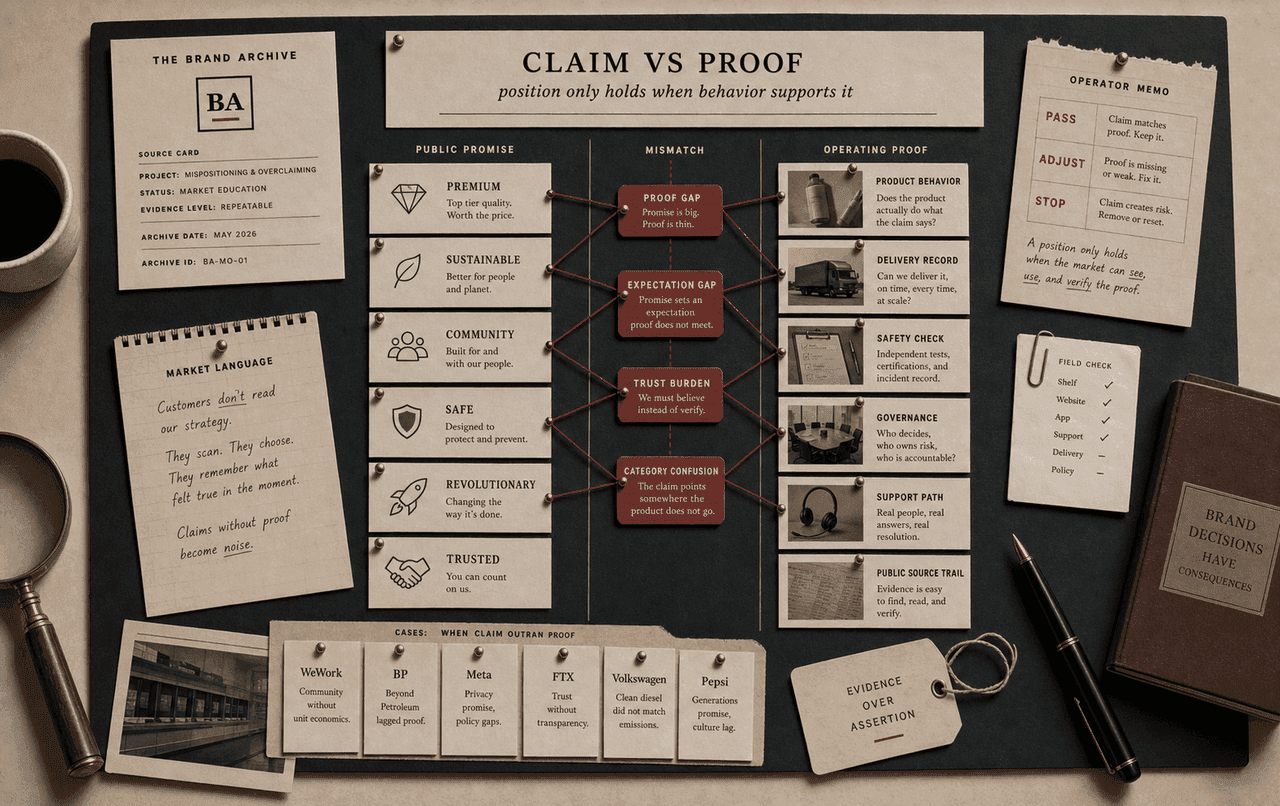
That visual rule matters for this build. Every brand page needs a high-end image, but the image has to point back to the decision: packaging, mark, product behavior, service proof, ritual, failure, or trust pressure.
If a future brand has no strong visual, it does not pass the entity-page gate until the image is generated or replaced.
Sources
- AP, Bud Light brewer says sales were still down after backlash, October 31, 2023
- AB InBev, Second Quarter 2023 Results
- AB InBev via Business Wire, Full Year and Fourth Quarter 2023 Results
- Bud Light, official site
- Anheuser-Busch, brands
- Anheuser-Busch, newsroom
- AB InBev, annual reports
- Google Search Central, helpful content self-assessment
- Google Search Central, SEO starter guide
People Also Ask
What happened to Bud Light, and what should readers inspect?
The Bud Light file proves that broad brands need audience-signaling discipline before a message enters public conflict. Start by inspecting this point: Inspect how a low-cost post changed retailer, customer, political, and category readings of the brand.
What does Bud Light teach about branding?
The Bud Light file proves that broad brands need audience-signaling discipline before a message enters public conflict.
What should readers inspect first in the Bud Light file?
Inspect how a low-cost post changed retailer, customer, political, and category readings of the brand.
What is the main risk in the Bud Light file?
The risk is letting a light campaign object become the brand's loudest social signal.
Which Bud Light case should readers open first?
Start with Bud Light and the Audience Signal That Became a Distribution Problem, because it is the primary filed case behind this brand file.