Assuming marketplace traffic creates brand memory
Marketplace discovery helps only if the seller cue, package, product, or service path is memorable after comparison.
Branding guide · evidence and decision
Compare marketplace and owned-store branding through Shopify, Amazon, eBay, Etsy, Walmart, Target, Nike, Apple, Sephora, Nespresso, Zappos, and Costco.
decision · proof · use
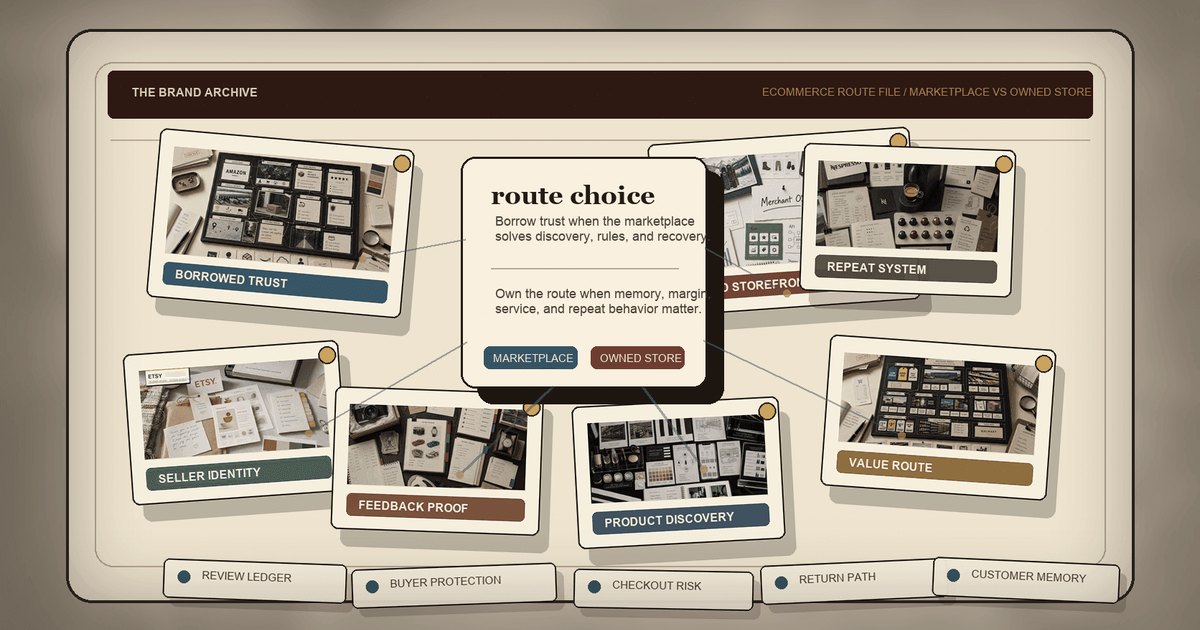
Marketplace branding borrows trust. Owned-store branding has to earn it directly. The best ecommerce route depends on which proof the buyer needs: reviews, platform rules, seller identity, product-page proof, checkout confidence, delivery, returns, or a direct relationship.
A marketplace can make the first purchase safer. An owned store has to make the next relationship worth remembering.
Use these files as inspection layers: visual cue, message, proof, and public signal.
"Grow Your Brand defines marketplace vs owned-store branding as the brand choice between borrowing platform trust through marketplaces and building direct customer memory through owned commerce surfaces."
Most ecommerce brands do not live on one route.
A marketplace can create discovery and reassurance, while an owned store can protect memory, service, margin, and repeat behavior.
The mistake is turning the route into ideology.
Marketplace and owned-store channels both help and both create risk. The proof decides.
Most marketplace advice turns into channel ideology.
This page treats the route as proof: borrowed platform trust, owned-store control, seller identity, delivery, returns, and customer memory.
The useful comparison is not control versus dependency in the abstract. It is which route gives the buyer enough proof at the moment of choice.
| Route | What helps | What can break |
|---|---|---|
| Marketplace | Borrowed trust, search demand, reviews, buyer protection, seller comparison, convenience. | The seller can become interchangeable and the platform owns much of the customer memory. |
| Owned store | Brand control, product storytelling, margins, first-party relationship, service, repeat memory. | The buyer may not trust the store unless proof, checkout, delivery, and returns are visible. |
| Hybrid route | Marketplace discovery can feed owned-store memory when the cues and service path stay consistent. | Customers can receive different promises, prices, policies, and service expectations by channel. |
| Marketplace product page | Review trails, seller history, fulfillment signals, and platform rules reduce stranger risk. | The brand may lose control of comparison, adjacent listings, discount pressure, and search order. |
| Owned product page | The brand controls proof, imagery, naming, bundles, service, and post-purchase route. | The page has to replace the trust that a marketplace would otherwise lend. |
| Delivery and returns | Fulfillment and recovery can make either route read safer. | Weak handoff makes marketplace convenience or owned-store polish read false. |
These cases show ecommerce route choices by trust source, control, seller identity, and recovery ownership.
| Case | What happened | GYB interpretation | Practical check |
|---|---|---|---|
| Shopify Launch / 2006-present | Shopify made owned commerce practical by giving merchants storefront, checkout, apps, payments, POS, and sales-channel control. | Owned-store branding works when the operating surface lets the merchant prove trust directly. | Use owned channels when you can make product proof, checkout, service, and repeat memory visible. |
| Amazon Prime Brand System / 1994-present | Amazon Prime made a vast marketplace read as safer through membership, reviews, fulfillment expectation, delivery speed, and return confidence. | A marketplace can lend trust when platform behavior lowers the buyer's search, delivery, and recovery risk. | Borrow platform trust when discovery and reassurance matter more than full control. |
| eBay Trust / 1997-present | eBay made unknown sellers legible through feedback, transaction history, buyer protection, and marketplace rules. | Marketplace branding depends on visible reputation because the platform does not own every product. | Show seller proof before asking a buyer to trust a stranger. |
| Etsy Trust / 2005-present | Etsy puts shop identity, item detail, reviews, policies, and category rules close to the handmade purchase. | Seller identity can be a brand asset when the marketplace keeps individuality and governance in balance. | Do not let marketplace scale erase the human proof that made the route attractive. |
| Walmart Brand System / 1962-present | Walmart extends value through stores, app, pickup, delivery, marketplace, receipt memory, and grocery habit. | A hybrid route works only when every channel keeps the same value promise legible. | check price, availability, substitution, delivery, and return proof across every route. |
| Target Launch / 1962-presentTarget | Target's bullseye helps the retail system stay recognizable across store signs, app surfaces, pickup, bags, and owned channels. | Owned-store control is stronger when a retrieval cue travels across physical and digital routes. | Make the route easy to recognize before asking customers to remember the store. |
| Nike Launch / 1971-presentNike | Nike's direct channel can lean on product drops, membership, athlete proof, and the Swoosh instead of only marketplace comparison. | Owned-store branding is stronger when the brand cue carries performance proof and repeat reason. | Use direct routes to deepen the product system, more than to remove intermediaries. |
| Apple Comeback / 1997-1998Apple | Apple rebuilt demand through product focus, retail control, presentation, service, and a store experience that made the system easier to understand. | Owned channels can turn product proof into a controlled buying ritual. | Use owned retail when the product needs explanation, comparison discipline, and service memory. |
| Sephora Brand System / 1970 / 1998-present | Sephora translated open-sell retail into discovery, comparison, loyalty, sampling cues, and product-page proof. | Owned and app routes can reduce choice risk when they preserve the browsing logic customers trust. | Design owned ecommerce around how customers compare, more than around catalog volume. |
| Nespresso Launch / 1986-present | Nespresso's owned system explains machine fit, capsule choice, replenishment, boutiques, sleeves, and repeat ritual. | A direct route can protect compatibility and replenishment memory better than a generic marketplace listing. | Own the route when the system needs education after the first purchase. |
| Zappos Trust / 1999-present | Zappos made the store trustworthy through service, shipping, returns, and support behavior that buyers could remember. | An owned store can compete on recovery proof when product fit is uncertain. | Make service the reason buyers trust the route. |
| Costco Trust / 1983-present | Costco makes value read governed through membership, limited selection, warehouse behavior, ecommerce, and return expectations. | Direct membership can own customer memory when the rules keep proving the bargain. | Use membership only when the operating model keeps earning the fee. |
The route is part of the brand when customers use it to decide who they trust.
The useful pattern is the decision mechanism. Brand names are evidence, not the organizing principle.
| Pattern | What it means | Cases to inspect |
|---|---|---|
| Borrowed trust | The marketplace lends reviews, rules, search, and buyer protection. | Amazon, eBay, Etsy |
| Owned control | The brand controls proof, product page, service, memory, and repeat relationship. | Shopify, Apple, Nike, Nespresso |
| Seller identity | The buyer has to remember who sold it after comparison ends. | Etsy, eBay, Shopify merchants |
| Route consistency | Store, app, pickup, delivery, marketplace, and returns have to teach the same promise. | Walmart, Target, Sephora |
| Recovery ownership | The customer needs to know whether the platform, seller, card, carrier, or brand solves the failure. | Amazon Prime, Zappos, Costco, eBay |
The practical test is whether the concept changes a real decision.
Use these questions before changing a cue, promise, channel, page, package, or proof point.
These mistakes are common because they sound reasonable inside the company and fail when customers meet the brand.
Marketplace discovery helps only if the seller cue, package, product, or service path is memorable after comparison.
A direct store needs visible proof where the marketplace would normally supply reviews, protection, and fulfillment confidence.
Different prices, policies, delivery promises, or support paths can teach customers to distrust the brand.
Marketplace listings answer comparison risk. Owned pages also have to carry story, proof, service, and repeat memory.
Return and support clarity often decide whether the buyer trusts the route at all.
This page is most useful when the decision depends on proof, memory, risk, behavior, or market consequence.
Use the checklist as a pressure test. If the answer is vague, the brand decision is not ready.
Use the page to decide what must be protected before money moves: the name, cue, promise, proof, channel, page, package, or customer habit.
The useful output is not a prettier opinion. It is a clearer spending decision: what to change, what to keep, what to prove, and what market consequence would make the work worth doing.
Marketplace branding borrows trust from platform rules, reviews, search, convenience, and buyer protection. Owned-store branding relies more on direct product proof, checkout trust, service, delivery, returns, and repeat customer memory.
No. A marketplace can reduce discovery and trust barriers. The risk is that the product becomes easier to compare than remember.
An owned store matters when the brand needs control over product explanation, customer relationship, margins, membership, service, replenishment, or long-term memory.
Use the marketplace for discovery and trust borrowing, then make product cues, packaging, service, return proof, and owned follow-up strong enough that the brand remains memorable.