Rebrand / Fuel Retail / 2002-2004
Aral Rebrand Case: Local Equity Over Parent Uniformity
Aral is the brand-architecture case for keeping local fuel-station equity visible after parent ownership changes, instead of forcing every market into one corporate mark.

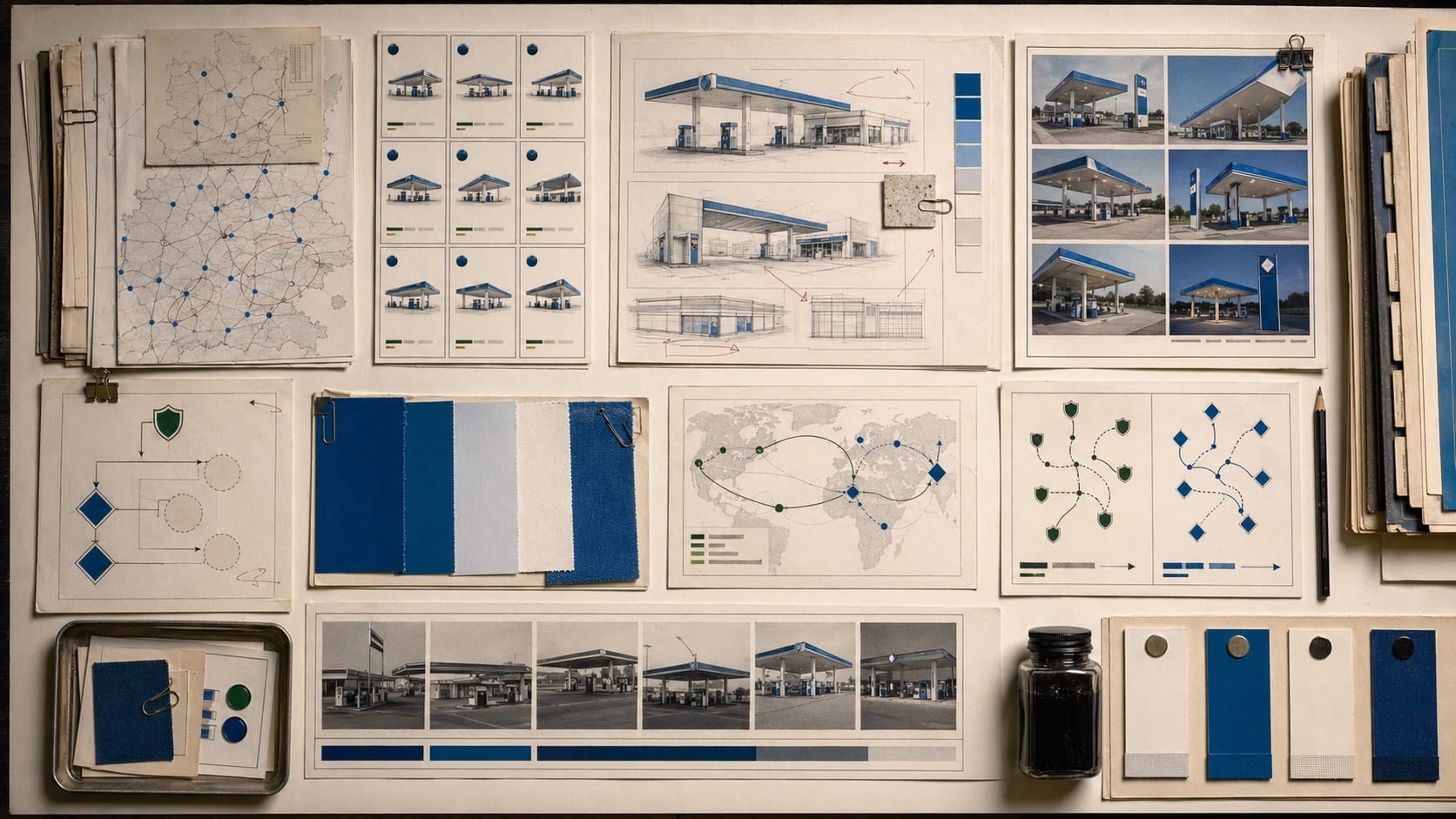
Short Answer
Aral Rebrand Case: Local Equity Over Parent Uniformity is a rebrand case about Aral in 2002-2004. Aral matters because fuel-station brands are chosen at speed. Local recognition, route memory, station trust, payment, shop behavior, and parent ownership have to be balanced. Brand architecture is not tidiness. A parent brand should keep a local mark when that mark still lowers customer friction better than the corporate system.
Reader Task
What this entry should help you finish
Use this entry to finish four jobs: answer what happened to Aral, see why it belongs in the rebrand lane, inspect the decision consequence, and leave with the operator lesson. The point is not to remember the brand. The point is to know what decision, proof surface, or failure mode a team should check next. Then compare it with Microsoft, Nickelodeon, Taco Bell before turning the case into a rule.
What Aral teaches
- Aral is a local-equity case because drivers use signs, colors, station memory, and habit under time pressure.
- BP ownership did not automatically make BP the stronger retail signal in Germany.
- Fuel branding has to work from the road, the map, the pump, the shop, the receipt, and the loyalty path.
- The weak copycat forces a global architecture because it looks cleaner internally.
- The repair test is whether the local sign still helps customers find, trust, and use the station.
Why This Brand Belongs In Grow Your Brand
Aral belongs in Grow Your Brand because the page studies a specific brand decision, not a company profile. The decision sits in rebrand and gives operators a way to see how trust changes commercial value.
The useful archive question is what changed in recognition, trust, demand, pricing power, category position, or public memory after the market saw the move.
The Brand Asset At Stake
The asset at stake is access, transaction confidence, service recovery, and visible risk control. That asset matters because it affects how people find, understand, choose, trust, or repeat the brand when the company is not in the room to explain itself.
For Aral, the asset is not abstract equity. It has to show up in the buying surface, product surface, service route, source record, or repeated customer behavior.
What Changed
Aral matters because fuel-station brands are chosen at speed. Local recognition, route memory, station trust, payment, shop behavior, and parent ownership have to be balanced.
The change forced the market to decide whether the old shortcut still worked, whether the new proof was strong enough, and whether the brand had made the category easier or harder to understand.
What The Market Learned
The market learned to judge Aral through the gap between the visible move and the proof behind it. calling the brand trusted while avoiding the proof of access, error handling, fees, service, and recovery is the weak reading this page is meant to prevent.
A useful brand decision makes buying, remembering, trusting, or repeating easier. A weak decision makes the audience do more work before it believes the claim.
Commercial Consequence
The commercial consequence sits in trust: access, transaction confidence, service recovery, and visible risk control. When that proof becomes easier to see, customers have more reason to choose, trust, repeat, or pay attention. When it becomes harder to see, the brand has to spend more money explaining what the market used to understand faster.
Aral matters because the decision changed more than presentation. It changed buyer confidence, memory, category position, or repeat behavior in fuel retail. That is why the case belongs in a brand decision library instead of a general company profile.
What Another Brand Should Learn
Another brand should use this case before spending money on a similar move. Name the customer behavior, the proof surface, the protected cue, and the consequence that would make the decision worth the cost.
If the same proof does not exist in the business, copying Aral would copy the surface while missing the reason the decision mattered.
The Decision Context
Aral sits in a category where recognition is practical. Drivers often decide at speed, near exits, while watching price boards, fuel type, traffic, and route timing.
That makes local station memory commercially important. A parent company can own the business, but the customer may still use the local name to navigate trust and habit.
Local Equity Can Beat Corporate Tidiness
BP's ownership created an architecture question: should the group standardize the retail mark or keep Aral where the local equity is stronger?
The Aral case argues for customer-side discipline. Architecture should be clean enough to manage, but not so clean that it removes a cue buyers still use.
The Station Is The Brand Surface
A fuel-station brand is read across canopy, sign, pump, price board, forecourt, shop, card terminal, receipt, app, and map result.
That means identity decisions have operating consequences. A mark change can alter recognition, route memory, loyalty behavior, and perceived station reliability.
Ownership Needs A Public Boundary
Parent ownership can support the business through supply, standards, investment, and governance. But the parent name does not need to replace the customer-facing cue in every market.
The public boundary is the brand architecture decision: what should customers see first, what should partners understand, and what should the parent govern quietly?
Austria Creates A Useful Contrast
Different markets can justify different answers. The strongest architecture is not always uniform across borders; it is uniform about the decision rule.
If the local brand is the better customer cue in one market and weaker in another, architecture should reflect the evidence rather than a diagram preference.
Where The Strategy Breaks
The strategy breaks when local equity becomes untouchable nostalgia. A local mark should stay because it lowers friction now, not because the company is afraid of change.
It also breaks when parent standardization becomes vanity. A global logo that weakens local navigation is not strategic clarity.
The Bad Copycat
A bad copycat would use Aral to defend every legacy name in a portfolio.
That is the wrong reading. The case defends local equity only when the cue still helps customers choose, find, pay, and return.
The Signal Reading
Aral is filed here because it records how brand architecture should respect customer-side evidence before parent-side neatness.
The decision test is whether the name on the station still performs a job the parent mark cannot perform as well.
The Decision Pressure
Aral's pressure is that the customer is often making a low-attention, high-speed choice. The driver sees a sign, price board, canopy, map label, or familiar station route before thinking about corporate ownership.
That means a parent-brand decision has to be tested in the road context, more than in an architecture review. A cleaner group diagram can still weaken the customer's fastest cue.
The page should teach that local equity has to earn protection through current use. The question is not whether the old name is loved. The question is whether the name still reduces friction better than the parent mark.
The Evidence Standard
The evidence standard is whether the local sign still performs at the point of choice. Drivers should be able to recognize the station from the road, the map, the price board, the canopy, the loyalty path, and the receipt.
The stronger page should ask for market-side evidence before replacing the mark. Does the parent mark lower friction, or does it ask customers to relearn a route they already understood?
That makes Aral a governance case as much as a design case. The parent has to decide when to standardize, when to endorse quietly, and when to let a local retail asset keep doing the public job at road speed, on maps, at pumps, in shop visits, in fleet routines, in price comparison, and in everyday route memory.
The practical check is field evidence, not identity preference: road recognition, station visits, loyalty behavior, customer language, and local search should all be reviewed before a parent mark replaces a working local cue.
Compare Next
Related Cases
Do not read Aral alone. Compare it against nearby cases: Microsoft, Nickelodeon, Taco Bell.
Sources


People Also Ask
What happened to Aral?
Aral Rebrand Case: Local Equity Over Parent Uniformity is a rebrand case about Aral in 2002-2004. Aral matters because fuel-station brands are chosen at speed. Local recognition, route memory, station trust, payment, shop behavior, and parent ownership have to be balanced. Brand architecture is not tidiness. A parent brand should keep a local mark when that mark still lowers customer friction better than the corporate system.
Why is Aral a rebrand case?
Aral is filed as a rebrand case because the visible consequence sits in that decision pattern. Aral matters because fuel-station brands are chosen at speed. Local recognition, route memory, station trust, payment, shop behavior, and parent ownership have to be balanced.
What can brands learn from Aral?
Brand architecture is not tidiness. A parent brand should keep a local mark when that mark still lowers customer friction better than the corporate system.
Is Aral still operating?
Grow Your Brand marks Aral as Active / continuing. That means the brand, company, platform, product system, or parent organization is still operating, continuing, or being actively resolved.
What should Aral be compared with?
Compare Aral with Microsoft, Nickelodeon, Taco Bell to see the same decision pattern from nearby cases.