Trust / Dairy / cooperative food system / 1946-present
Amul Branding Case: Dairy Cooperative and Household Trust
Amul is the cooperative-brand case for turning farmer ownership, milk collection, cold-chain control, value pricing, product range, and household repetition into public trust.

Short Answer
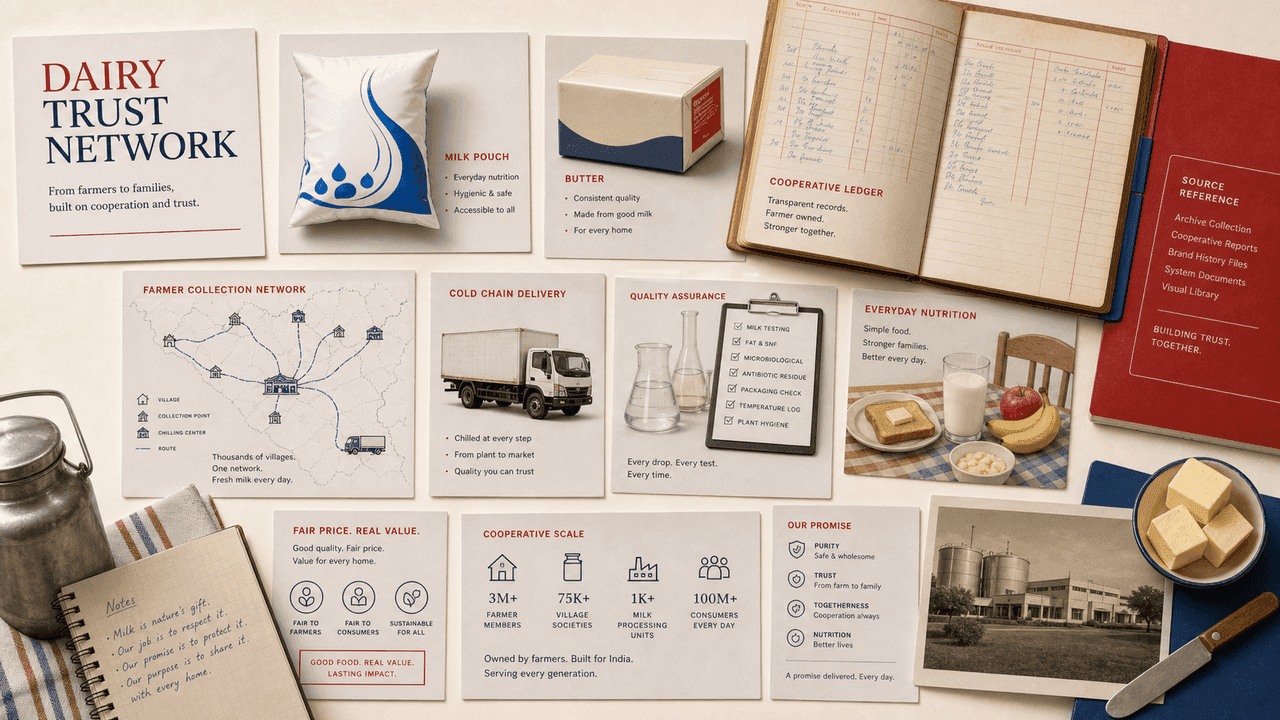
Amul Branding Case: Dairy Cooperative and Household Trust is a trust case about Amul in 1946-present. Amul works when the cooperative structure becomes visible to the buyer through price, availability, freshness, product consistency, and everyday household use. A cooperative food brand cannot rely on purpose language alone. The farmer network has to show up in supply reliability, quality control, value, and products families buy repeatedly.
Reader Task
What this entry should help you finish
Use this entry to finish four jobs: answer what happened to Amul, see why it belongs in the trust lane, inspect the decision consequence, and leave with the operator lesson. The point is not to remember the brand. The point is to know what decision, proof surface, or failure mode a team should check next. Then compare it with Yakult, Quaker Oats, Dove before turning the case into a rule.
What Amul teaches
- Amul's brand strength comes from a public link between cooperative supply and household demand.
- The farmer story matters because it is connected to milk collection, processing, distribution, and value access.
- Product range gives Amul more memory surfaces, but the dairy trust has to stay consistent across milk, butter, cheese, ice cream, and adjacent products.
- The weak copycat uses purpose language while the product route, quality control, and availability remain unclear.
- The repair test is whether the buyer can see why the cooperative model creates better everyday value.
Why This Brand Belongs In Grow Your Brand
Amul belongs in Grow Your Brand because the page studies a specific brand decision, not a company profile. The decision sits in trust and gives operators a way to see how operating layer changes commercial value.
The useful archive question is what changed in recognition, trust, demand, pricing power, category position, or public memory after the market saw the move.
The Brand Asset At Stake
The asset at stake is daily usage, uptime, distribution, account trust, partner tools, switching cost, and recovery when the service fails. That asset matters because it affects how people find, understand, choose, trust, or repeat the brand when the company is not in the room to explain itself.
For Amul, the asset is not abstract equity. It has to show up in the buying surface, product surface, service route, source record, or repeated customer behavior.
What Changed
Amul works when the cooperative structure becomes visible to the buyer through price, availability, freshness, product consistency, and everyday household use.
The change forced the market to decide whether the old shortcut still worked, whether the new proof was strong enough, and whether the brand had made the category easier or harder to understand.
What The Market Learned
The market learned to judge Amul through the gap between the visible move and the proof behind it. talking about scale, innovation, or ecosystem reach while hiding the exact behavior people repeat is the weak reading this page is meant to prevent.
A useful brand decision makes buying, remembering, trusting, or repeating easier. A weak decision makes the audience do more work before it believes the claim.
Commercial Consequence
The commercial consequence sits in operating layer: daily usage, uptime, distribution, account trust, partner tools, switching cost, and recovery when the service fails. When that proof becomes easier to see, customers have more reason to choose, trust, repeat, or pay attention. When it becomes harder to see, the brand has to spend more money explaining what the market used to understand faster.
Amul matters because the decision changed more than presentation. It changed buyer confidence, memory, category position, or repeat behavior in dairy / cooperative food system. That is why the case belongs in a brand decision library instead of a general company profile.
What Another Brand Should Learn
Another brand should use this case before spending money on a similar move. Name the customer behavior, the proof surface, the protected cue, and the consequence that would make the decision worth the cost.
If the same proof does not exist in the business, copying Amul would copy the surface while missing the reason the decision mattered.
The Decision Context
Amul's brand meaning sits between farmer ownership and household buying. The cooperative structure gives the brand a public story, but the customer still judges the milk, butter, cheese, ice cream, packaging, price, and availability.
That makes Amul a trust-network case. The promise has to travel from village collection to processing plant to cold chain to retail shelf to family use.
The Cooperative Is A Supply Proof
The cooperative structure matters because it explains where the supply comes from and who participates in the value chain. It gives the brand a reason to speak about farmers, scale, and access in the same sentence.
But the structure is not enough by itself. The buyer needs evidence that the route produces reliable products at a price and quality level worth repeating.
Value Has To Stay Practical
Amul's value frame is powerful because dairy is a frequent household category. Price, pack size, availability, freshness, and trust can affect weekly buying behavior.
A cooperative brand can lose credibility if the value promise becomes abstract. The shelf has to connect the social story to a product the household can afford and use.
Range Creates Memory And Risk
A broad range helps Amul enter more household moments: breakfast, tea, cooking, school snacks, desserts, and celebrations. Each product gives the brand another repetition point.
The risk is quality drift. A dairy brand with many products has to keep the core trust intact across categories, formats, and stores.
Communication Made The Brand Public
Amul's public personality gave the brand a voice beyond dairy. Topical advertising and the Amul girl helped make the brand visible in culture while the products kept it anchored in the kitchen.
That balance matters. Public wit can increase recall, but food trust still comes from product control and repeat household proof.
Where The Strategy Breaks
The strategy breaks when cooperative purpose is used as a substitute for quality evidence. Customers may respect the model and still leave if the product disappoints.
The second break is overextension. A trusted dairy name can stretch, but every stretch has to preserve freshness, price logic, and shelf clarity.
The Bad Copycat
A bad copycat would copy farmer language, local pride, and family cues without building the route from collection to product proof.
That creates purpose without purchase evidence. The market will judge the carton, pack, taste, date, price, and availability before it judges the manifesto.
The Signal Reading
Amul is filed here because it records how cooperative structure can become brand trust when the operating chain reaches the household.
The decision test is whether the purpose improves the buyer's actual experience: reliable product, fair value, visible freshness, and repeatable use.
The Decision Pressure
Amul's pressure is that the cooperative story must reach a perishable product decision. The buyer may respect the farmer network, but the repeat purchase depends on taste, date, pack condition, value, availability, and the confidence that the product stayed controlled.
That pressure is especially clear in dairy because trust can be lost quickly. A weak batch, confusing date, poor shelf condition, or missing product can damage more than one SKU because the same household often buys several Amul products.
The page should teach that purpose becomes stronger when the product route is visible. The cooperative model has to make everyday value and freshness easier to believe.
The Evidence Standard
The evidence standard is whether the cooperative claim changes what the household can trust. The buyer should see the benefit through product availability, freshness cues, price value, pack clarity, and quality consistency across ordinary weekly buying.
The stronger page should also ask where the farmer story reaches the product. If milk collection, chilling, processing, distribution, and retail are invisible, the cooperative claim becomes a social story detached from the purchase.
That is the hard part of food branding. A household may enjoy the public personality of Amul, but repeat trust is earned when the product stays reliable across ordinary buying moments, stores, seasons, product formats, price points, family uses, replacement purchases, and the next carton chosen without a second thought.
Compare Next
Related Cases
Do not read Amul alone. Compare it against nearby cases: Yakult, Quaker Oats, Dove.
Sources
People Also Ask
What happened to Amul?
Amul Branding Case: Dairy Cooperative and Household Trust is a trust case about Amul in 1946-present. Amul works when the cooperative structure becomes visible to the buyer through price, availability, freshness, product consistency, and everyday household use. A cooperative food brand cannot rely on purpose language alone. The farmer network has to show up in supply reliability, quality control, value, and products families buy repeatedly.
Why is Amul a trust case?
Amul is filed as a trust case because the visible consequence sits in that decision pattern. Amul works when the cooperative structure becomes visible to the buyer through price, availability, freshness, product consistency, and everyday household use.
What can brands learn from Amul?
A cooperative food brand cannot rely on purpose language alone. The farmer network has to show up in supply reliability, quality control, value, and products families buy repeatedly.
Is Amul still operating?
Grow Your Brand marks Amul as Active / continuing. That means the brand, company, platform, product system, or parent organization is still operating, continuing, or being actively resolved.
What should Amul be compared with?
Compare Amul with Yakult, Quaker Oats, Dove to see the same decision pattern from nearby cases.