Brand System / Life insurance / Health protection / 1919-present
AIA Branding Strategy Case: Hong Kong, Protection, and Premier Agency
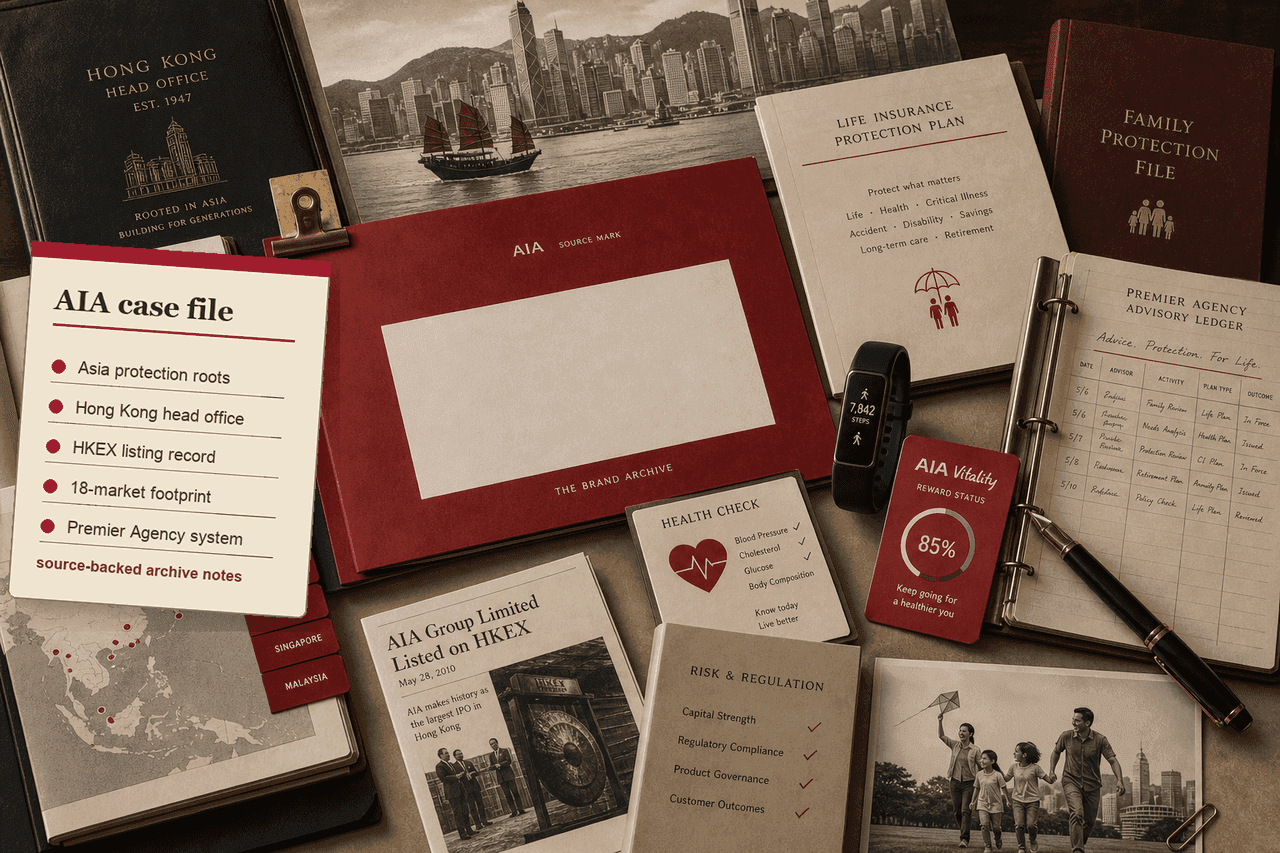
AIA built a Hong Kong-centered protection brand by joining life insurance, health behavior, Premier Agency advice, Asia market reach, and listed-company trust.

Short Answer
AIA Branding Strategy Case: Hong Kong, Protection, and Premier Agency is a brand system case about AIA in 1919-present. AIA turned protection into an Asia operating system: Hong Kong trust, advisor behavior, health incentives, public disclosure, and market reach working together. Insurance brands are judged when customers cannot easily inspect the product. AIA shows why the advisor network, health behavior layer, local market trust, and public-company proof have to reinforce the same protection promise.
Reader Task
What this entry should help you finish
Use this entry to finish four jobs: answer what happened to AIA, see why it belongs in the brand system lane, inspect the decision consequence, and leave with the operator lesson. The point is not to remember the brand. The point is to know what decision, proof surface, or failure mode a team should check next. Then compare it with HSBC, Cathay Pacific, GEICO before turning the case into a rule.
What AIA teaches
- AIA says its corporate roots in Asia go back to Cornelius Vander Starr's insurance agency in Shanghai in 1919.
- AIA's own history ties the move of the head office to Hong Kong to 1947 and the Hong Kong Stock Exchange listing to 2010.
- The group says it operates in 18 markets and serves tens of millions of individual policyholders and group insurance members.
- AIA's 2025 annual results describe Premier Agency as the cornerstone of its success, with more than 96,000 active agents across 15 markets.
- AIA Vitality matters because it turns health behavior into part of the brand system rather than a side reward.
- The useful rule is to make advice, protection, claims confidence, health behavior, and market trust readable as one system.
Why This Brand Belongs In Grow Your Brand
AIA belongs in Grow Your Brand because the page studies a specific brand decision, not a company profile. The decision sits in brand system and gives operators a way to see how trust changes commercial value.
The useful archive question is what changed in recognition, trust, demand, pricing power, category position, or public memory after the market saw the move.
The Brand Asset At Stake
The asset at stake is access, transaction confidence, service recovery, and visible risk control. That asset matters because it affects how people find, understand, choose, trust, or repeat the brand when the company is not in the room to explain itself.
For AIA, the asset is not abstract equity. It has to show up in the buying surface, product surface, service route, source record, or repeated customer behavior.
What Changed
AIA turned protection into an Asia operating system: Hong Kong trust, advisor behavior, health incentives, public disclosure, and market reach working together.
The change forced the market to decide whether the old shortcut still worked, whether the new proof was strong enough, and whether the brand had made the category easier or harder to understand.
What The Market Learned
The market learned to judge AIA through the gap between the visible move and the proof behind it. calling the brand trusted while avoiding the proof of access, error handling, fees, service, and recovery is the weak reading this page is meant to prevent.
A useful brand decision makes buying, remembering, trusting, or repeating easier. A weak decision makes the audience do more work before it believes the claim.
Commercial Consequence
The commercial consequence sits in trust: access, transaction confidence, service recovery, and visible risk control. When that proof becomes easier to see, customers have more reason to choose, trust, repeat, or pay attention. When it becomes harder to see, the brand has to spend more money explaining what the market used to understand faster.
AIA matters because the decision changed more than presentation. It changed buyer confidence, memory, category position, or repeat behavior in life insurance / health protection. That is why the case belongs in a brand decision library instead of a general company profile.
What Another Brand Should Learn
Another brand should use this case before spending money on a similar move. Name the customer behavior, the proof surface, the protected cue, and the consequence that would make the decision worth the cost.
If the same proof does not exist in the business, copying AIA would copy the surface while missing the reason the decision mattered.
The Real Decision
Life insurance has a hard brand problem. The buyer is asked to trust a promise that may matter years later, under stress, through paperwork, advice, exclusions, regulation, and family consequences.
AIA's case is how to make that invisible promise inspectable. The red mark helps recognition, but the real system is built from Hong Kong institutional trust, Asia market reach, advisors, health behavior, public disclosure, and claims confidence.
Asia Was The Starting Point
AIA says its corporate roots in Asia began when Cornelius Vander Starr established an insurance agency in Shanghai in 1919.
The company's overview also ties the head-office move to Hong Kong to 1947. That makes Hong Kong more than a listing address. It became the place where the group built an Asia protection identity.
The Listing Made Trust Public
AIA's overview names its 2010 listing on the Hong Kong Stock Exchange. The group's own 2024 headquarters release repeats the listing status and describes a presence across 18 markets.
For an insurer, public-company visibility is part of the trust surface. Customers may not read the balance sheet, but the brand depends on confidence that the promise is backed by a visible institution.
Premier Agency Made Advice The Front Line
AIA's 2025 annual results call its proprietary Premier Agency strategy the cornerstone of the group. The same annual-results announcement says the agency platform had more than 96,000 active agents across 15 markets and generated around five million online leads in 2025.
That is not back-office detail. In insurance, the advisor is often the brand's most important interface. Product design, suitability, explanation, follow-up, and trust all pass through that person.
Vitality Changed The Behavior Layer
AIA Vitality gives the brand a second job: protection after a bad event and health behavior before one.
That changes the reading of the brand. A protection company that can connect checkups, activity, rewards, and plan behavior has a stronger daily surface than a policy file alone.
Claims Are The Hidden Moment
Insurance brands are often sold in calm moments and judged in bad ones. The claim, the exclusion, the document request, the beneficiary conversation, and the service handoff become the real brand test.
That is why an advisor-led protection brand cannot live on acquisition alone. Follow-up, suitability, claim explanation, and renewal behavior have to protect the promise after the policy is signed.
What People Get Wrong
The weak reading is to call AIA trusted because it is large, Asian, red, and listed. Scale and listing status help. They do not explain the customer decision.
The stronger reading is that the brand reduces a hard-to-inspect risk through repeated proof surfaces: advisor quality, product explanation, market presence, health incentives, capital disclosure, and claim behavior.
The Bad Example
The bad copycat builds an insurance brand around a strong logo, friendly agents, wellness language, and a promise of care, then leaves exclusions, suitability, claims, and service recovery buried in fine print.
That breaks trust at the exact moment the customer needs the brand. In insurance, the hidden clause can erase years of advertising.
What To Copy
Copy the proof system. Make advisors easier to judge. Make product fit easier to understand. Make claims and exclusions easier to inspect. Make health incentives connect to real behavior rather than vague wellness language.
AIA is useful because it connects several proof surfaces instead of asking the logo to carry the whole promise.
The Decision Limit
The AIA comparison is weak when the product can be inspected immediately. Insurance has a delayed proof problem: the buyer pays now and may learn the quality years later.
Use the case when a brand sells a promise the customer cannot fully test at purchase: protection, health, finance, security, custody, or long-term service. Those categories need visible proof before the bad day arrives.
Compare Next
Related Cases
Do not read AIA alone. Compare it against nearby cases: HSBC, Cathay Pacific, GEICO.
Sources

People Also Ask
What happened to AIA?
AIA Branding Strategy Case: Hong Kong, Protection, and Premier Agency is a brand system case about AIA in 1919-present. AIA turned protection into an Asia operating system: Hong Kong trust, advisor behavior, health incentives, public disclosure, and market reach working together. Insurance brands are judged when customers cannot easily inspect the product. AIA shows why the advisor network, health behavior layer, local market trust, and public-company proof have to reinforce the same protection promise.
Why is AIA a brand system case?
AIA is filed as a brand system case because the visible consequence sits in that decision pattern. AIA turned protection into an Asia operating system: Hong Kong trust, advisor behavior, health incentives, public disclosure, and market reach working together.
What can brands learn from AIA?
Insurance brands are judged when customers cannot easily inspect the product. AIA shows why the advisor network, health behavior layer, local market trust, and public-company proof have to reinforce the same protection promise.
Is AIA still operating?
Grow Your Brand marks AIA as Active / continuing. That means the brand, company, platform, product system, or parent organization is still operating, continuing, or being actively resolved.
What should AIA be compared with?
Compare AIA with HSBC, Cathay Pacific, GEICO to see the same decision pattern from nearby cases.