Brand System / Skin care / retail design / 1987-present
Aesop Branding Strategy Case: Packaging, Stores, and Sensory Proof
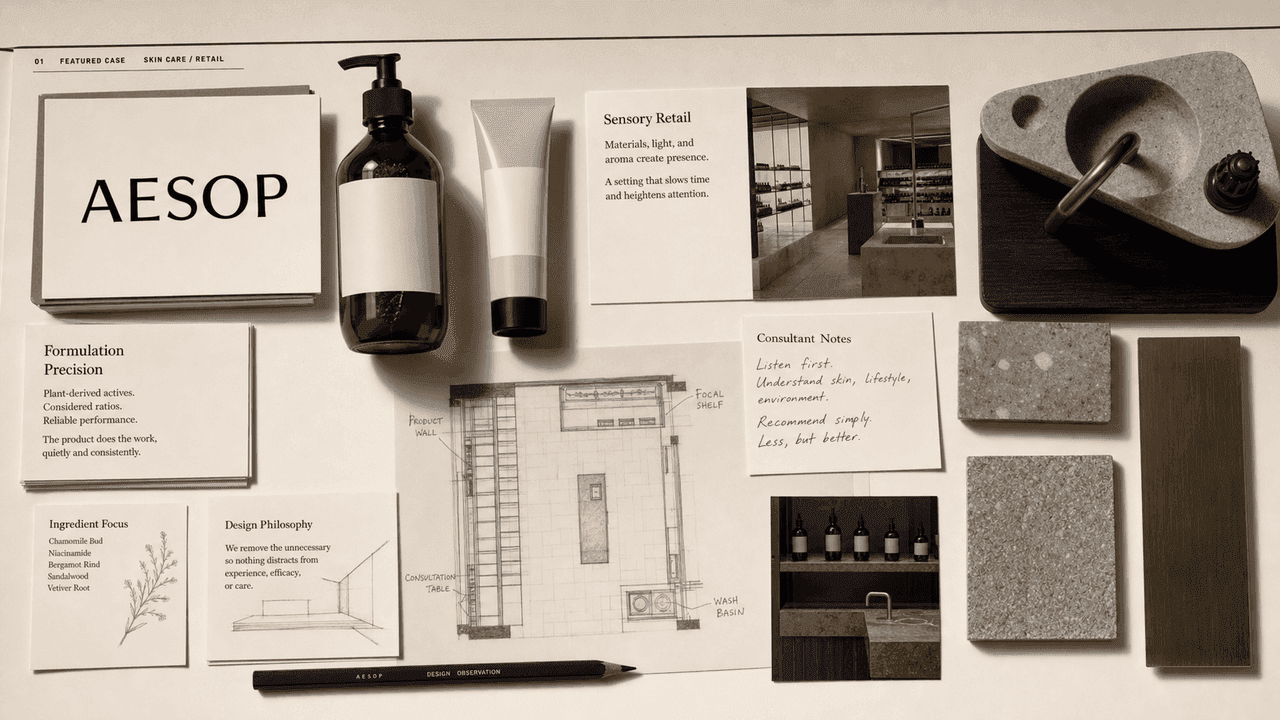
Aesop turned skin care into a controlled retail ritual: amber packaging, restrained labels, formulation language, trained consultation, sinks, materials, and site-specific stores all carried the same promise.

Short Answer
Aesop Branding Strategy Case: Packaging, Stores, and Sensory Proof is a brand system case about Aesop in 1987-present. Aesop turned restraint into proof by making packaging, stores, consultation, and formulation language repeat the same product belief. Premium retail atmosphere only works when it does a job. In Aesop's case, the store, bottle, label, sink, scent, and consultant all reduce the same buyer doubt: is this product controlled, considered, and worth the price?
Reader Task
What this entry should help you finish
Use this entry to finish four jobs: answer what happened to Aesop, see why it belongs in the brand system lane, inspect the decision consequence, and leave with the operator lesson. The point is not to remember the brand. The point is to know what decision, proof surface, or failure mode a team should check next. Then compare it with Chanel, Sephora, MUJI before turning the case into a rule.
What Aesop teaches
- Aesop was founded in Melbourne in 1987.
- The amber bottle and spare label system borrow apothecary memory: protection, formulation, routine, and edited choice.
- The stores work because they are not generic luxury boxes. Architecture, basin, counter, material, light, and consultation make the product promise physical.
- L'Oreal's 2023 acquisition adds the hard question: can a larger owner protect the restraint that made the brand valuable?
- The bad copycat buys brown bottles and quiet typography. The real work is a governed sensory system that helps the buyer choose.
Why This Brand Belongs In Grow Your Brand
Aesop belongs in Grow Your Brand because the page studies a specific brand decision, not a company profile. The decision sits in brand system and gives operators a way to see how operating layer changes commercial value.
The useful archive question is what changed in recognition, trust, demand, pricing power, category position, or public memory after the market saw the move.
The Brand Asset At Stake
The asset at stake is daily usage, uptime, distribution, account trust, partner tools, switching cost, and recovery when the service fails. That asset matters because it affects how people find, understand, choose, trust, or repeat the brand when the company is not in the room to explain itself.
For Aesop, the asset is not abstract equity. It has to show up in the buying surface, product surface, service route, source record, or repeated customer behavior.
What Changed
Aesop turned restraint into proof by making packaging, stores, consultation, and formulation language repeat the same product belief.
The change forced the market to decide whether the old shortcut still worked, whether the new proof was strong enough, and whether the brand had made the category easier or harder to understand.
What The Market Learned
The market learned to judge Aesop through the gap between the visible move and the proof behind it. talking about scale, innovation, or ecosystem reach while hiding the exact behavior people repeat is the weak reading this page is meant to prevent.
A useful brand decision makes buying, remembering, trusting, or repeating easier. A weak decision makes the audience do more work before it believes the claim.
Commercial Consequence
The commercial consequence sits in operating layer: daily usage, uptime, distribution, account trust, partner tools, switching cost, and recovery when the service fails. When that proof becomes easier to see, customers have more reason to choose, trust, repeat, or pay attention. When it becomes harder to see, the brand has to spend more money explaining what the market used to understand faster.
Aesop matters because the decision changed more than presentation. It changed buyer confidence, memory, category position, or repeat behavior in skin care / retail design. That is why the case belongs in a brand decision library instead of a general company profile.
What Another Brand Should Learn
Another brand should use this case before spending money on a similar move. Name the customer behavior, the proof surface, the protected cue, and the consequence that would make the decision worth the cost.
If the same proof does not exist in the business, copying Aesop would copy the surface while missing the reason the decision mattered.
The Real Decision
Skin care shelves can become a mess of claims: ingredients, textures, routines, before-and-after promises, clinical language, natural language, celebrity language, and price cues. Aesop chose a narrower code.
The decision was to make the whole buying environment behave like the product argument. The amber bottle, spare label, store basin, material palette, scent, and consultant do not shout separately. They give the customer a controlled read before the product is tested.
The Packaging Job
The amber bottle is doing more than holding liquid. It borrows a pharmacy memory: protection from light, careful formulation, routine, and seriousness. That gives the product line a reason to look restrained instead of plain.
The label system then keeps a large range readable. Product names, categories, and usage language can sit inside one shelf code without every item needing its own color fight.
Stores Became Proof
Aesop's stores are not neutral distribution boxes. They put the product argument into wood, stone, tile, metal, counters, basins, and light. The customer sees control before reading a formula.
The useful tension is that many stores are site-specific while still clearly Aesop. Too much variation would blur recognition. Too much sameness would make the stores ordinary chain retail. The brand uses material restraint to keep both sides working.
Consultation Is Part Of The Brand
The consultant matters because Aesop sells products people use on skin, hair, body, and face. Buyers have sensitivity, routine, price, scent, and gift questions. A beautiful shelf does not answer those alone.
That makes service part of the brand system. The advice has to sound controlled, specific, and low-pressure. If the staff behaves like ordinary upsell retail, the store design starts to look like stage dressing.
The Acquisition Risk
L'Oreal completed the acquisition of Aesop in 2023. That adds a real brand-architecture test. Aesop became part of a much larger beauty group while its value depended on restraint, specificity, and controlled distribution.
The risk is not ownership by itself. The risk is scale without custody. If more doors, more categories, more promotions, or louder retail language weaken the quiet code, the asset that justified the acquisition can erode.
What People Get Wrong
The weak reading is that Aesop is successful because it looks minimal. Minimalism is the surface. The stronger point is that the same restraint appears in packaging, stores, service, product language, and range discipline.
The second mistake is calling the stores experiential and stopping there. The experience has to reduce buyer anxiety. The customer should leave knowing what to use, why it fits the routine, and why the price has a reason.
The Bad Example
The bad copycat buys amber bottles, uses serif type, makes the store darker, adds a sink, and calls the result premium. That copies the costume, not the mechanism.
It fails when the range is confusing, the staff cannot explain the products, the scent is overpowering, the packaging is hard to shop, or the store looks designed for photographs instead of purchase decisions.
What To Copy
Copy the governance. Decide what the product belief is, then make the bottle, label, merchandising, room, staff script, sample behavior, and checkout reinforce it.
A serious Aesop lesson is not brown packaging. It is the discipline to remove noise from a category that usually adds noise to look expensive.
The Decision Limit
The Aesop comparison is weak when the product does not need sensory inspection or guided choice. If the buyer already knows the exact item and only wants speed, a theatrical store can become friction.
Use the case when the purchase carries uncertainty: skin reaction, scent preference, routine fit, gift risk, premium price, or ingredient confusion. Those are the moments where restraint and consultation can earn money.
Compare Next
Related Cases
Do not read Aesop alone. Compare it against nearby cases: Chanel, Sephora, MUJI.
Sources
People Also Ask
What happened to Aesop?
Aesop Branding Strategy Case: Packaging, Stores, and Sensory Proof is a brand system case about Aesop in 1987-present. Aesop turned restraint into proof by making packaging, stores, consultation, and formulation language repeat the same product belief. Premium retail atmosphere only works when it does a job. In Aesop's case, the store, bottle, label, sink, scent, and consultant all reduce the same buyer doubt: is this product controlled, considered, and worth the price?
Why is Aesop a brand system case?
Aesop is filed as a brand system case because the visible consequence sits in that decision pattern. Aesop turned restraint into proof by making packaging, stores, consultation, and formulation language repeat the same product belief.
What can brands learn from Aesop?
Premium retail atmosphere only works when it does a job. In Aesop's case, the store, bottle, label, sink, scent, and consultant all reduce the same buyer doubt: is this product controlled, considered, and worth the price?
Is Aesop still operating?
Grow Your Brand marks Aesop as Active / continuing. That means the brand, company, platform, product system, or parent organization is still operating, continuing, or being actively resolved.
What should Aesop be compared with?
Compare Aesop with Chanel, Sephora, MUJI to see the same decision pattern from nearby cases.