Treating packaging as a mood board
Package cues need jobs: recognition, category, proof, ritual, or trust.
Branding guide · evidence and decision
Ecommerce packaging carries memory after the click. See Tropicana, Liquid Death, Oatly, Tiffany, Cadbury, Apple, Nespresso, and Coca-Cola.
decision · proof · use
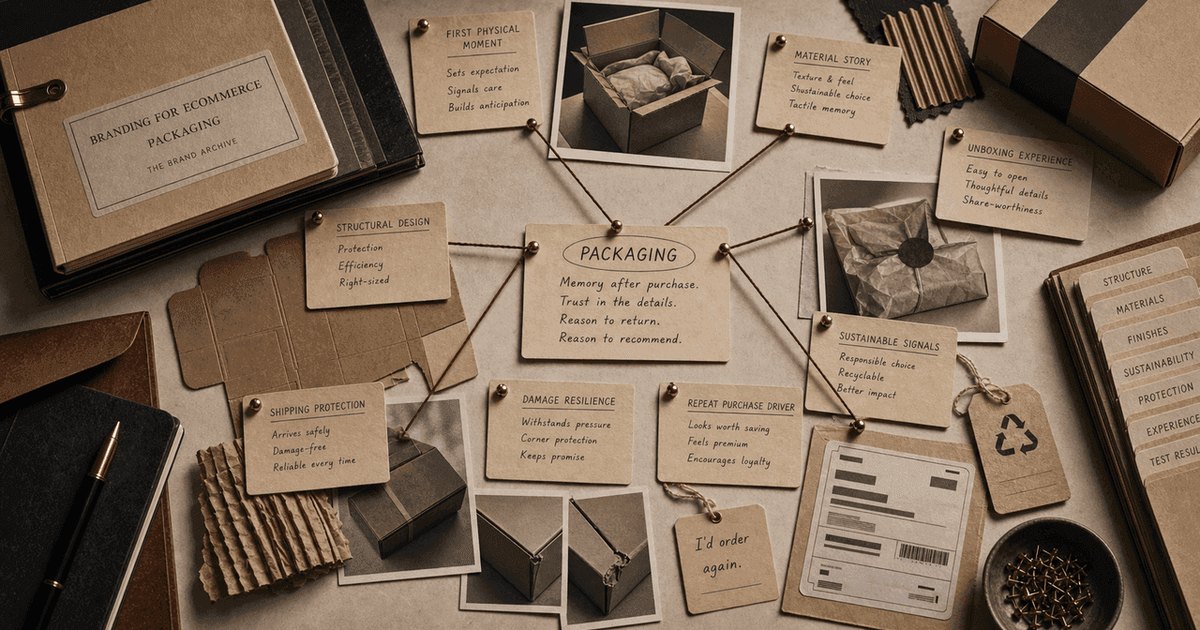
Ecommerce packaging is the first physical proof after an online promise. It can confirm trust, teach category memory, protect a repeat cue, create ownership ritual, or reveal that the product story was thin.
"Grow Your Brand defines ecommerce packaging as the box, wrap, label, bottle, insert, carton, unboxing, and product surface that carries brand memory after an online purchase."
The package is where digital trust becomes physical.
The buyer finally touches the brand and decides whether the promise held.
The mistake is treating packaging as decoration.
For ecommerce, packaging carries recognition, use confidence, unboxing memory, repeat purchase, and sometimes the whole category frame.
Most packaging pages focus on aesthetics.
This page treats packaging as recognition, proof, trust, shelf memory, thumbnail memory, and post-purchase ritual.
A package is a memory surface, not a container alone.
| Packaging job | What it carries | Archive cases |
|---|---|---|
| Recognition | Fast shelf or unboxing memory. | Tropicana, Cadbury, Tiffany |
| Category frame | What the product should be compared with. | Liquid Death, Oatly |
| Ritual | The reading of ownership or repeat use. | Tiffany, Nespresso |
| Proof | Quality, restraint, craft, or product behavior. | Apple, Nespresso |
| Risk | What happens when a familiar cue changes. | Tropicana, Coca-Cola |
These cases show packaging as recognition, proof, ritual, and category behavior.
| Case | What happened | GYB interpretation | Practical check |
|---|---|---|---|
| Tropicana Failure / 2009 | Tropicana removed the orange-and-straw package cue that helped shoppers find the carton fast. | Packaging can be the buying shortcut. A cleaner design broke the recognition system. | Test package changes in shelf and thumbnail conditions before launch. |
| Liquid Death Launch / 2019 | Liquid Death's tallboy can makes water look like a music and beer-adjacent object. | Packaging reframes the category before the buyer reads the copy. | Use package form when the product needs a new comparison. |
| Oatly Launch / 1990s-present | Oatly's carton voice helped explain oat drink while making the package distinct on shelf. | Packaging can teach a new category and carry personality at once. | Let package language do category education at the point of choice. |
| Tiffany Brand System / 1845 / 1886-presentTiffany | Tiffany's blue box is part of the gift ritual and status signal before jewelry is seen. | The package can become the emotional proof of ownership. | Protect packaging when it carries the purchase meaning. |
| Cadbury Brand System / 1905-present | Cadbury trained purple as a chocolate locator through wrapper repetition. | Color memory can make packaging faster than search or copy. | Treat color changes as recognition-risk decisions. |
| Apple Comeback / 1997-1998Apple | Apple used product and packaging restraint to make the comeback read disciplined and designed. | Packaging supports brand trust when the unboxing matches the product promise. | Make the delivery moment confirm the wider brand system. |
| Nespresso Launch / 1986-present | Nespresso's capsules, sleeves, and machine cues organize flavor, fit, and replenishment. | Packaging makes the system tangible and repeatable. | Use packaging to reduce compatibility and repeat-purchase friction. |
| Coca-Cola Failure / 2011 | Coca-Cola's white holiday can weakened the red-can distinction buyers used for the original. | Seasonal packaging can damage product recognition when color is a trained cue. | Keep promotional packaging subordinate to core recognition. |
The package works when the physical moment confirms the online promise.
The useful pattern is the decision mechanism. Brand names are evidence, not the organizing principle.
| Pattern | What it means | Cases to inspect |
|---|---|---|
| Recognition protection | Packaging must preserve the cue customers already use. | Tropicana, Coca-Cola, Cadbury |
| Category reframing | Packaging changes the comparison set. | Liquid Death, Oatly, Nespresso |
| Status ritual | The package becomes part of ownership meaning. | Tiffany, Apple |
| Thumbnail memory | The cue has to work in small ecommerce contexts. | Cadbury, Nespresso, Tropicana |
| Unboxing proof | The delivery moment confirms or contradicts the promise. | Apple, Tiffany |
The practical test is whether the concept changes a real decision.
Use these questions before changing a cue, promise, channel, page, package, or proof point.
These mistakes are common because they sound reasonable inside the company and fail when customers meet the brand.
Package cues need jobs: recognition, category, proof, ritual, or trust.
Tropicana and Coca-Cola show the risk of moving familiar cues.
Ecommerce packaging is a service moment after the sale.
The package has to make the product easier to believe or use.
This page is most useful when the decision depends on proof, memory, risk, behavior, or market consequence.
Use the checklist as a pressure test. If the answer is vague, the brand decision is not ready.
Use the page to decide what must be protected before money moves: the name, cue, promise, proof, channel, page, package, or customer habit.
The useful output is not a prettier opinion. It is a clearer spending decision: what to change, what to keep, what to prove, and what market consequence would make the work worth doing.
It is the box, wrap, label, bottle, insert, carton, unboxing, and product surface that carries brand memory after an online purchase.
Tropicana, Liquid Death, Oatly, Tiffany, Cadbury, Apple, Nespresso, and Coca-Cola show different packaging memory jobs.
It is the first physical proof after a remote purchase and can confirm trust or weaken recognition.