What exactly is being approved, paused, narrowed, rebuilt, or stopped?
Decision
One sentence with the surface affected: name, mark, website, message, package, route, or proposal.
Branding guide · evidence and decision
A brand decision memo template for rebrands, logo changes, website redesigns, package updates, message rewrites, and agency proposals.
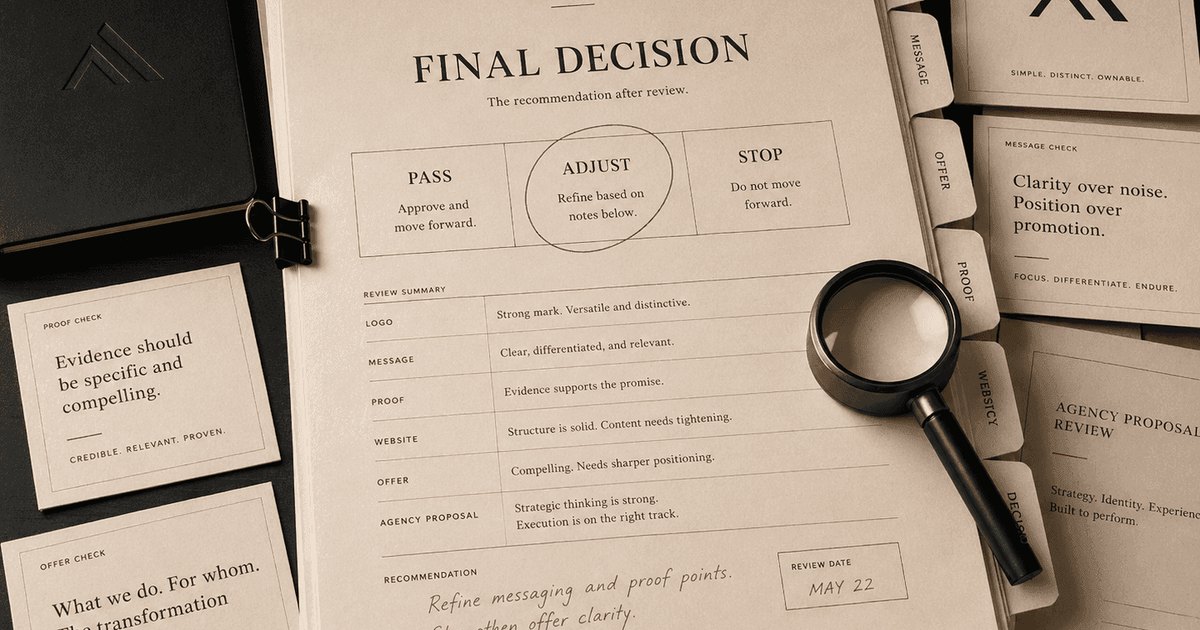
decision · proof · use
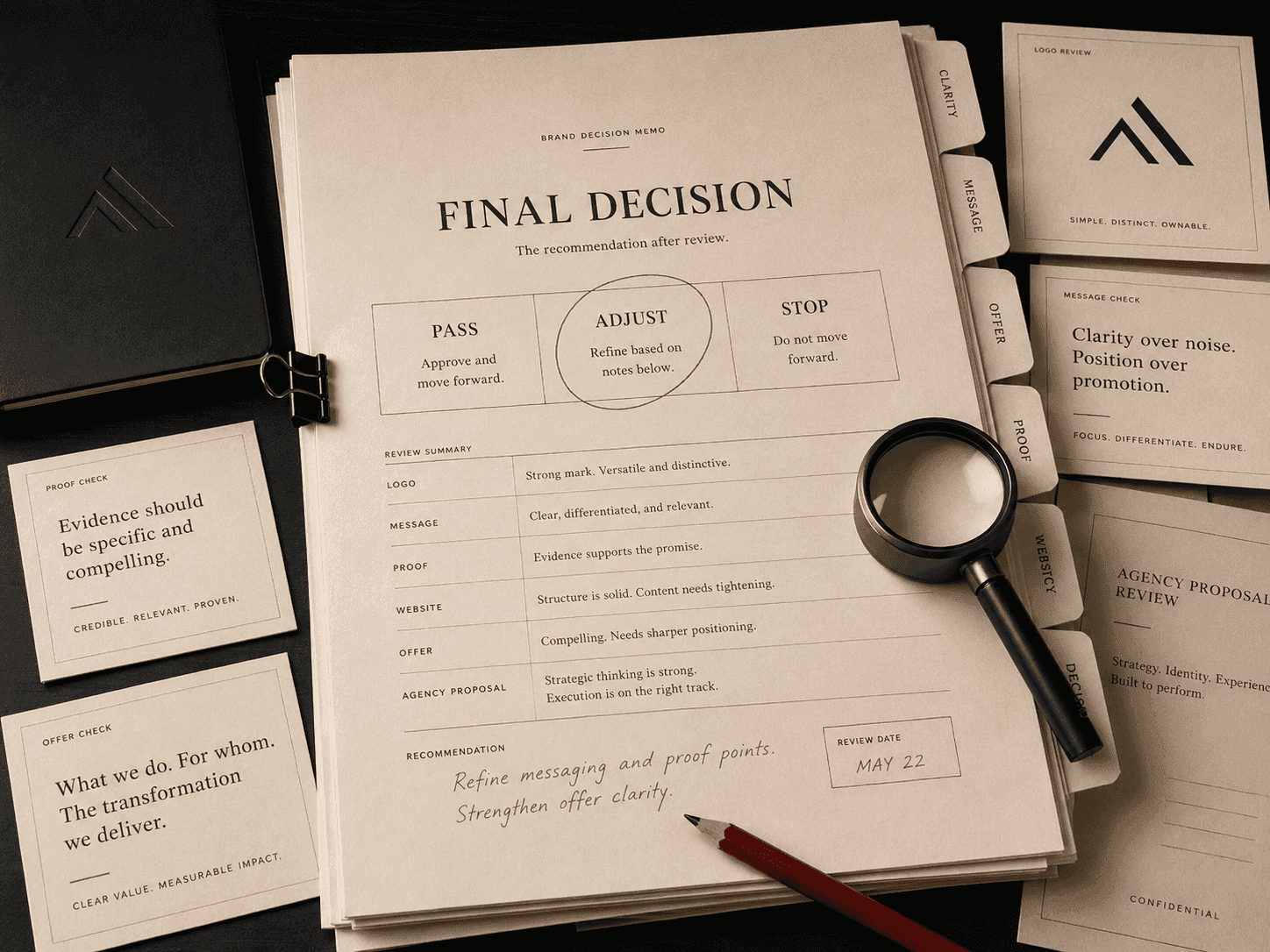
A brand decision memo should state the decision, the evidence, the risk, the options, the owner, the deadline, and the reason a team should preserve, adjust, rebuild, or stop.
Use the scale below to rate each of the six checks, then add the ratings for a total from 0 to 18. These are GYB editorial review prompts and proposed decision bands, not a validated risk model or evidence that a launch will succeed. Record the evidence behind every rating and resolve missing critical evidence before approval.
A memo is done only when a skeptical reader can see the decision, evidence, risk, and owner.
Decision
One sentence with the surface affected: name, mark, website, message, package, route, or proposal.
Problem
Current evidence and the cost of leaving the problem alone.
Options
Preserve, adjust, rebuild, stop, bridge, test, or delay, with the reason each lost.
Evidence
Customer behavior, public source, search result, AI answer, competitor route, case precedent, and operating proof.
Risk
Recognition loss, trust gap, category confusion, rollout waste, legal conflict, or source-trail damage.
Owner
Named person, deadline, next action, review date, and stop rule.
A weak memo hides risk behind presentation polish.
The favorite direction appears without proof that alternatives were considered.
Add the losing options.
The decision is written for the team, not the person choosing in market.
Rewrite from the buyer's decision.
Nobody knows what evidence would change the verdict.
Name the proof threshold.
Approval is clear, but stopping the work is politically impossible.
Assign the pause rule.
A memo should make the decision easier to audit later.
The template prevents brand work from drifting into taste.
The wrong approval logic shows up later as public confusion.
A brand decision memo belongs before the creative final. It forces the team to write what the change is supposed to fix and what would happen if the team is wrong.
The memo is especially useful when a founder preference, agency presentation, board request, or launch deadline is moving faster than the evidence.
State the problem, the decision, the options, the proof, the risk, the affected public surfaces, the rollout order, and the stop rule.
Then write the plain answer a buyer, customer, employee, or partner should understand after the change. If that answer is vague, the memo is not ready.
A memo should point to the next file that proves or challenges the decision.
If the memo exposes a high-cost decision, use protected contact with the evidence file.
It should include the decision, problem, options, proof, risk, affected surfaces, owner, deadline, stop rule, and next action.
The person accountable for the decision should own it, even if an agency, strategist, or designer contributes evidence.
It is useful before approving a rebrand, logo change, website redesign, package update, message rewrite, naming direction, or agency proposal.