Nintendo · Grow Your Brand · Play System · Japan / Active
Nintendo
Nintendo makes play easy to recognize before the explanation starts. A Nintendo brand page about the system behind play: the red masterbrand, Switch 2 and Switch hardware, Nintendo Account and online services, enduring game worlds, films, merchandise, mobile touchpoints, and real-world experiences that carry recognition beyond one console cycle.
Positioning, name, and architecture.
Three evidence checks before the page talks about scale, color, or public reaction.
Nintendo makes play physical across generations: NES pads, Super NES buttons, Wii motion, Mario worlds, Switch handheld mode, TV dock, and detachable controllers all make the system legible.
Nintendo positions play as a visible family system: pick up, press, move, detach, share, dock, and return to the world.
Nintendo is a long-running Japanese company name; the Switch product name made the console behavior plain.
The card reads product behavior rather than a single company slogan.
Integrated entertainment platform with owned worlds, account services, IP expansion, and an equity-method associate lane
Nintendo is clearest when the parent brand, platform, services, owned worlds, IP expansion, and Pokémon relationship are labeled rather than flattened into one list.
Hardware and Nintendo software make play portable, shared, and repeatable.
Integrated platform: Switch 2, Switch source
Identity, digital distribution, subscriptions, and continuity connect console generations.
Account and service layer: Nintendo Account source
Long-lived characters and worlds turn hardware cycles into returning audience memory.
Nintendo-owned worlds: Super Mario source
Nintendo encounters now reach audiences away from the console while feeding interest back into games.
Adjacent IP expansion: The Super Mario Bros. Movie and Super Nintendo World source
Pokémon is strategically connected through The Pokémon Company and must not be described as an ordinary Nintendo-owned sub-brand.
Equity-method associate lane: Pokémon source
Naming and tagline progression
company origin
home console becomes family hardware
character world becomes a Nintendo asset
motion play becomes visible
Switch makes the console behavior readable
Switch 2 keeps the same visible architecture
Market and scale snapshot.
Nintendo combines a profitable integrated hardware-and-software platform with account services, owned character worlds, entertainment expansion, and a public-market scale that is larger than any one console cycle.
Switch 2 launch-year demand lifted the integrated hardware-and-software platform.
Owner earnings show the economic power of hardware, software, digital, and IP activity together.
A dated public-market observation, not a permanent brand valuation.
Tokyo Stock Exchange Prime listing; Nintendo is the public parent entity.
Color system.
Nintendo red works because it sits beside physical play behavior, not because red alone explains the brand.
How the palette behaves
Red gives the system energy and shelf recognition.
Switch red and blue separate the controller behavior into a quick visual shorthand.
Black hardware grounds the color so the device still feels like equipment.
Recognition assets.
Memory pieces the brand can use before someone finishes a sentence.
The core promise is visible when the same game moves from the television to the player's hands.
Red and blue help buyers remember that the system separates, shares, and moves.
Nintendo does not only sell hardware. It returns people to worlds they already know how to enter.
Scores.
Use these scores to compare recognition, trust, proof, pressure, and risk.
Red, console shapes, controller behavior, and Mario-style worlds are easy to identify.
The Switch promise is visible in the device.
Generation naming must stay simple.
Red works with the controller-color split.
Nintendo company and Switch product need clean separation.
Each hardware cycle has to prove the behavior again.
Nintendo positions play as a visible family system: pick up, press, move, detach, share, dock, and return to the world.
Make the hardware behavior visible enough that the category promise explains itself.
How the logo changed.
A Japanese card-era mark gave way to the Latin-letter wordmark, the rounded racetrack enclosure, a quieter gray period, and the current return to red.
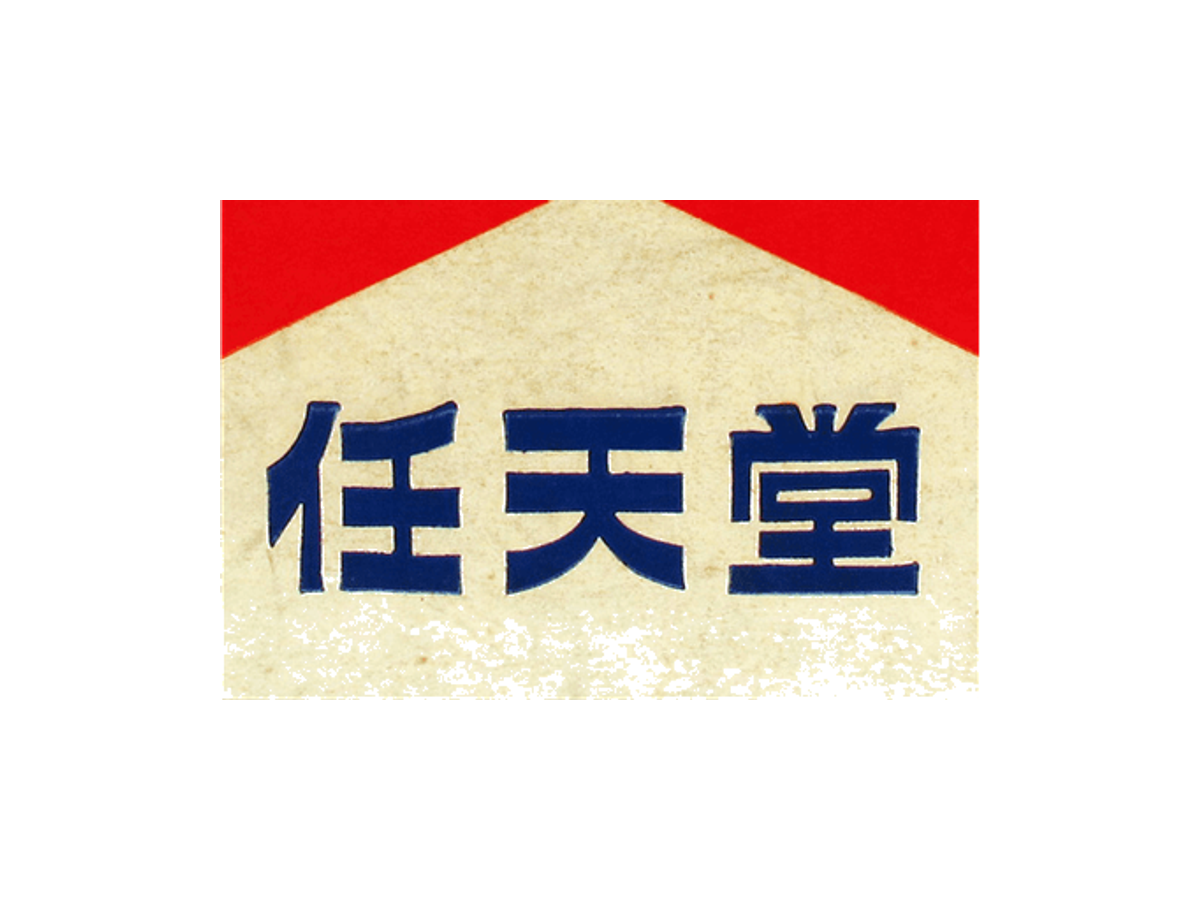
The original-language mark ties the name to Nintendo’s playing-card beginning.
The heavy wordmark shifts recognition from a local card artifact to a scalable company name.
The enclosure gives Nintendo a compact signature that survives changing console designs.
The same recognition shape remains while the palette becomes more neutral.
Color returns without sacrificing the racetrack shape accumulated across product generations.
Product and service lineage.
The strongest Nintendo cue is not only the logo. It is play made visible through hardware, controllers, families, and worlds.
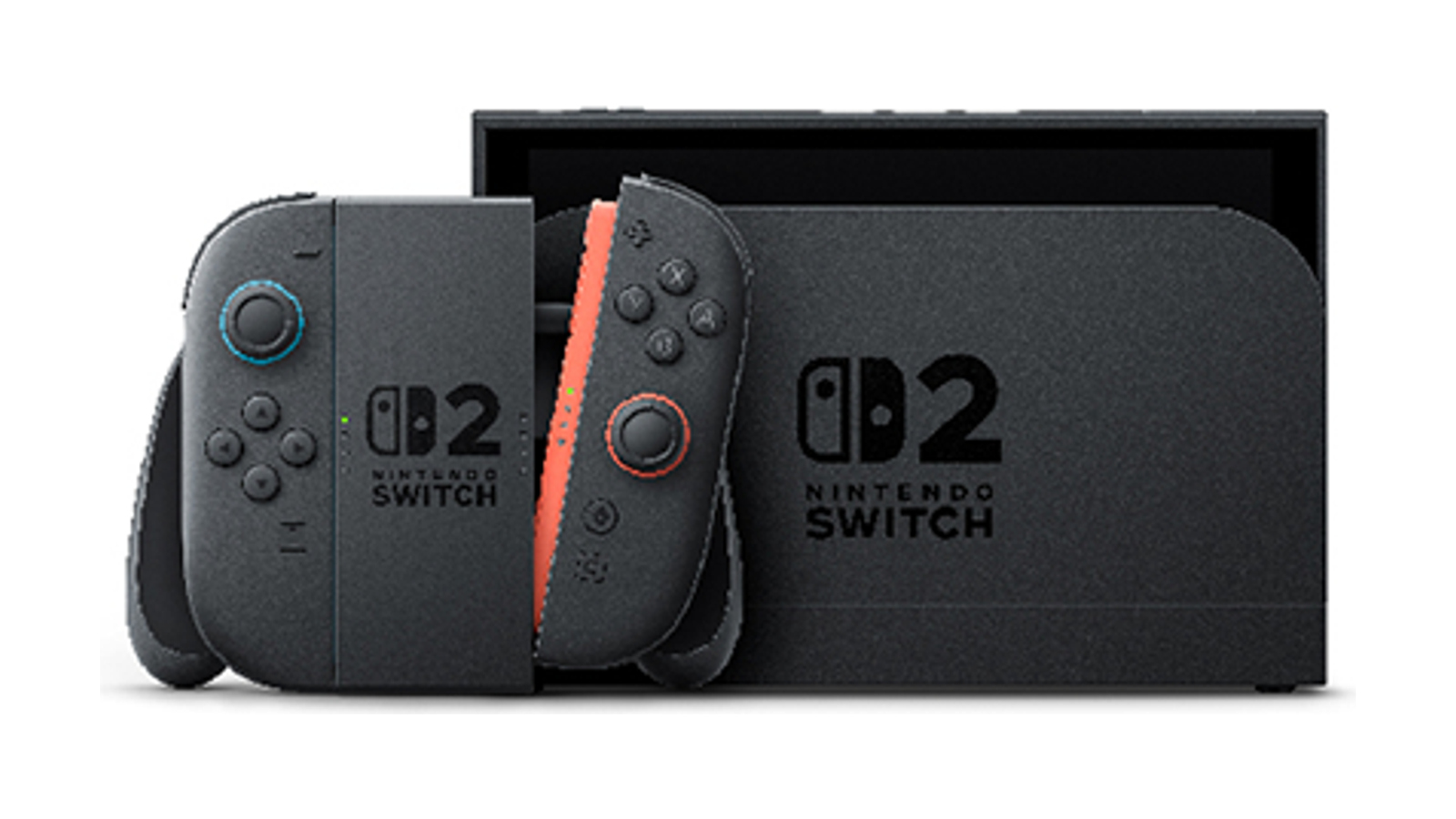
Switch 2 platform
The current platform keeps screen, dock, and detachable-controller behavior visible as one system.
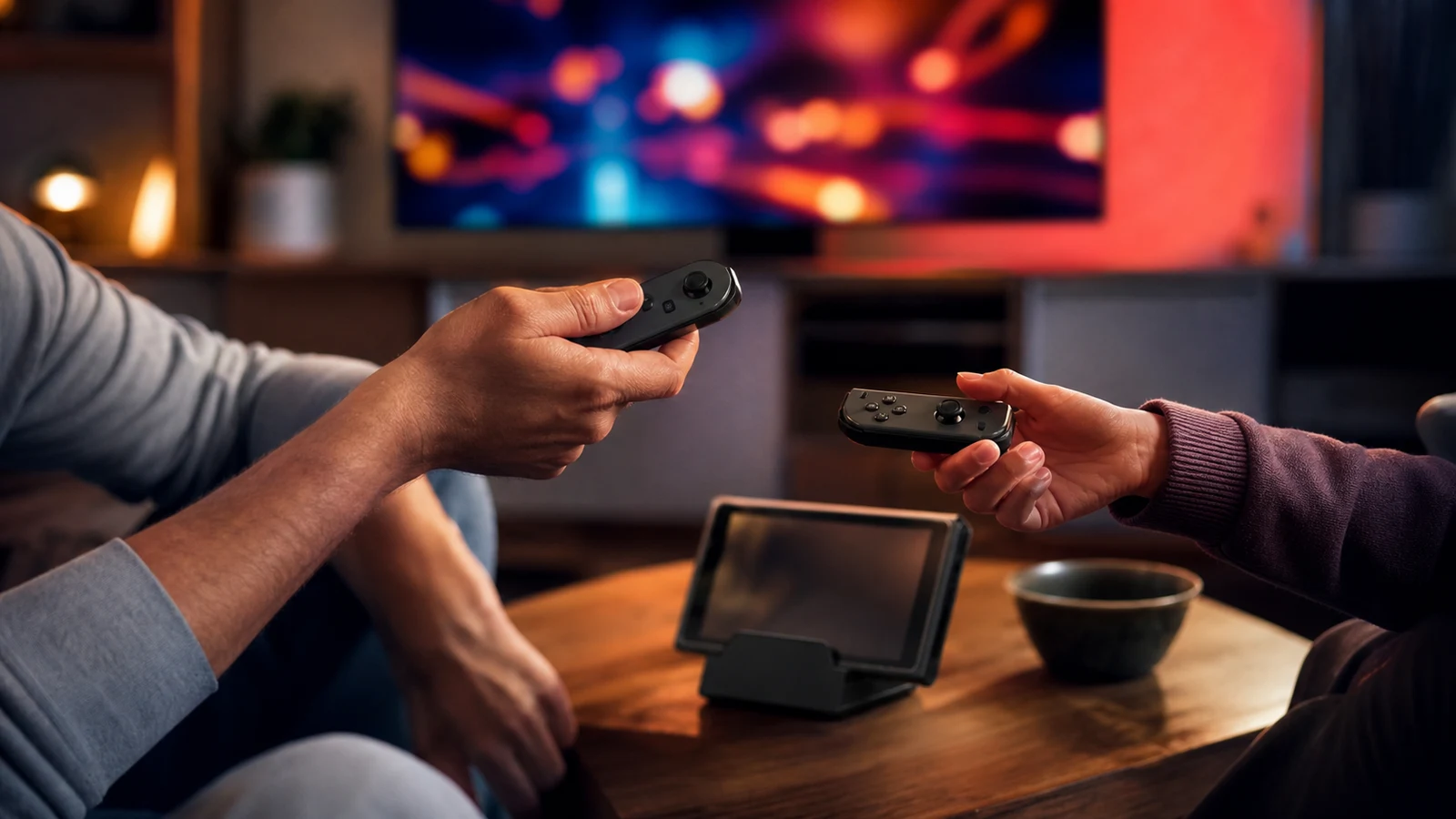
Shared play behavior
Passing a controller turns the product promise into an action another person can understand immediately.
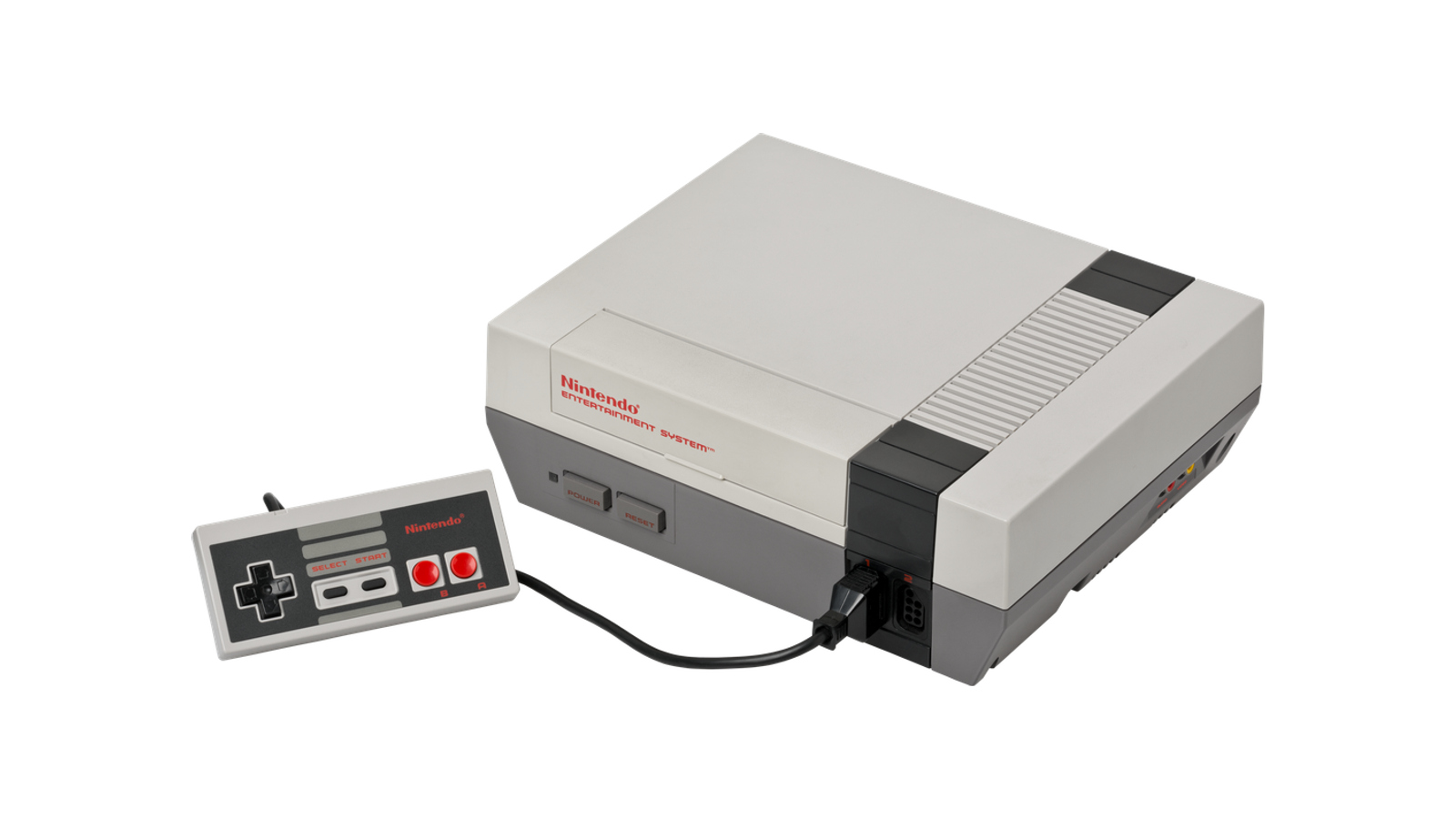
NES household memory
The NES made the controller, console, and television a repeatable family entertainment setup.
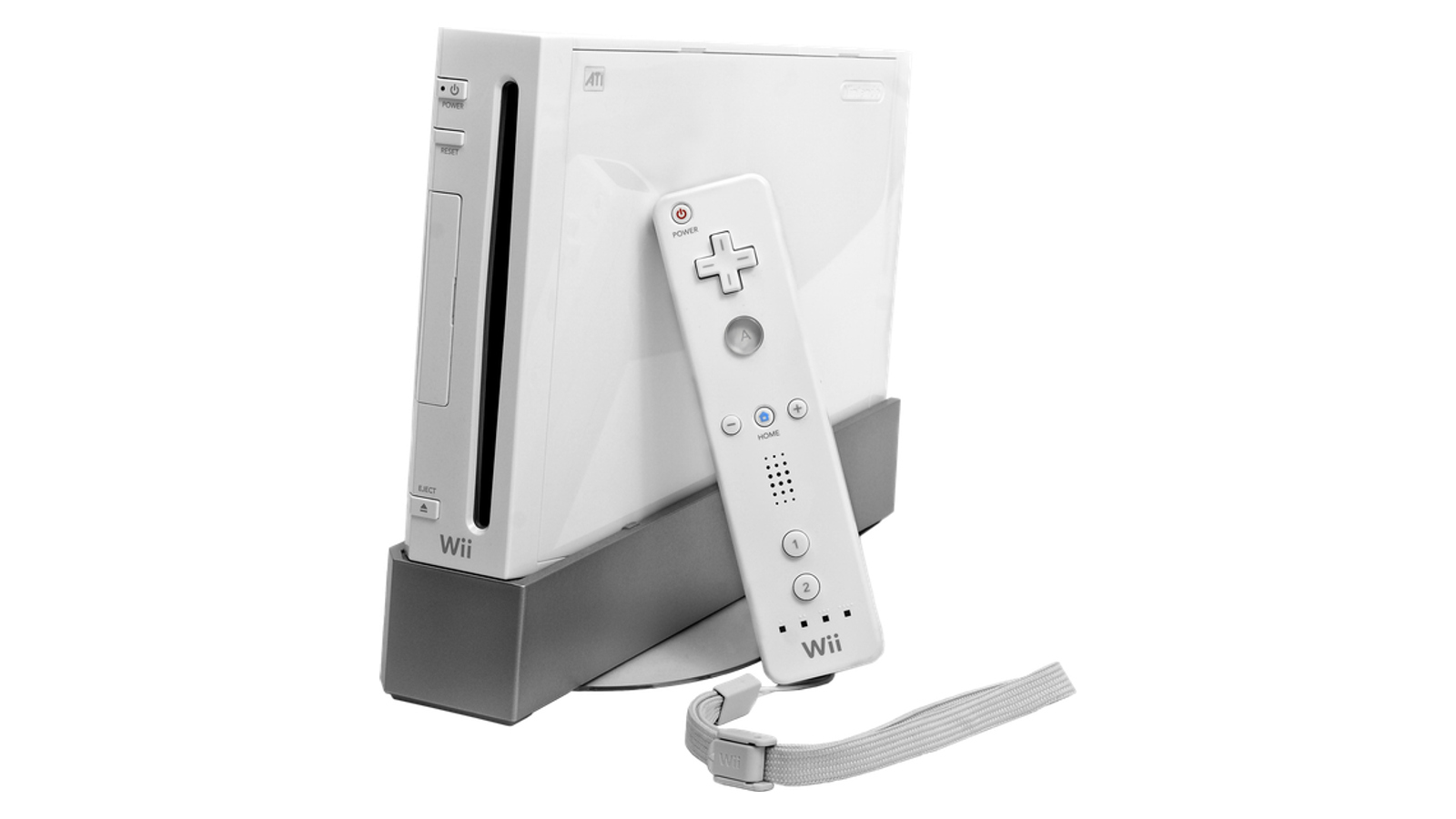
Wii motion cue
The Wii Remote made physical movement part of the brand demonstration before a feature list was needed.
Product and service system
Nintendo begins by making and selling Hanafuda playing cards.
Famicom launches in Japan and becomes the Nintendo Entertainment System abroad.
Super Famicom launches and becomes the Super Nintendo Entertainment System abroad.
Wii makes motion play visible through the player.
Switch combines television and handheld play in one legible product behavior.
Switch 2 launches and reaches 19.86 million hardware units by March 31, 2026.
Turning points.
Moments that show how the public cue becomes product proof.
The product idea became hard to repeat.
Nintendo made the promise physical again: TV, handheld, shared controller.
The next system keeps the visible architecture instead of starting from zero.
Public reaction.
Nintendo earns affection when the system is easy to understand and loses it when product naming gets foggy.
The buyer can understand the system before reading a feature list.
Confusing hardware generations can weaken even a loved brand.
Full timeline.
Fusajiro Yamauchi begins making and selling Hanafuda cards in Kyoto.
The company adopts the current Nintendo Co., Ltd. name.
Famicom launches and Nintendo lists on the First Section of the Tokyo Stock Exchange.
Super Mario Bros. launches for Famicom/NES.
Wii launches.
Wii U launches.
Nintendo Switch launches.
Nintendo Switch Online launches.
Super Nintendo World opens at Universal Studios Japan.
The Super Mario Bros. Movie opens.
Nintendo Switch 2 launches.
Switch 2 reaches 19.86 million hardware units by March 31.
Steal / avoid.
- Make the promise visible in the product behavior.
- Use color to help people remember the behavior.
- Separate company trust from product-generation clarity.
- Do not let a product name explain less than the product does.
- Do not use nostalgia instead of proof.
- Do not make color carry a promise the hardware cannot show.
Short answer.
Nintendo shows how a brand can carry play across generations: NES and Super NES made home hardware familiar, Mario made the world repeatable, Wii made motion visible, and Switch made the console promise physical again.
Frequently asked questions
What is Nintendo's core brand signal?
Play made visible through hardware behavior, character worlds, and family memory.
Why does Mario matter to Nintendo's brand?
Mario turns Nintendo from a hardware name into a world people return to.
What should another brand steal from Nintendo?
Make the product behavior easy to show, not only easy to describe.
What should another brand avoid copying from Nintendo?
Do not copy playful color without a concrete product behavior behind it.
Need help with your own brand?
Use Private brand work when your name, identity, proof, or message needs a sharper branding decision.
Sources.
Use the education shelf for the concepts behind this brand page.
Private brand workUse this when the decision belongs to your own brand.
All brandsReturn to every brand page.
- Nintendo FY2026 Annual Report
- Nintendo FY2026 Financial Results
- Nintendo company history
- Nintendo dedicated video game sales units
- Nintendo management policy
- Nintendo company profile and affiliates
- Nintendo current logo source file
- Nintendo corporate logo archive
- NES console source image
- Wii console source image


