Starting with the fix
Start with the pressure. A new logo, name, page, campaign, or promise may solve the wrong problem.
Branding guide · evidence and decision
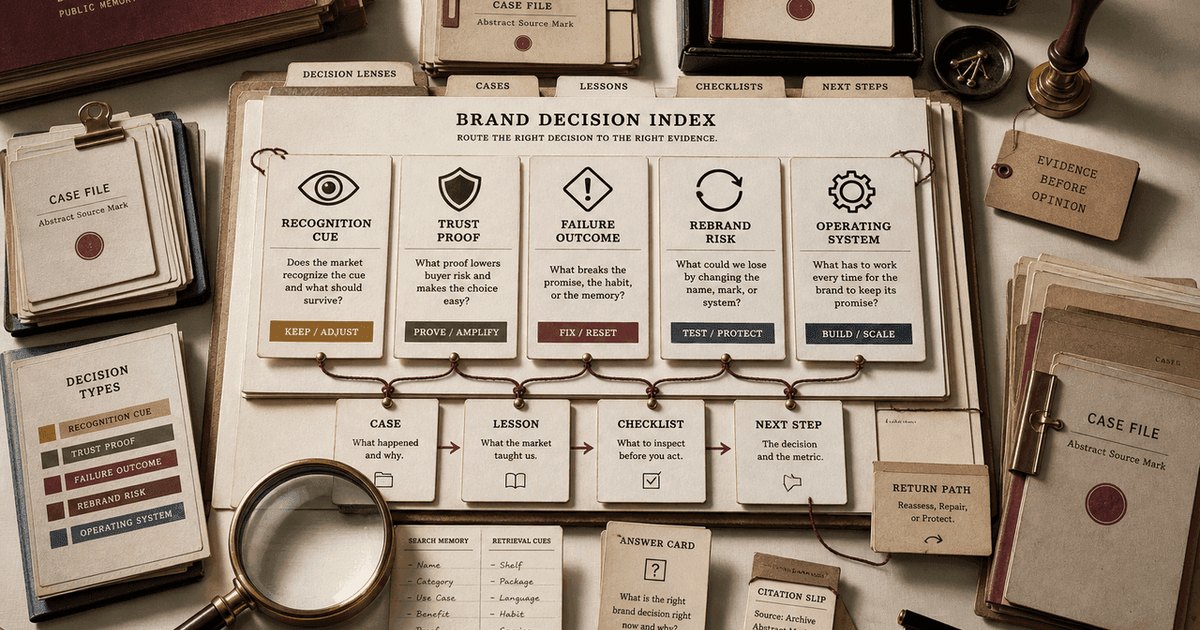
Use the Brand Decision Index to route brand questions by recognition, proof, failure, rebrand risk, trust, behavior, search memory, and operating system.
decision · proof · use
Use the Brand Decision Index when the problem is unclear. Start with the pressure: recognition, trust, failure outcome, rebrand risk, customer behavior, search memory, or operating proof. Then read the matching cases and choose the next inspection path.
Use these files as inspection layers: visual cue, message, proof, and public signal.
"Grow Your Brand defines brand decision index as a navigation layer that sorts brand questions by the decision pressure they create, then points readers to matching cases, lessons, checklists, and proof tests."
The index matters because brand problems are often named too early. A logo complaint may be recognition loss, a trust problem, a category problem, or missing proof. The decision route should come before the prescription.
The weak move is to jump from symptom to fix: new logo, new campaign, new positioning, new website, or new name. the guide works better when the reader first asks which decision pattern the case belongs to.
Use this map to choose the guide lens before opening a case or checklist.
| Decision pressure | Use this route when | Start with these files |
|---|---|---|
| Recognition cue | People cannot find, name, recall, or distinguish the brand fast enough. | Tropicana, Gap, Mastercard, Distinctive Brand Assets |
| Trust proof | The promise sounds right but the buyer needs evidence before risk reads lower. | Volvo, FedEx, Zappos, How Brands Build Trust |
| Failure outcome | The brand memory survived longer than the operating route or original business. | Pier 1, Zune, Windows Phone, Failed Brands |
| Rebrand risk | The team wants to change a name, mark, package, voice, or identity system. | Gap, Twitter/X, Rebrand Risk Checklist, Brand Transformations |
| Customer behavior | The brand depends on a habit, ritual, membership, route, or repeat action. | JCPenney, Blockbuster, Tesco, Customer Habits Move Before Brands Die |
| Search and AI memory | Old names, summaries, citations, or public language may outrank the new story. | Perplexity, Twitter/X, Branding Checklist |
| Operating system | The brand works because logistics, service, software, payments, or infrastructure keep proving it. | Siemens, Shopify, Stripe, Infrastructure Becomes Brand When Customers See the Handoff |
| Written decision | The team needs to turn the guide read into a clear memo before spend moves. | Brand decision memo template, Brand Decision Guide |
These cases show how to enter the guide through the decision pressure rather than the brand name alone.
| Case | What happened | GYB interpretation | Practical check |
|---|---|---|---|
| Tropicana Failure / 2009 | The package lost the shelf cue shoppers used under low attention. | Recognition can be the buying system. | Route packaging, color, and thumbnail problems to recognition before judging taste. |
| Gap Rebrand / 2010Gap | A cleaner mark was rejected because the old cue still carried public memory. | Internal preference can underprice an existing asset. | Use rebrand-risk checks before deleting a familiar cue. |
| Volvo Trust System / 1959-presentVolvo | Safety became believable through a physical belt and repeated proof. | Trust improves when the proof is visible before danger. | Route trust questions to proof, recovery, and repeat behavior. |
| Pier 1 Imports Failure / 1962-2020 / online remnant | The treasure-hunt memory could not carry the retail model after behavior moved. | A remembered brand can lose the route customers now use. | Use status and behavior routes before calling the problem awareness. |
| Windows Phone Failure / 2010-2019 | Hardware and design could not overcome weak app and developer gravity. | A platform brand needs a full participation system. | Route platform questions to ecosystem gravity and support continuity. |
| Tesco Brand System / 1919-present | Value became inspectable through Clubcard, private label, stores, online grocery, and delivery. | A functional association gets stronger when the routine keeps proving it. | Route value claims to the customer habit where comparison happens. |
| Shopify Launch / 2006-present | The brand became the operating layer merchants use to sell, pay, ship, and scale. | Infrastructure can become a brand when customers see the handoff. | Route system claims to the surfaces that make work easier. |
| Stripe Brand System / 2010 / 2011-present | Developer focus, documentation, APIs, and payment reliability made the category easier to implement. | A technical brand can win through user-specific proof. | Route complex categories through the user who reads the friction first. |
When the route is clear, the next page becomes useful: case for proof, lesson for pattern, checklist for action, collection for comparison.
The useful pattern is the decision mechanism. Brand names are evidence, not the organizing principle.
| Pattern | What it means | Cases to inspect |
|---|---|---|
| Cue problem | The market cannot retrieve the brand or chooses through an old cue. | Tropicana, Gap, Mastercard, Cadbury |
| Proof problem | The claim needs operating evidence before the market will believe it. | FedEx, Toyota, Volvo, Domino's |
| Behavior problem | The customer habit moved, broke, or never formed. | JCPenney, Zune, Blockbuster, Tesco |
| Status problem | The public business, product, or platform ended while memory remains. | Pier 1, Windows Phone, Quibi, Borders |
| Transformation problem | The brand needs to change without wasting useful memory. | Burberry, Airbnb, Twitter/X, Burger King |
| Retrieval problem | Search, AI, speech, or public language keeps returning the wrong file. | Twitter/X, Perplexity, Accenture, Consignia |
| Operating-system problem | The brand promise is carried by infrastructure, process, software, or service proof. | Siemens, Shopify, Stripe, Amazon Prime |
The practical test is whether the concept changes a real decision.
Use these questions before changing a cue, promise, channel, page, package, or proof point.
These mistakes are common because they sound reasonable inside the company and fail when customers meet the brand.
Start with the pressure. A new logo, name, page, campaign, or promise may solve the wrong problem.
Use famous names as evidence only after the decision pattern is clear.
Separate failed decisions from failed brands. Some failures happen inside brands that still operate.
check search and answer-engine memory when names, categories, summaries, and old language are part of the risk.
Compare the pattern across cases before turning one story into a rule.
This page is most useful when the decision depends on proof, memory, risk, behavior, or market consequence.
Use the checklist as a pressure test. If the answer is vague, the brand decision is not ready.
Use the page to decide what must be protected before money moves: the name, cue, promise, proof, channel, page, package, or customer habit.
The useful output is not a prettier opinion. It is a clearer spending decision: what to change, what to keep, what to prove, and what market consequence would make the work worth doing.
The Brand Decision Index is a navigation layer that routes brand questions by decision pressure: recognition, trust, failure status, rebrand risk, behavior, search memory, or operating proof.
Use it when the brand problem is unclear and the team is jumping to a fix before naming the decision pattern.
the guide page lists files. The decision index tells you which type of file to read first and why.
Ask what pressure the decision creates: lost recognition, weak proof, broken trust, changed behavior, terminal status, retrieval confusion, or operating-system proof.